Nebraska’s Federal Legislative Summit: Key Issues and Future Directions
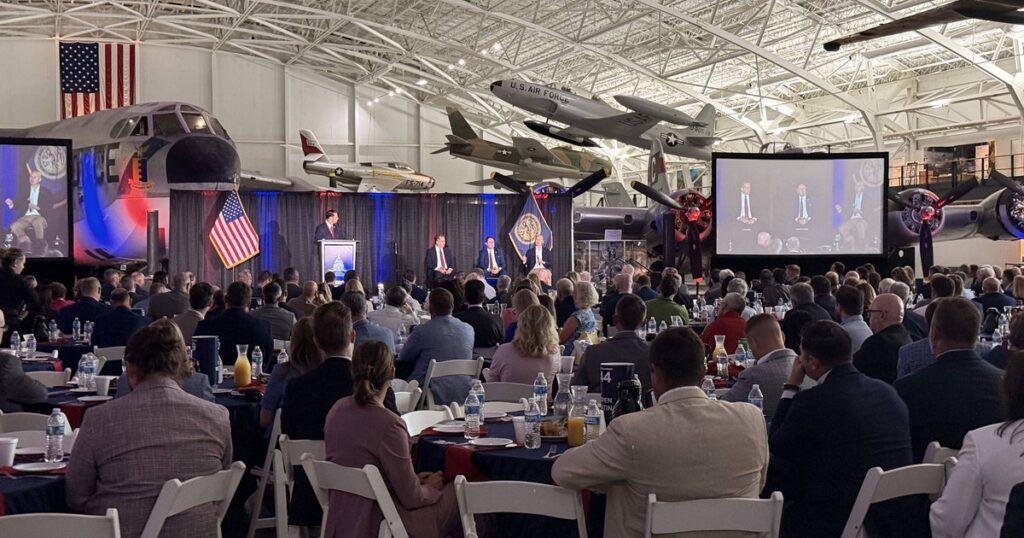
Under the shadow of military and exploratory air and spacecraft that symbolize decades of aeronautical history, Nebraska’s Congressional representatives convened at the Strategic Air Command and Aerospace Museum. The discussions focused on several pivotal issues, including energy policy, artificial intelligence development, economic affordability, and geopolitical challenges, particularly those involving China.
The Federal Legislative Summit, organized by the Lincoln and Omaha chambers of commerce alongside the Nebraska Chamber of Commerce & Industry, served as a platform for Nebraska’s federal delegation to communicate their legislative efforts. While the discussions centered on advancing Nebraska’s interests, they also extended into international matters, including relations with Iran and China.
Senator Pete Ricketts emphasized the competitive edge AI could provide against global adversaries, stating, “Communist China thinks they can beat us with AI… So we’re going to need AI and data centers to be able to compete in that field with communist China.” This aligns with the push for advanced data infrastructure despite local hesitations in certain Nebraska counties that have implemented or are considering moratoriums on data centers due to concerns over resource consumption.
Congressman Adrian Smith highlighted the transformative potential of AI, remarking, “The efficiencies that can be achieved already with AI, it’s amazing.” He advocated for harnessing AI’s economic benefits while acknowledging the need for regulatory frameworks. Congressman Mike Flood underscored the importance of ensuring AI does not contravene existing laws, particularly concerning discrimination.
In addition to technology, the representatives discussed legislative achievements aimed at bolstering the state’s economy, such as tax incentives for working families and the 21st Century ROAD To Housing Act. This act aims to facilitate housing investment through financial incentives and reduced regulatory barriers. Ricketts noted bipartisan cooperation in these efforts, saying, “Democrats came to the table with us and helped us do this.”
The delegation also addressed the affordability crisis affecting Nebraskans, with discussions inevitably touching on the geopolitical tensions with Iran. The representatives justified U.S. military actions in the region as necessary to prevent nuclear proliferation, with Ricketts advocating for sustained pressure on Iran through sanctions and diplomatic efforts.
On energy, the conversation shifted to strategies for achieving independence, with Ricketts suggesting nuclear energy despite potential regulatory challenges. Flood and Smith promoted the Farm Bill, which supports the year-round sale of E15 ethanol gasoline as a step toward energy self-sufficiency.
Congressman Flood humorously noted Smith’s enthusiasm for ethanol, stating, “(Smith) drinks E15 for breakfast.” Smith acknowledged the controversies surrounding the Farm Bill but emphasized the importance of biofuels for Nebraska’s economic future, expressing concern over bureaucratic obstacles.
In closing, Smith reflected on the economic challenges posed by environmental conditions in Nebraska, advocating for policies that protect the state’s agricultural economy from adverse impacts.