Nebraska Fire Departments Impose Burn Bans Amid Escalating Drought-Driven Fire Risks
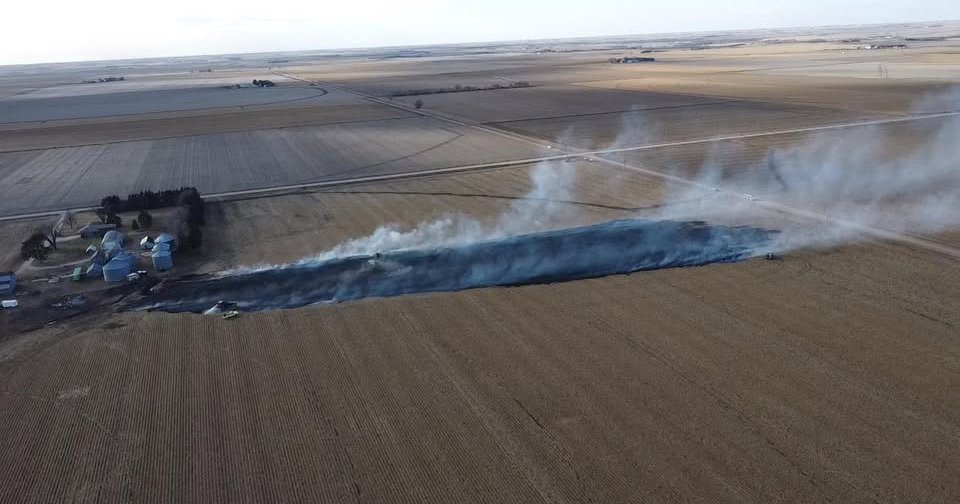
In response to increasing drought conditions elevating fire hazards, numerous Nebraska fire departments are implementing burn bans. The Sutton Volunteer Fire Department recently suspended burn permits after a controlled fire unexpectedly spread through a field of corn stubble.
Chief Tracey Landenberger of the Sutton Fire Department announced on Facebook, “We, the Sutton Fire Department will not be issuing any new burn permits until we get some significant moisture in our area. Thanks for your cooperation and understanding.”
Similarly, the St. Paul Volunteer Fire Department, along with all volunteer fire departments in Howard County, declared a halt on burn permits, emphasizing the urgent need for substantial rainfall.
Other communities, including Uehling, Unadilla, and Waverly, have also initiated burn bans as precautionary measures.
Nebraska faces widespread fire weather advisories, with western and central areas under red flag warnings. Meanwhile, eastern Nebraska and the Panhandle are subject to a fire weather watch.
Caleb Brown, a meteorologist at the National Weather Service Office in North Platte, highlighted the heightened potential for fires in their region, marking the highest risk levels in recent years. An extreme fire risk warning has been issued for parts of the Panhandle and southwest Nebraska, a situation not observed since April 2015.
Brown explained, “The gist of the forecast is we are expecting near-record temperatures tomorrow in the upper 60s to 70s, relative humidity values as low as 10% to 15% tomorrow afternoon, and winds from the west gusting as high as 50 to 55 mph.” He further noted that such conditions could lead to “rapid and extreme fire spread.”
The North Platte office has declared a “particularly dangerous situation” (PDS), a designation typically reserved for tornadoes or severe storms, marking its first use for fire conditions since inception in 2019. Brown expressed concerns about the potential for any fires to become large and challenging to control.
The escalating fire risk is largely attributed to an expanding drought, with nearly 60% of Nebraska currently affected, a significant increase from 17% three months ago. Extreme drought conditions have been identified in Morrill and Box Butte counties in the Panhandle, the first such occurrence since June.
Western Nebraska is experiencing one of its warmest and driest winters on record, with snow deficits reaching 90%-95% in some areas of the Panhandle and southwest Nebraska. However, there is a possibility of relief as forecasts predict colder temperatures and potential rain and snow later this week, starting Wednesday.