As cities grapple with growing traffic concerns, roundabouts are increasingly being considered as a viable solution. These circular intersections are gaining popularity due to their ability to function smoothly even during power outages and reduce maintenance costs over time, compared to traditional signalized intersections.
“Roundabouts are traditionally more expensive up front,” explained McClintock, a senior engineer with Lincoln Transportation and Utilities. “But when you look at the total life cycle cost of a roundabout versus a traditional signal, the roundabout does come out ahead.”
Unlike signalized intersections, roundabouts use yield rules, allowing them to remain operational during power outages. They also have fewer components needing repair or replacement, such as signal bulbs and poles, which can be cost-saving over time.
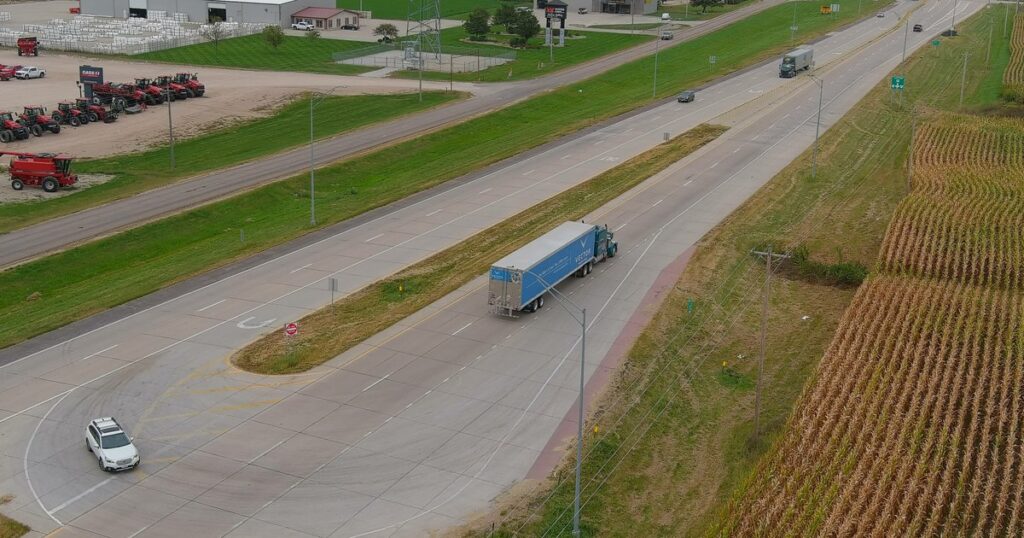
The design of roundabouts varies based on their location. In rural areas, larger roundabouts are constructed to accommodate semi-trucks and larger vehicles, whereas urban roundabouts have tighter curves to slow traffic. Rural roundabouts allow speeds of 30 to 35 mph, while urban ones slow traffic down to 15 to 20 mph.
Roundabouts are particularly effective at intersections with high accident rates, heavy traffic delays, or complex configurations involving more than four roads. While they require more space for the circular part, they occupy less space on the approach roads.
Cities are also utilizing smaller versions of roundabouts, such as traffic calming circles and mini roundabouts, in residential areas to manage traffic flow.
Cities Implement Vision Zero Plans
Omaha and Lincoln have embraced Vision Zero plans, aiming to eliminate all traffic fatalities and severe injuries. The Vision Zero Network supports communities in this mission by focusing on designing safer roadways and vehicles and implementing policies that prevent severe accidents.
To be acknowledged as a Vision Zero city, a commitment to ending traffic injuries and fatalities by a specific date is necessary, along with a detailed action plan. Lincoln’s Safe Streets Vision Zero Action Plan, approved unanimously by the City Council in March, aims to eliminate traffic deaths and reduce serious injuries by 60% by 2045. This plan was supported by a $400,000 federal grant and $100,000 in local funds to develop the action plan, which is available here.
“It looked at 10 years of crash data from 2014 through 2023. Then, from that crash data, we identified our high injury network,” said Partida, who led the plan’s development. “And from there what type of strategies, what type of projects, what type of policy recommendations can we make to get us to our ultimate goal, which is all about eliminating fatalities and serious injuries on our streets.”
A noteworthy strategy in Lincoln’s plan is the formal adoption of a roundabout-first policy, similar to those in New York and Virginia, making roundabouts the preferred choice for new or reconstructed intersections after engineering analysis.
“Just the fact that we have that in our action plan, I think speaks to our approach to how we design intersections and view traffic safety in general for the city,” Partida stated.
Omaha’s Vision Zero plan, launched in November 2023, also targets zero fatalities and serious injuries by 2045. The city’s action plan emphasizes community involvement and actionable strategies.
Omaha has found success with modular roundabouts, which allow the city to test the effectiveness of roundabouts at specific intersections before making permanent changes. This approach has been positively received by the community, according to Jeff Sobczyk, Omaha’s Vision Zero Coordinator.
“We’ve been pleasantly surprised that the community has been relatively supportive of this,” Sobczyk mentioned. “So that’s one reason why we like that, its adaptability, but also the low cost that it has. Focusing on those opportunities for those low-cost, high-impact projects, which are anything really modular, is what we’re trying to pursue.”
To address community confusion, cities like Lincoln and Omaha have launched educational campaigns. Initiatives include trivia-style booths at events such as Big Red Welcome, where University of Nebraska-Lincoln freshmen learn how to properly navigate roundabouts.