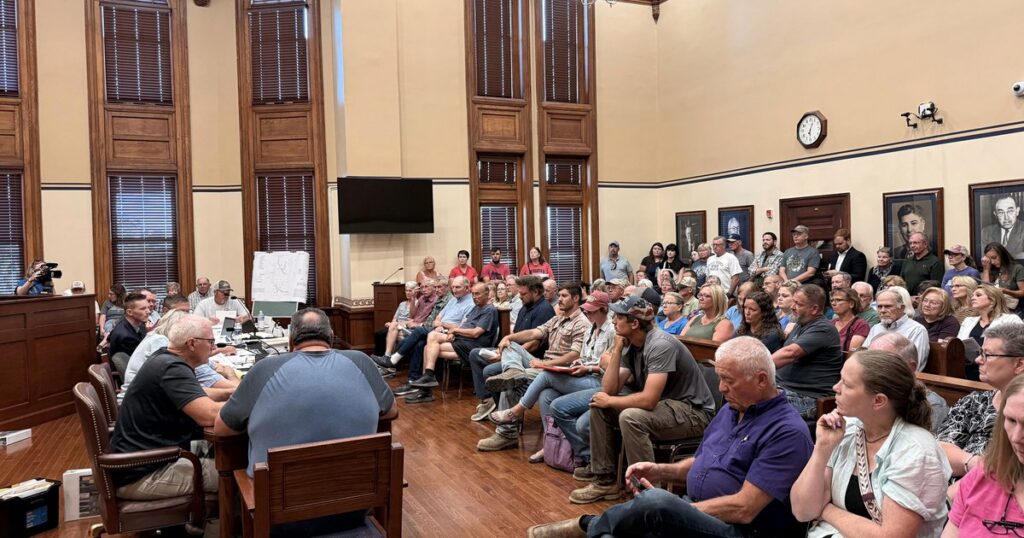
In an unexpected turn of events, the Gage County courtroom in Beatrice buzzed with anticipation late Tuesday evening. Residents packed the courthouse well into the night, eager to hear the outcome of a significant decision that could shape the region’s future.
After an exhaustive four-hour session, the Planning and Zoning Commission reached a consensus, voting unanimously to impose an 18-month halt on the approval of data center construction. The decision, met with enthusiastic applause, serves as a temporary barrier against the issuance of conditional and special use building permits for data centers, giving Gage County officials time to devise appropriate regulations.
The courtroom was teeming with concerned citizens, some even spilling into a nearby listening room. Their worries revolved around the potential environmental repercussions of data centers, particularly their impact on local water and electricity resources. These concerns have been amplified by reports that Google is contemplating a data center in southeast Nebraska, which could demand more power than the entire city of Lincoln. More details can be found here.
Long-time Gage County residents voiced anxieties about the persisting drought conditions affecting the area. They claimed that rivers, once overflowing, are now running dry, and were troubled by estimates suggesting data centers might consume up to 5 million gallons of water daily, potentially harming the environment.
However, the debate is not one-sided. Briana Bartlett from Cortland acknowledged that some community members present well-reasoned arguments in favor of data centers, noting their potential to recycle water and create jobs. Yet, she challenged the notion that regulations would deter business, dismissing it as a false dilemma.
“A big employer who uses the water of up to 50,000 people and only employs ten people is not an employer,” Bartlett remarked. “It’s nothing but an extraction on our county. We are being asked to sacrifice the lifeblood of our local community so that a trillion dollar company can save a fraction of a cent on its margins. We are being asked to drain our aquifer, so that a chatbot can write a poem, or so that a president can make an AI image of himself as Jesus.”
Among the companies interested in the project is Tenaska, a Nebraska-based energy firm. Eli Waring, a representative, clarified that Tenaska specializes in energy, not data center development, but is open to serving large-scale power clients, potentially including data centers.
Waring expressed concerns about the moratorium, stating, “We’ve seen other counties stay away from implementing moratoriums, even short term. You’ve heard about this from the potential signal it can send to the business community that you’re not interested in this type of development.” Notably, Waring was the sole voice opposing the moratorium.
Recently, Nebraska lawmakers enacted LB663, a law designed to streamline the review process for permits and applications. Many Gage County residents argue that without the moratorium, projects like data centers could proceed rapidly, bypassing thorough scrutiny.
Brad Wilken, a resident from Firth, expressed his apprehensions regarding large-scale developments, emphasizing their potential to permanently alter the local community and landscape. “Agriculture is the backbone of Nebraska,” Wilken stated. “Not data.”