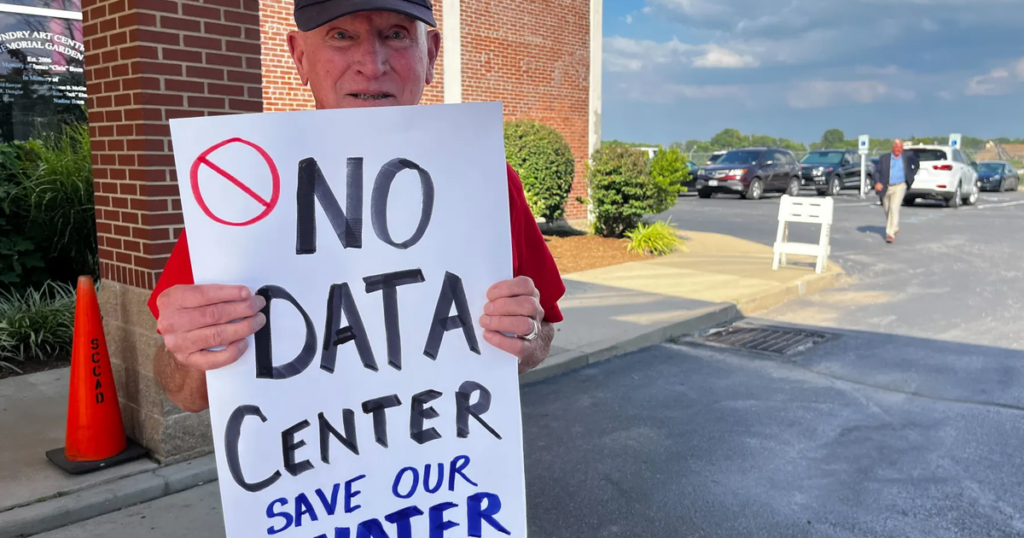
In St. Charles, Missouri, a debate over transparency and trust with local officials reached a boiling point in August 2025. Residents were eager to uncover the identity of a company involved in a proposed expansive 440-acre data center project, which was reported by St. Louis Public Radio.
Tim Kline, a local farmer, expressed his frustration, questioning, “How in the world can you work for the citizens of St. Charles and not be able to discuss this project with them before you take a vote on it?” A year later, in August 2026, the St. Charles City Council unanimously approved a one-year pause on new data center applications. It was later revealed that the unnamed data center was linked to Google.
Meanwhile, in Linn County, Iowa, and Palo, Google faced criticism about potential secretive dealings regarding the annexation of a part of Palo. Opponents suggested these plans were developed behind closed doors. A local figure, Brown, noted, “There is absolutely no way that this big, successful company did that unless they thought or knew they would get a better deal with Palo. There’s no reason.” However, Palo Mayor Bryan Busch refuted these claims, asserting, “Any insinuation that somebody’s just going to sort of override or bulldoze Palo, or bully Palo, or anything like that, is discrediting. Just being very honest with you.”
Support for data centers
Proponents of data centers, including developers and officials, frequently highlight the economic benefits such projects can bring. Korb Maxwell, a lawyer for the St. Charles project, stated, “It’s the jobs, it’s the tax revenues, it’s the construction jobs that are coming. It’s the look towards the new economy that is going to happen whether folks want it or not. You know, America is changing, and the economy is digitizing further and further.”
However, the reality of job creation is nuanced. Montgomery pointed out that most employment opportunities related to data centers are temporary. “There can be hundreds or thousands of people employed at various parts in the development of the data center,” he explained. “In the longer run, these facilities are highly automated and often don’t produce many long-term jobs.” The number of permanent positions varies significantly with facility size, ranging from dozens to hundreds.
Communities are deliberating whether these job numbers will substantially impact local economies, according to Robin Saywitch, a professor at St. Louis University. “For some communities, they (are) going to radically transform the workforce of the area,” she observed, citing the example of a data center being constructed in New Florence, Missouri, where 200 new jobs could significantly alter the town of 700 residents.
There are local residents who also support data center projects. In Otoe County, Nebraska, Jim Nemec voiced his concerns during a commissioners meeting, suggesting that fellow residents might be having a “knee-jerk reaction” to development. “Maybe we need to say ‘yes’ to a few things,” Nemec said, while acknowledging the temporary ban to study the issue. “But I also worry about the intention or impression it gives. Are we sending out the impression that business is closed here?”
Montgomery noted that local officials are considering other potential community benefits from data centers, including increased tax revenue and shared infrastructure costs. He added, “There’s no question that, in the long run, many of these data centers are going to be built. The real question is whether they’re going to be built in a way and in a location where the neighbors feel like they’re benefiting from the investments as well, and not just the companies that built them.”
Finding a way forward
Saywitch highlighted efforts in Illinois as a potential model for regional governments to leverage data center interest by mandating renewable energy investments and water usage regulations. In early 2026, Illinois Democratic state Rep. Carol Ammons proposed the POWER Act. This legislation would require developers to fund their own renewable energy projects and grid improvements, disclose water usage, and secure permits aligning with water-efficiency standards. Although the POWER Act did not pass this spring, its sponsors are committed to ongoing negotiations.