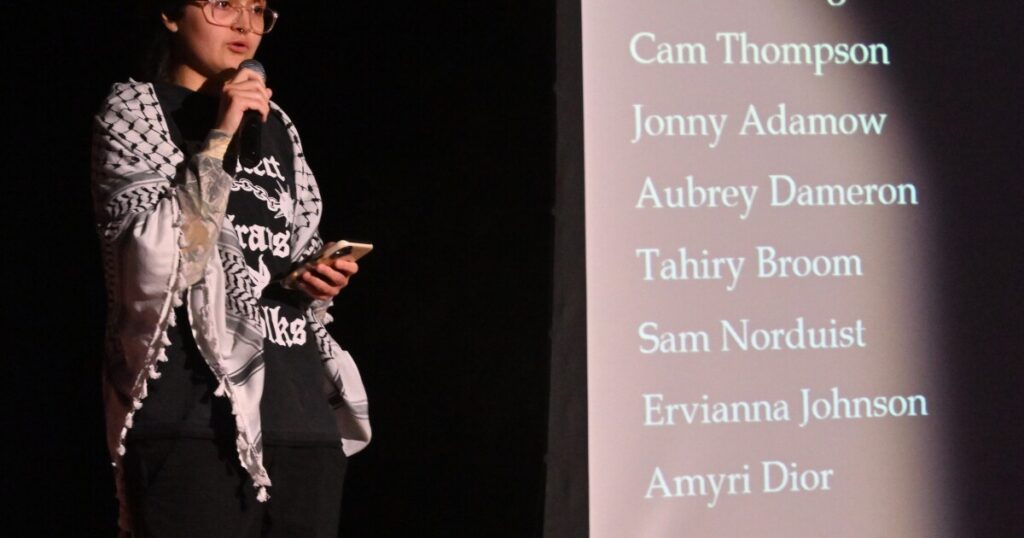
In a quiet room at Wilkes University, the air was heavy with emotion as attendees gathered to honor the lives lost to violence within the transgender community. Alec Walker-Serrano stood amongst them, reflecting on the stories of individuals like Sam Nordquist, Elisa Rae Shupe, and Sonny Hopkins.
“It started to feel as I read through all the stories of those who are now gone, as I heard about the stories of Sam (Nordquist) and Elisa (Rae Shupe) and Sonny Hopkins, like death was closing in on me,” Walker-Serrano said, candles flickering in the dim light. “But then I remembered you. I remembered love.”
Held every November, the Transgender Day of Remembrance commemorates transgender, nonbinary, and gender-expansive individuals in the United States who have lost their lives to violence over the past year.
The Human Rights Campaign’s 2025 report highlighted that at least 27 transgender or gender expansive individuals were killed by violence in the previous year, a figure that might be underestimated due to frequent misgendering in official reports.
Wilkes-Barre’s Tradition of Remembrance
Since 2020, Nikki Berlew has been the driving force behind the Transgender Day of Remembrance vigil in Wilkes-Barre. Initially held in Public Square, it has found a regular venue at Wilkes University, where Helen Davis, an English professor, solemnly reads the names of the deceased from the past year.

The indoor setting at Wilkes University has allowed more people to share their stories, fostering a sense of community and understanding. Berlew emphasizes the importance of visibility and familiarity in overcoming fear and prejudice.
Political climates have a significant impact on the sense of security felt by transgender individuals, Berlew noted. “It goes back and forth, depending on the political climate,” she said. “It was getting better for a long time … politically everyone’s under attack. It’s very, very difficult.”
Walker-Serrano, who recently returned to Northeast Pennsylvania, acknowledges the progress made in creating safer spaces for LGBTQ+ individuals. “Wilkes is so secure,” he remarked. “I feel safe there and queer students feel safe there.”
Community and Resilience
Despite the somber occasion, Walker-Serrano finds hope in the solidarity of the community. “Even when things are this heavy there is still so much hope,” he observed.
Reflecting on the past year, Walker-Serrano acknowledged the burden faced by marginalized groups within the transgender community, including people of color, black trans women, and those who are disabled or economically disadvantaged.

The Human Rights Campaign’s 2025 LGBTQ+ community survey revealed that nearly 44% of transgender and gender expansive individuals experienced discrimination, and many are now less open about their identities compared to a year ago.
Levi Larouche, from the Eastern Pennsylvania Trans Equity Project, shared the persistent struggles faced by transgender individuals, noting, “I don’t think I know a single person who hasn’t lost something this year, be that something tangible … or things that are a little harder to put into words — a plan for the future or a sense of safety.”
However, Larouche emphasized the resilience and joy inherent in the transgender experience, affirming, “You are already doing enough. You are doing enough by waking up every single morning and being the person that you are.”
Walker-Serrano, reflecting on the gathering, expressed gratitude for the support and unity. “I’m wrapping myself in you, and you can wrap yourself in me, and together we are a gift,” he said, underscoring the enduring strength of the community.