Amid ongoing discussions about land use at the University of North Carolina Asheville, community members recently explored alternative plans for the university’s millennial campus property. The gathering was a response to the university’s intention to construct a new stadium, a proposal that involves the contentious removal of 45-acres of cherished woodland.
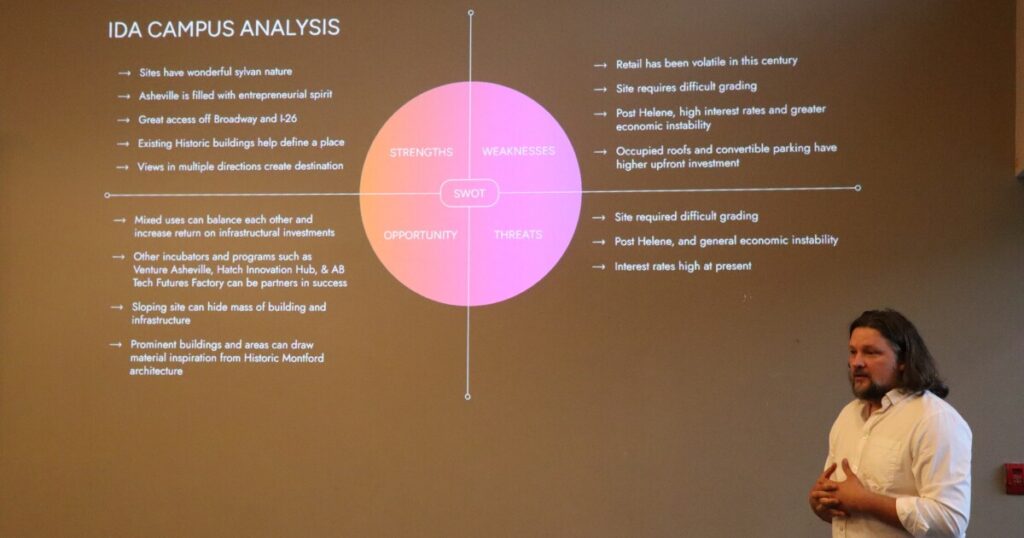
Hosted by the advocacy organization Save the Woods, the meeting took place at Grace Covenant Presbyterian Church with over 30 attendees. The alternative proposals emerged from a visioning workshop held in August, led by Scott Burroughs, a local architect from This Land Studio.
“The purpose of this was, here are some other ways that you can get” the economic benefit, Burroughs stated. “Perhaps get them quicker and perhaps get them more resilient to economic changes.”
Burroughs suggested relocating the millennial campus projects to the Zillicoa Street area, a site acquired by the UNC Asheville Foundation in 2014 for potential campus growth. This 22-acre parcel is situated closer to downtown Asheville, southwest of the current campus.
The architect’s vision includes the development of an innovation, design, and arts district at the Zillicoa site, alongside potential market and food hall or additional housing options.
Another proposal involves situating the planned soccer stadium near the Greenwood Sports Fields, a location already used by some university sports teams for games and practices.
The ongoing conflict between Save the Woods and UNCA faces a potential turning point due to the recent passage of House Bill 926 on October 6. This legislation exempts UNC System projects from Asheville’s Unified Development Ordinance, which governs city development.
Kerry Graham Walter, a member of Save the Woods, expressed disappointment but little surprise at the legislative move. “Obviously we’re disappointed, but not especially surprised,” Walter remarked. “A lot of people have been contacting their representatives, not just here but throughout the state because of the way it removes local political power from the process. And I think that’s a dangerous thing overall in the long term.”
Brian Hart, UNCA’s Director of Communications, reiterated the university’s commitment to providing community benefits through the millennial campus project. “We continue to uphold the standards of transparency and good faith across our operations,” Hart communicated via email. “Our decisions of mutual interest and concern will continue to be guided by conversations with our stakeholders.”
Whether UNCA will adhere to the newly passed law remains uncertain as the deadline for a final report from the Millennial Campus Development Commission approaches in January.
The commission, whose members were appointed by UNCA Board of Trustees Chair Roger Aiken and van Noort, is charged with collecting community feedback, examining alternatives to the south campus plan, and advising on the sequencing and prioritization of projects, although its composition remains unclear.