Net-zero homes are gaining momentum, particularly new constructions. However, a significant challenge remains in retrofitting the UK’s 29 million older properties. A 1930s house provides a model for how this can be achieved.
With the majority of UK homes being old, inefficient, and prone to heat loss, a significant portion of the UK’s housing problem lies in the age of the houses. Even newer properties have often been built without the incorporation of efficient, modern technologies due to outdated regulations. Consequently, homeowners have been burdened with high utility bills.
Fortunately, changes are on the horizon. The Future Homes Standard, to be introduced over the next two years, mandates that new homes be built with high energy efficiency and low-carbon heating systems. This move towards ‘zero-carbon-ready’ homes will cut emissions from new properties by 75-80% compared to those constructed under the 2013 regulations.
Under the new regulations, heating will predominantly be supplied by heat pumps or heat networks as gas boilers are phased out. Improvements include better insulation, high-performance glazing, enhanced air tightness, and a requirement for new homes to generate renewable electricity on-site. Already, the UK government has confirmed that solar panels will be included in most new homes across the country, and planning rules have been revised to expedite the installation of heat pumps.
However, these progressive steps largely affect homes yet to be built, leaving the challenge of retrofitting the country’s existing housing stock. Approximately 29 million homes in Britain need some form of retrofit, ranging from basic draught proofing to complete mechanical overhauls. Without homeowners and landlords taking the initiative, new regulations will not benefit these properties.
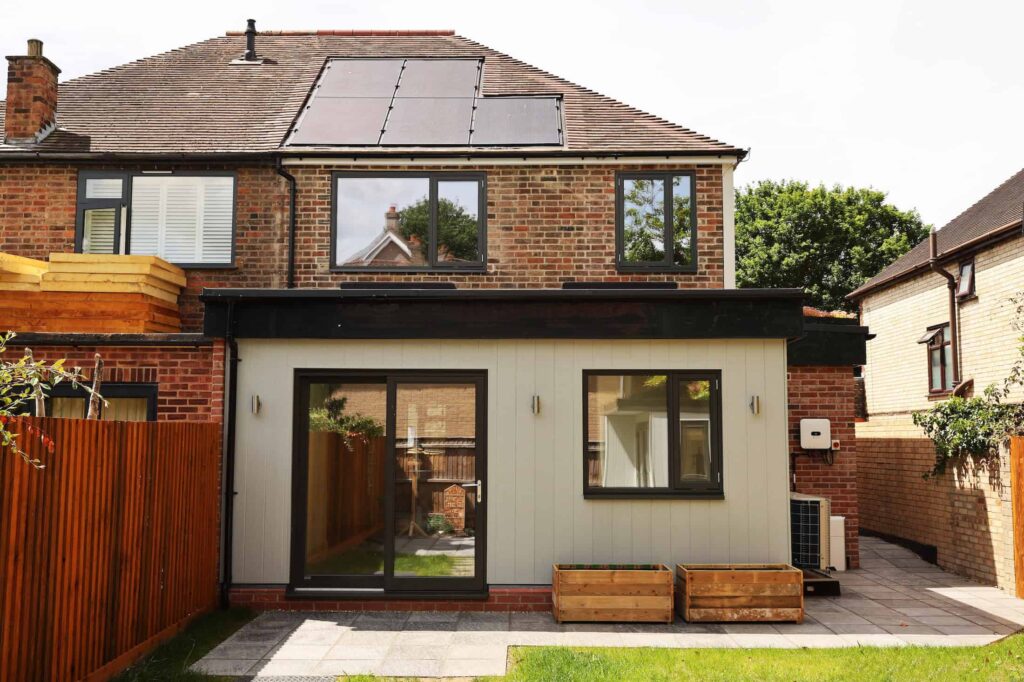
A retrofit project by the Cambridge Building Society demonstrates the potential of these initiatives. The Society purchased a typical 1930s semi-detached home and transformed it into an A-rated, carbon-negative property. This example illustrates that even ageing homes can surpass minimum requirements and contribute significantly to the journey towards net-zero emissions.

A 1930s semi-detached home turned into an A-rated, carbon-negative property by the Cambridge Building Society.
The extensive and costly upgrade involved the application of every type of insulation, an intelligent liquid membrane to improve air tightness, and a full mechanical ventilation system with heat recovery. An air source heat pump supplies heating and hot water, while solar panels generate electricity. A modular battery system stores excess power, and a 3,000-litre tank collects rainwater for household use.
While the upfront costs of retrofitting are high, homeowners stand to benefit from significantly reduced utility bills and potential revenue from selling power back to the grid. Crucially, these technologies are no longer specialist or unaffordable. As costs have diminished over the past decade and the technology has become more accessible, retrofitting can be a practical solution for many homeowners.
Main image: A 1930s property in Cambridge has been retrofitted to become carbon positive. Photography: Cambridge Building Society.