Trailblazing Discovery: T. Rex Trackway Uncovered by Science Teacher
September 12, 2026
A monumental discovery emerged from the rugged terrains of North Dakota when a high school science teacher unearthed what scientists have never recorded before: a trackway of footprints from a fully grown Tyrannosaurus rex.
src=”https://pub-1c31579dfca6402ebca842d57e4a19b2.r2.dev/uploads/TRex-discovery-teacher-6aa5574b4e09c2.75686883.webp” />
Credit: 9 News / Kent Hups (right)
The discovery was made in 2025 by Kent Hups, a science teacher at Northglenn High School in Colorado and an avid volunteer with the Denver Museum of Nature & Science. He stumbled upon this groundbreaking find while participating in a paleontological excavation at the Hell Creek Formation near Marmarth, North Dakota.
Despite the thrill of discovery, Hups faced a personal challenge—he had just undergone knee replacement surgery, complicating his traversal of the steep, rugged terrain.
“I just had my knee replaced, so I was hobbling around a little bit,” Hups shared.
Choosing to explore the area at a slower pace, rather than navigating the hills, proved to be a pivotal decision.
This choice altered the course of paleontology.
Just about 23 feet away, something unusual caught his eye.
“It was probably about 23 feet away,” Hups explained. “You start going through your mind, ‘So, how do I prove it’s a track? And what kind of animal left the track?'”
What initially appeared as a peculiar rock formation turned out to be four massive, three-toed footprints etched into the stone.
Each track measures nearly three feet in length, collectively forming a trackway that spans about 23 feet across the prehistoric ground.
Based on the size and shape of the footprints, and the abundance of tyrannosaur fossils nearby, scientists attribute them to an adult T. rex.
The connection between these footprints is what makes the find remarkable.
Previously, only two isolated footprints ascribed to an adult T. rex had been discovered worldwide, neither of which provided insight into the creature’s movement.
This new set of tracks offers scientists the unprecedented ability to trace the path of a full-grown T. rex.
Analyzing the distance between footprints, researchers estimate the gigantic predator moved at a pace between 3.5 and 4.5 miles per hour, akin to a brisk human walk.
src=”https://pub-1c31579dfca6402ebca842d57e4a19b2.r2.dev/uploads/trex-footprint-6aa558599ba789.75042253.webp” />
Credit: Kent Hups / National Science Foundation
“Bones tell us an enormous amount about these animals, but footprints capture a moment of behavior,” explained Dr. Tyler Lyson, senior curator of vertebrate paleontology at the Denver Museum of Nature & Science. “With a trackway, we can actually follow an animal as it moved across the landscape. That is incredibly rare for T. rex.”
Hups, an advocate of scientific curiosity, has long encouraged his students to pursue science with questions and passion. He never anticipated his own curiosity leading to such a significant finding.
“As a teacher, I’m always telling my students that science starts with curiosity, passion and careful observation,” href=”https://www.cbsnews.com/minnesota/news/adult-tyrannosaurus-rex-trackway-north-dakota/”>Hups said. “I never imagined that could lead me to a discovery like this.”
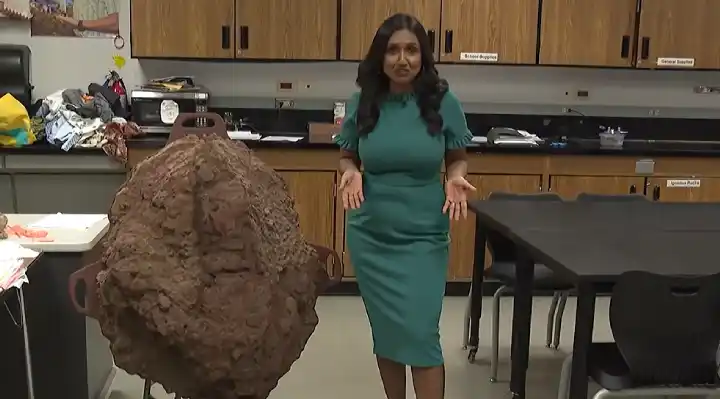
His students now share in that wonder, as demonstrated during a paleontology club session where they painted a 3D model of one of these monumental footprints.
“Having the privilege now to have a part in this because of Mr. Hups and because I wanted to join the paleontology club is just, it fills my soul with so much joy,” expressed 10th-grade student Alexandra Acosta.
For Acosta, the discovery offered broader insights.
“Life continues even after things go extinct,” she remarked. “Life, it’s so big and humans are such a small part of it, and this really puts it into perspective.”
Plans are underway to relocate three of the four footprints by helicopter to the Denver Museum of Nature & Science this fall, allowing for further study and public exhibition.
For Hups, the power of the discovery lies in the glimpse it provides into the ancient past.
“That’s the neat thing about a trackway, it allows you to go back in time and see what the area was like when this thing was walking around,” he said. “It’s the closest you get to a time machine.”