

In the high altitudes of Wyoming’s Beartooth Mountains, researchers are unearthing secrets frozen in time. Amidst this rugged terrain, a team of scientists is unraveling the mysteries held within ancient ice patches, remnants from millennia past, now threatened by a warming climate.
During a recent expedition, scientist Sophia Wensman encountered a challenge when a drill piece detached deep underground. “Oh. I lost it,” she exclaimed. With no immediate resources available at nearly 11,000 feet above sea level, the team worked tirelessly to retrieve the equipment. Their perseverance paid off, and cheers erupted as they succeeded.
These researchers are studying an ice patch on the Beartooth Plateau, not far from Yellowstone National Park. The landscape, dotted with rocks and old snow, appears timeless. The ice patch, spanning approximately two football fields, contains clear ice that has remained frozen for thousands of years, according to Nathan Chellman of the Desert Research Institute.
Unlike glaciers, these ice patches do not shift, preserving ice, vegetation, and evidence of human activity over millennia. Though found in high mountain regions globally, these features are less understood than glaciers, especially in terms of their formation and endurance amid climate change.
A Landscape Frozen in Time
At the bottom of the ice patch, a small stream of meltwater flows through an opening beneath the snow and ice. Nearby, tree stumps emerge, a peculiar sight in such a windswept, treeless environment.
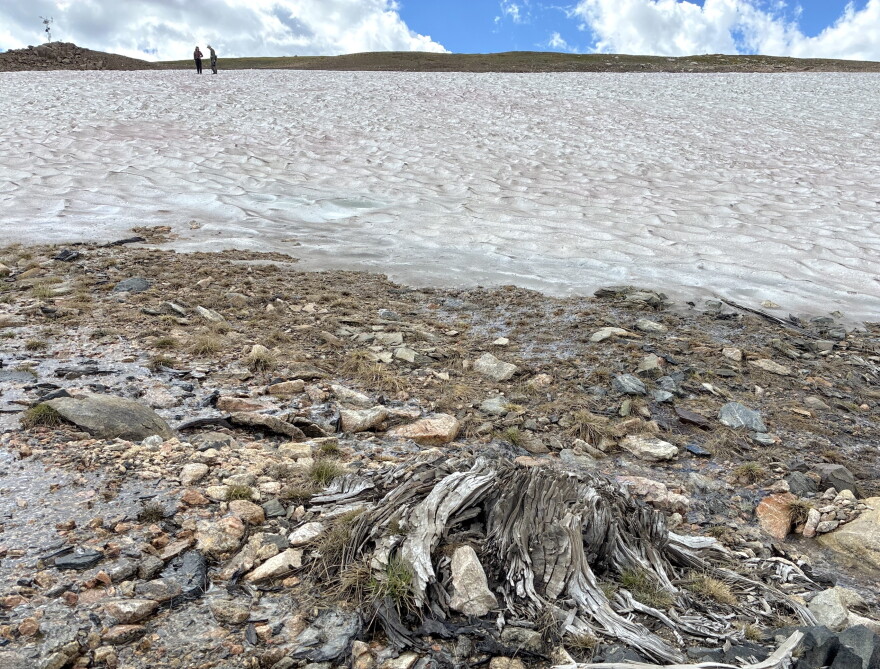
Researchers have discovered remnants of an ancient whitebark pine forest preserved in ice on the Beartooth Plateau, dating back 6,000 years, when forests reached higher elevations. Cores drilled here offer insights into past climate changes by examining layers of ice and trapped materials.
However, these frozen archives are at risk. “I mean, we’ve seen ice patches going away in real time,” Wensman noted. The loss of ice patches could erase 10,000 years of history, impossible to reconstruct once gone. Similar losses are occurring across the West.

In Yosemite National Park, researchers observed a decline in year-round snow patches from over 400 in 1988 to under 70 by 2021, with a significant reduction in total area due to rising temperatures.
What Lies Beneath?
Shannon Hibbard, a permafrost scientist, drilled into the ground beside the ice, aiming to uncover the dynamics beneath the surface. “We want to know if there’s permafrost here to see how that permafrost is interacting with this ice patch,” Hibbard explained.

By placing sensors into the borehole, the team seeks to understand if the permafrost beneath is helping preserve the ice above. As Hibbard connected the sensors to a data logger, she noted, “It’s logging. Chad is doing his job.” This data, along with atmospheric and ice core measurements, aims to explain the resilience of these ancient ice patches.
Monitoring Change
Despite the limited time studying these ice patches, the broader retreat of alpine ice is evident. “There’s no doubt that ice in these alpine regions is disappearing at an alarming rate,” Chellman stated. Understanding whether these specific patches have natural buffers against warming is crucial.

Currently, the ice persists, with meltwater flowing and ancient wood revealed. Instruments continue to record data, offering insights into the future of these ice patches amid a changing climate.


