As spring begins to unfurl, gardens are starting to show signs of life with blooming wildflowers, daffodils, and tulips. Soon, backyard plots will be brimming with tomatoes, cucumbers, and other seasonal produce.
To usher in the gardening season, Penn State Master Gardeners convened at Penn State Wilkes-Barre for the “Spring into Gardening” event, offering advice and motivation for a fruitful planting season.
Understanding Master Gardeners
PLANT PEOPLE
An occasional feature highlighting gardening tips, projects and inspiration.
Master gardeners undergo comprehensive training in various horticultural areas, maintaining their status through continuous education and volunteering. They engage in public educational programs and community garden initiatives.
“We have the overarching mission of sharing research-based information,” said Jill Baer, Penn State Master Gardener coordinator for Lackawanna and Luzerne counties. “But a huge piece of our mission is also really to be an integrative, supportive, collaborative part of improving the quality of life in Luzerne County.”
Getting Started with Gardening
During the event, Suzanne Beck provided valuable insights on planning a vegetable garden.
“Where to place your garden is one of the most important decisions you can make,” Beck stated in her presentation.
Haley O’Brien
/
WVIA News
She suggests placing gardens where they receive full sun—ideally 6 to 8 hours a day. Regular soil testing every three to five years is also crucial.
“Before you add fertilizer, before you plant, before you try to fix a problem, you really need to know what’s going on in your soil,” Beck emphasized.
Penn State Extension offers soil testing kits for $10, identifying nutrient deficiencies for better garden management.
Jason Kilgore, supporting Beck’s presentation, advises creating a detailed garden plan. Consider plant suitability for the region and available space. Draw a planting map and prepare a planting calendar based on the growth and harvest timeline.
“You’re going to want to put taller plants in the back because you don’t want them shading out your shorter plants,” he advised. “Think about the mature size of your plant … you need to plan for that space.”
Optimal Planting Times
Warm season crops like peppers and tomatoes are best planted after the last frost, usually in mid to late May. Beck advises starting seeds indoors for these plants to ensure a robust start.
“There are some cooler crops that you could put out right now,” Beck suggested. “I’ve just put out some onions right now. You could probably put out some snow peas right now.”
Kilgore emphasizes the importance of indoor seed starting for tomatoes, noting, “If you try to start them in the ground from seeds … you’re unlikely to get a very big or any harvest before the growing season ends.”
Gardening Without Vast Spaces
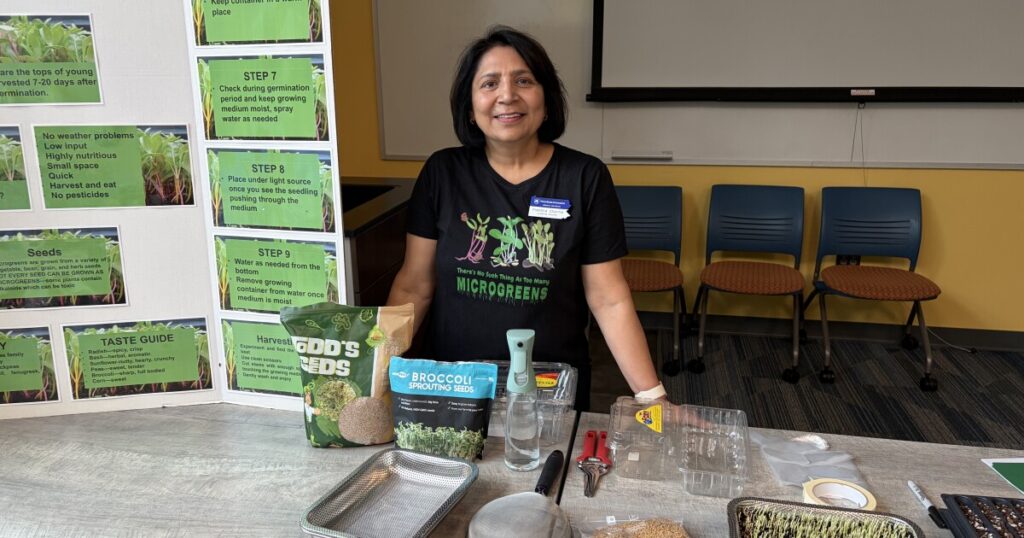
Gardening is possible even without extensive land. Pratibha Sharma’s workshop highlighted microgreen cultivation as a space-efficient option.

Haley O’Brien
/
WVIA News
“My favorite is toast with an egg sunny side up, and then you can throw in some microgreens,” Sharma noted. “Or you can blend it in your smoothies if you want more nutrition.”
Microgreens, rich in nutrients, can be grown on a refrigerator top and are ready in weeks.
Vertical gardening, staggered planting, and raised beds are other space-saving strategies.
“We are always learning, every day is something new,” Sharma reflected. “That’s what gardening is, experimenting and learning.”
Expanding Gardening Knowledge
Penn State Extension offers resources like an insect ID lab and a plant disease clinic. The master gardener hotline, luzernemg@psu.edu, is available for Pennsylvania residents.
“Whether you’re growing something in a container on a balcony or indoors even, or whether you have a lot of space … we sort of want to be that conduit to information, that sort of support system and engagement system,” Baer mentioned.
“You can reach out, ask us questions,” she added. “We’ll work with you on a one-on-one level and try to help you mitigate a problem.”
Beck, a gardener for three decades and a master gardener for five years, shared her favorite tip: growing celery. “I grow celery every year because Jason recommended it to me … When you grow it yourself from seed, it tastes amazing,” she shared. “I always learn something new and I love the friendships that you build as a master gardener, too.”
“I enjoy the knowledge that we gain,” Kilgore concluded. “But then also being able to share that knowledge with other garden enthusiasts.”
Every county in Pennsylvania hosts a Penn State Master Gardener program, with the next training course scheduled for October 2027.