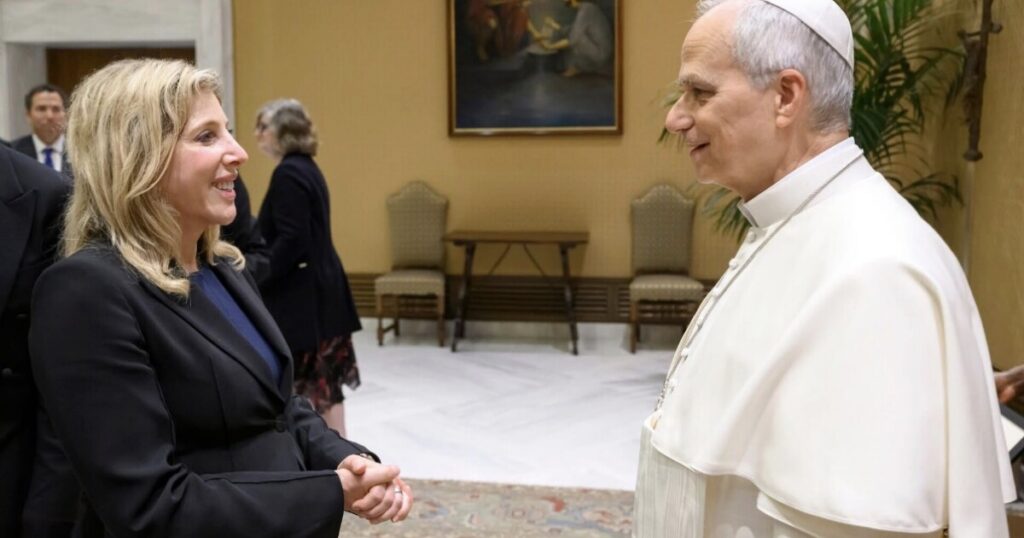
The convergence of religious insight and educational leadership unfolded recently in Rome, where two proponents of Catholic education met. Marywood University President Lisa Lori had a unique encounter with Pope Leo XIV, marking a significant moment for Catholic academic leadership.
President Lori was part of a delegation from the Association of Catholic Colleges and Universities (ACCU) that attended a special audience with Pope Leo, coinciding with the ACCU’s 2026 Rome Seminar. “I told him who I was, about our sisters — our IHM sisters — and what we do here at Marywood, and he was very appreciative,” Lori shared. Marywood University, established in 1915 by the Congregation of the Sisters, Servants of the Immaculate Heart of Mary, is currently led by its first lay president, Lori, appointed two years ago.
Following the pope’s address, which discussed the significance of Catholic education, knowledge fragmentation, and challenges from artificial intelligence, Lori briefly met the pontiff. These topics were expanded upon in Leo’s recent encyclical letter “On Safeguarding the Human Person in the Age of Artificial Intelligence.”
Pope Leo’s Vision on AI in Education
During her visit, Lori observed a strong focus on the implications of artificial intelligence within the Vatican. “He realizes the reality of artificial intelligence and technological changes that are just accelerating at an incredible pace right now,” Lori noted. “They equate it to the Industrial Revolution, when you don’t realize what’s happening until years after it’s already happened.”
In her view, the Vatican’s message resonated with Marywood’s mission. “It was affirming for me to hear this, because in recent years, rather than ignoring artificial intelligence, we here at Marywood have been focused on the ethical use of it, guided by our faith and our mission,” Lori explained. She emphasized AI’s potential as a tool, rather than a replacement for human roles, stressing its ethical application to enhance human capability.
Lori draws on her background as a Philadelphia attorney to address AI’s role in various professions. “I was a partner in a big firm in Philadelphia. One of the things we were talking about among the partners was they were concerned that AI going to replace lawyers. I remember saying I don’t see that ever happening because you’re always going to need the human piece — it’s just a tool,” she recalled.
At Marywood, ethical AI usage is a priority, with software in place to detect academic dishonesty involving AI. Lori emphasized, “Our faculty are on it. It is something that is on everybody’s radar.”
Courtesy Marywood University
A Glimpse into the Vatican’s Leadership
This recent encounter wasn’t Lori’s first with a pope. In 2024, she met Pope Francis, an event marked by the pope’s candid and warm engagement with Catholic college leaders. “He was unscripted, just spoke right from the heart. And then he said, after about 10-15 minutes, ‘OK, I have some time, let’s talk, anybody have any questions?’ He was very, very outgoing and warm,” Lori recalled.
Contrasting with Francis, Pope Leo was perceived as “shy, almost … more introspective,” yet inspiring in addressing contemporary challenges and youth engagement. Lori was particularly impressed by Leo’s appointment of Maria Montserrat Alvarado, a female layperson, as Prefect of the Dicastery for Communication, a move aligning with Pope Francis’s vision to enhance lay leadership in the church.
Marywood’s Expansion into Florence
During her Italian visit, Lori also attended to administrative matters in Florence, anticipating the opening of a new academic site. The Marywood in Florence site is set to welcome architecture students in August, with plans to expand to additional programs. “Instead of sending our students to study abroad with other schools, we will do our own study abroad, and other schools could come to us,” noted Juneann Greco, special advisor for strategic communications.
Lori described the new Florence location as “a beautiful space in the heart of Florence, in the Santo Spirito area, a building from the 17th century,” underscoring its aesthetic and strategic appeal.