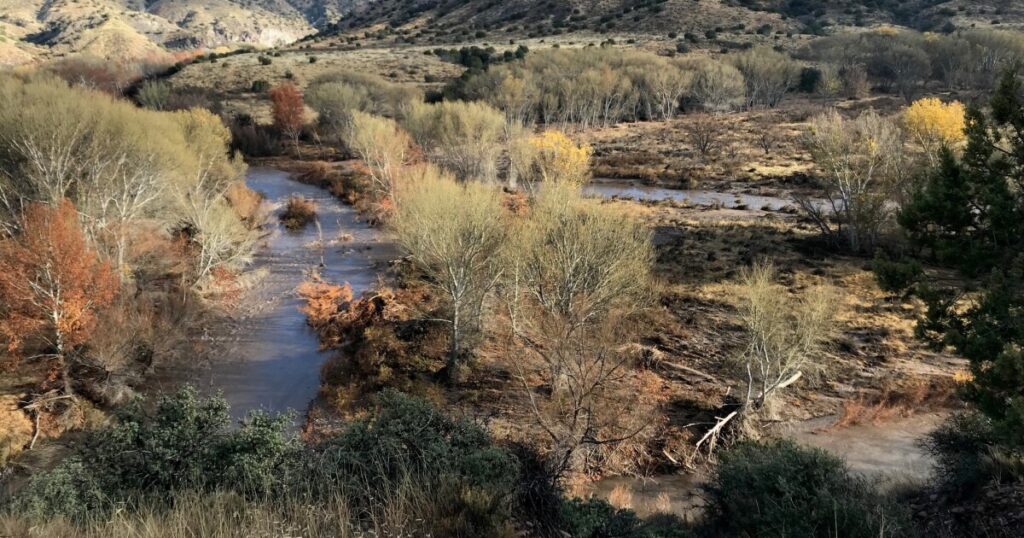
Recent research unveils a fascinating resilience in the Gila River’s ecosystem, offering hope amid growing concerns about water scarcity. This study, spanning over a decade, reveals how the river’s natural dynamics support vital plant life even during periods of low water flow.
Scientists who examined a portion of the Gila River, a tributary of the Colorado River, discovered that despite low water levels, the river’s floodplain still nourishes native vegetation like cottonwood and willow trees. The study, detailed by the researchers here, identifies the river’s inherent complexity as a crucial factor.
Flood events play a significant role by distributing the river into various side channels across its floodplain. This network facilitates underground water storage and movement, ensuring that plants can access moisture even when surface water is scarce.
Martha Cooper, a co-author of the study and scientist with The Nature Conservancy, emphasizes the importance of managing rivers to preserve their natural flow and capacity. “Let’s manage rivers to promote their health and function, and that’s retaining the flows, giving them space, so when there are floods, they can spread out and do good work,” said Cooper.
Using over ten years of data from southwestern New Mexico, the research underscores that consistent, albeit modest, river flows can sustain riparian ecosystems provided groundwater levels remain stable. This stability is crucial for young cottonwood and willow trees as they establish their roots.
The study also points out a notable risk: agricultural water diversion can significantly lower groundwater levels, potentially endangering young plants during crucial growth phases. However, there is a silver lining. Some human-engineered water systems, such as irrigation ditches and return flows, can inadvertently maintain groundwater levels, supporting vegetation in specific regions.
This research paints a complex picture of river management, suggesting that agriculture and river ecosystems can coexist harmoniously. Cooper advocates for river management that ensures natural benefits, stating, “If we can work to manage rivers to maintain their health, they’ll meet our needs better in terms of moving sediment for us, moving water for us, providing habitat that supports wildlife.”
Given that the Gila River feeds into the Colorado River, these findings may have broader implications for the Colorado River Basin and the wider Mountain West, areas predicted to face increasingly severe droughts and floods due to climate change.
This article is part of a collaborative effort by the Mountain West News Bureau, which includes KUNR, Wyoming Public Media, Nevada Public Radio, Boise State Public Radio in Idaho, KUNC in Northern Colorado, KANW in New Mexico, Colorado Public Radio, KJZZ in Arizona, and NPR, with additional support from partner newsrooms across the region. The Corporation for Public Broadcasting and Eric and Wendy Schmidt provide partial funding for the Mountain West News Bureau.