In an eye-catching photograph by Britta Jaschinski, an award-winning photographer, a green turtle seems to be swimming through glowing waters. Observing more closely, the image reveals a human handprint, detected through the use of forensic powder under ultraviolet light.
Employed by the UK’s Wildlife Crime and Forensics Unit, this novel technique has the capacity to unveil fingerprints, blood, bodily fluids, and gunpowder residue. This groundbreaking method aids investigators in tracing poachers and dismantling networks involved in the illegal wildlife trade.
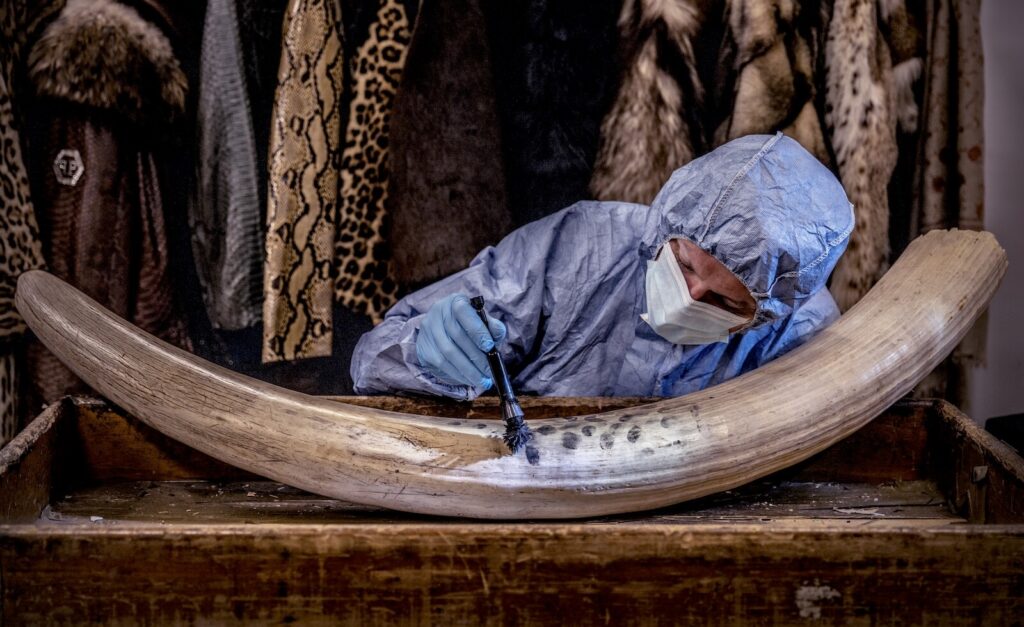
Jaschinski created this impactful image to highlight the marks humans leave behind on wildlife and to illustrate the increasing role of science in safeguarding wildlife from exploitation. A similar approach has been instrumental in addressing the ivory trade. London’s Metropolitan police forensic investigator Mark Moseley uses a novel magnetic powder to detect human fingerprints on an elephant tusk intercepted at Heathrow Airport.
Over 200 fingerprinting kits utilizing this technology have been disseminated to border forces in 40 countries across Africa and Asia. The impacts have been immediate. For instance, in Kenya, evidence gathered with one such kit resulted in 15 arrests, including five police officers, and the confiscation of 11 elephant tusks. Ivory, for the first time, was not merely proof of a crime but evidence of the culprits.
Science is proving indispensable in protecting wildlife from exploitation.
Currently, a white variant of the powder is being utilized to recover prints from rhino horns and pangolin scales. These powders are cost-effective, suitable for field deployment, and can be applied in areas where DNA testing is unfeasible.
Jaschinski’s prize-winning image, part of the Royal Geographical Society’s Earth Photo 2026 competition, is one of the selected works on display in London until July 24, after which it will tour the UK.
Photograph: Britta Jachinski