
An ongoing legal battle concerning the water contamination at Camp Lejeune has taken a significant turn as a federal court has set an October 30 deadline for both legal teams to reach a settlement. This decision comes after years of unresolved litigation, drawing attention from advocates who are hopeful for a resolution. The Department of Justice and the Plaintiffs’ Leadership Group are now under pressure to agree on compensation for those affected by the contamination.
From 1953 to 1987, Camp Lejeune’s drinking water was tainted with hazardous chemicals such as trichloroethylene, tetrachloroethylene, benzene, and vinyl chloride. The Agency for Toxic Substances and Disease Registry reported contamination levels far exceeding safety standards, leading to elevated rates of cancer, birth defects, and chronic illnesses among base residents. The CDC estimates that up to one million individuals may have been exposed to these pollutants.
(Photo: Annette Weston, Public Radio East)
Mike Partain, born at Camp Lejeune, was diagnosed with breast cancer years after being exposed to the contaminated water in-utero. He expressed satisfaction with the court’s decision, stating, “The court pretty much laid it down. They told both sides, quit messing around, get this done. You have until October 30th.” The court’s directive is linked to the reappointment of victims’ leadership attorneys, whose terms had expired.

(Photo: Annette Weston, Public Radio East)
Retired Marine Corps Master Sergeant Jerry Ensminger, another key advocate, lost his daughter to leukemia after she was born on the base. Ensminger noted, “Well, it looks like the court is really the only entity involved in this thing that is really looking out for the welfare of the victims.” He and Partain hope that the settlement talks will address the controversial 35-year latency requirement for claims related to cancer diagnoses.
Both advocates remain hopeful that stalled legislation, known as the Ensuring Justice for Camp Lejeune Victims Act, will gain traction. The bill, introduced by North Carolina Representatives Greg Murphy and Deborah Ross, aims to expand the judicial process and ease the burden of proof for victims. Despite having 95 cosponsors, it remains stuck in the House Committee on the Judiciary.
The court’s ruling mandates weekly meetings between attorneys and court-appointed settlement masters to ensure progress. If a settlement is not reached by October, the plaintiffs’ legal team could face restructuring, and the Department of Justice may encounter severe sanctions or a surge of individual trials. The court believes a global settlement is crucial for delivering timely compensation to victims and preserving public resources.
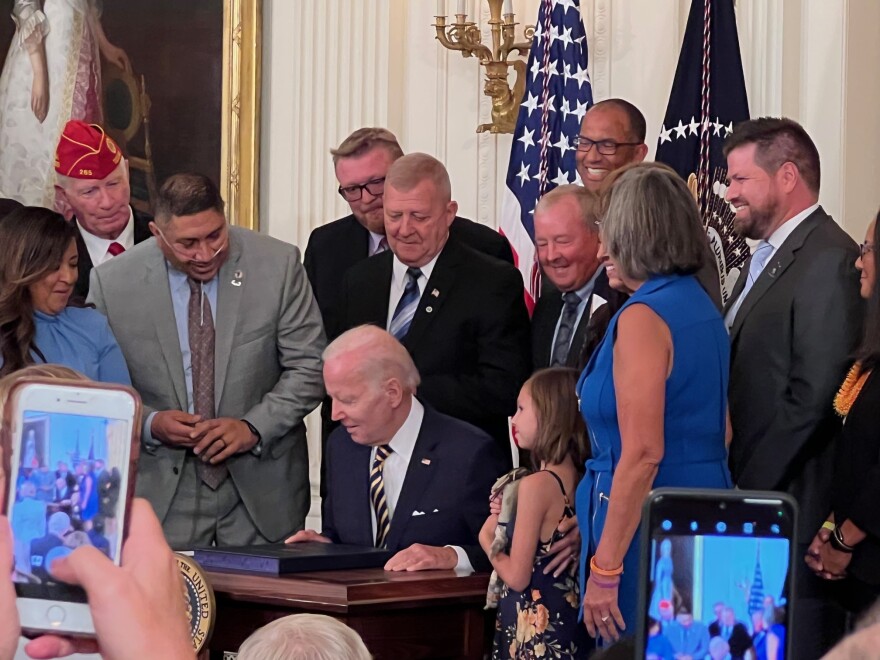
President Biden signed the Camp Lejeune Justice Act into law on August 10, 2022. The act was signed as part of the broader Honoring our Promise to Address Comprehensive Toxics (PACT) Act of 2022, allowing individuals exposed to contaminated water at Camp Lejeune to file claims for injuries.
For more information, visit the following links: Federal court deadline for Camp Lejeune lawsuit settlement, ATSDR report on Camp Lejeune contamination, and N.C. lawmakers push for changes to Camp Lejeune Justice Act.