China’s New Soybean Purchase Agreement: What It Means for U.S. Farmers
In a breakthrough after prolonged negotiations, China has confirmed a purchase of 12 million metric tons of U.S. soybeans this year. This quantity is significantly less than China’s usual imports, which have historically been more than double this amount. The reduction comes amidst ongoing trade tensions between the two nations.
Recently, U.S. soybean farmers faced the daunting prospect of losing their biggest export market. However, a new agreement between President Donald Trump and Chinese President Xi Jinping has somewhat alleviated those fears. Despite the deal, many farmers are opting to hold onto their soybean stock, hoping for improved market prices or choosing to process the beans domestically.
“China buys, traditionally, about half the soybeans we export, and we can’t replace that amount with domestic usage. It’s impossible,” said Tanner Ehmke, an economist with agricultural lender CoBank. “Even if we did, we would have a tremendous amount of soybean meal that we’d need to find a home for.”
Looking ahead, China has pledged to purchase 25 million metric tons annually over the next three years. This figure is more in line with pre-trade war levels, offering a glimmer of hope for U.S. soy farmers.
While China remains a primary buyer, a significant portion of U.S. soybeans is processed domestically. Known as “crushing,” this process involves grinding the beans into oil and meal. The meal, a key ingredient in livestock feed, constitutes the majority of the crushed soybean.
Recent years have seen an expansion in U.S. soybean crushing capacity to meet the rising demand for renewable diesel. The U.S. Department of Agriculture projects a record high in the volume of crushed soybeans this market year, reaching 2.49 billion bushels, which marks a 10% increase since 2017. New facilities have emerged in Iowa, Nebraska, Kansas, and North Dakota to accommodate this growth.
Despite these developments, experts like Scott Gerlt from the American Soybean Association acknowledge that increased domestic processing cannot compensate for the shortfall in Chinese purchases. “The limit there is always going to be that physical capacity, and we just don’t have the physical capacity to increase crush enough this year to offset China,” he stated.
Although emerging trade agreements with nations like Taiwan and increased exports to Egypt and Vietnam are positive steps, they are insufficient to completely bridge the gap left by China’s reduced purchases.
Nonetheless, U.S. soybean farmers are not left without options. As Brady Holst, a soybean farmer from western Illinois, remarked, “They all get sold and used somewhere, but the price just goes down when the demand is lower. The supply is always going to remain the same.”
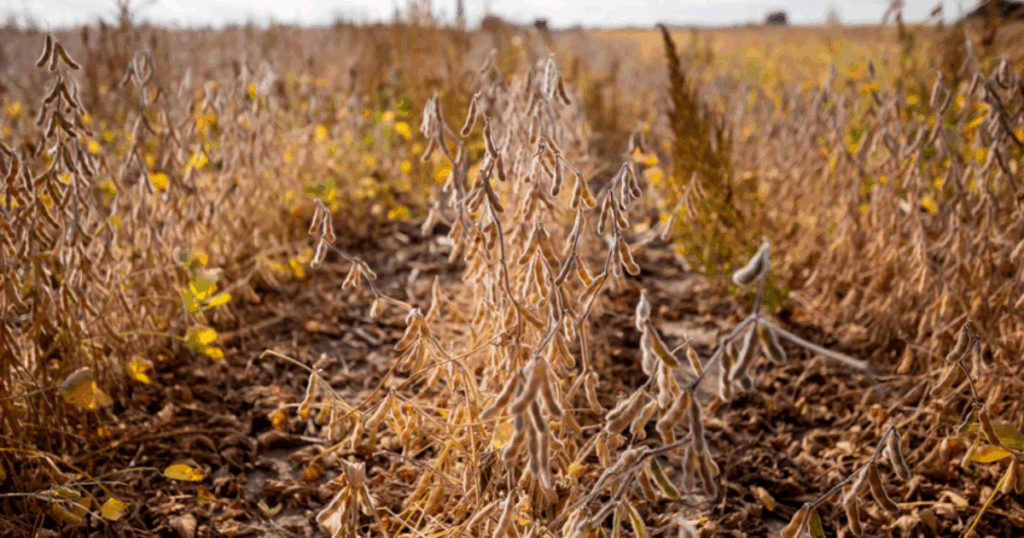
This year, soybean yields are expected to achieve record highs in several states, including Missouri, Illinois, Iowa, and Minnesota. According to the USDA, overall production aligns with previous years, but the abundance, coupled with trade tensions, is exerting downward pressure on prices.
Farmers in the southern Midwest, such as those in Indiana, Illinois, and Missouri, are somewhat better positioned for sales, thanks to their proximity to crushing facilities and access to shipping routes like the Mississippi River. However, producers in the northern regions, including the Dakotas and Minnesota, who traditionally rely on rail transport to China, face more significant challenges.
Farmers Opt to Store Soybeans in Hopes of Price Recovery
Many farmers are choosing to store their soybeans, waiting for a more favorable market. Holst noted that winter often becomes a prime selling season. “Most farmers, I would say, are waiting for a better price,” he said, suggesting that the recent trade deal might prompt more sales.
Holst, who also cultivates corn and wheat, is currently storing his soybean crop in grain bins, a common strategy among farmers hoping for a market rebound. Typically, he sells to facilities along the Mississippi or Illinois rivers but is biding his time this year.
Other growers in the northern Midwest are following suit, selling corn while storing soybeans. Ehmke from CoBank observed, “Usually, it is the opposite.”
However, storage capacity is a limiting factor and can affect profitability. Farmers utilizing external storage facilities face increased insurance and labor expenses, further tightening margins in an already challenging market.