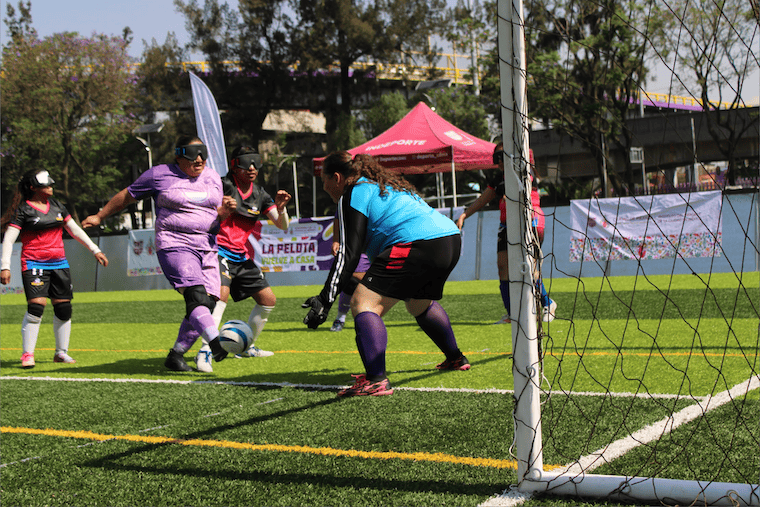
As the World Cup sweeps the nation, Chilangas FC is making a striking difference in the lives of visually impaired women. This fearless women’s blind football team has been instrumental in building confidence, fostering friendships, and igniting sporting ambition in women who’ve often been excluded from the sport.
Pau, a visually impaired 31-year-old mother, is among the many women whose lives have been transformed by Chilangas FC. Despite the traffic noise and the rain in Mexico City, she, along with her six-year-old son Noel, makes the two-hour journey across the city several times a week to train for the women’s blind football team. Her experience at Chilangas FC has not only improved her life but also inspired other women with visual impairments to challenge societal limitations.
Chilangas FC, one of Mexico’s six women’s blind football teams, serves as a beacon of hope, friendship, and independence. Its members refuse to be constrained by society’s expectations of visually impaired women. As Pau proudly states, “Football has changed how I see myself as a blind woman. I’m showing my son that there are no limits.”
The team was founded in 2022 by Wendy del Río with the aim of creating opportunities for visually impaired women in a sport predominantly dominated by men. Since then, it has evolved into more than just a sports team. It provides its players with a supportive community where the struggles of navigating through life with visual impairments are understood and respected.
The football team has positively impacted the lives of its players, boosting their confidence and opening up a world beyond their usual routines. Pau, for example, used to feel quite alone, with her world revolving mostly around work, childcare, and navigating Mexico City. Her involvement with Chilangas FC has provided her with a supportive network of teammates who understand and encourage her.
The sport of blind football has been around in Mexico for over two decades but opportunities for women have been limited. The sport equalizes different levels of vision by having all outfield players wear blackout eye coverings. Players use a rattling ball, relying on voice, trust, and spatial memory, guided by teammates, coaches, and goal guides positioned around the pitch.
The women’s blind football team is preparing for another milestone as they hope to compete in the Copa América in São Paulo, Brazil. Mexico is vying to be the fourth country globally – following Brazil, Argentina, and Canada – to form a women’s blind football national team.
Despite the significant impact of Chilangas FC, women’s blind football remains small in Mexico, with only six teams and approximately 45 women playing at an organized level. The team is currently crowdfunding to raise approximately 1 million pesos (£40,000) for their trip to Brazil. The funds will be used to cover flights, accommodation, uniforms, training, and food due to a lack of institutional funding.
Chilangas FC continues to break barriers and challenge stereotypes, proving that the sport is not exclusive to any gender or disability. What they have built goes far beyond a football club. As del Río says, “It becomes a community that embraces you. And that creates dreams.”