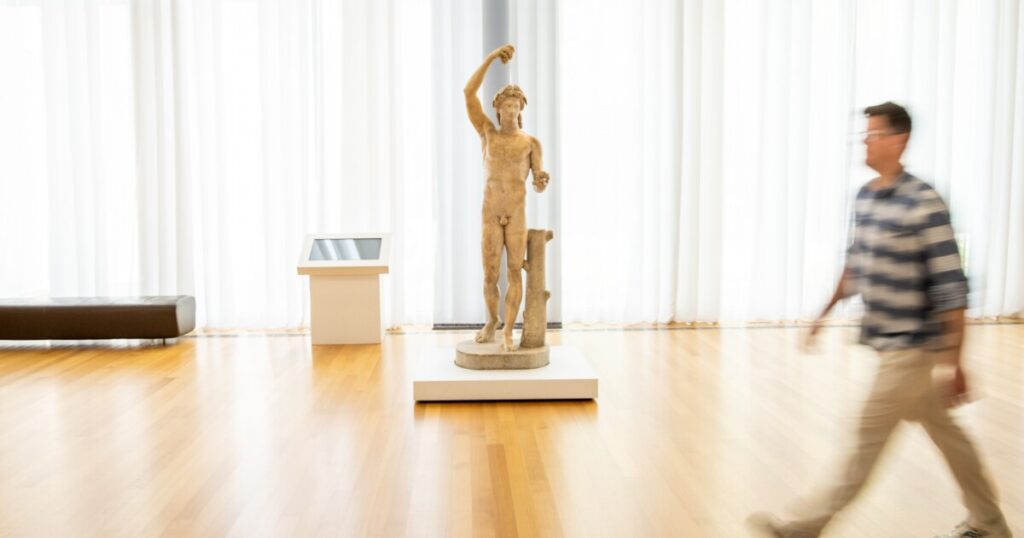
Standing before the Bacchus statue at the North Carolina Museum of Art, one might feel as though the sculpture is on the brink of conversation. Despite its silent stance, the intricacy and history encapsulated within Bacchus are far from mute. Curator Caroline Rocheleau has shepherded the statue through a meticulous seven-year conservation project, bringing its storied past into sharper focus.
The statue, despite extensive research and conservation, remains an enigma that continues to intrigue historians. “There are still a few mysteries,” Rocheleau remarked, expressing hope that future experts might unravel them.
Kate Medley
/
For WUNC News
The museum’s Bacchus has undergone numerous transformations throughout its existence, a reflection of the complexities of both its mythological and real-world journeys. The statue, far from a singular entity, is a composite, assembled from disparate sculptures.
“A horror image of antiquity”
With a head and torso originating from different Roman marbles, and limbs and decorative elements dating from the Baroque era to as recent as 2019, Bacchus offers a collage of historical artistry. Its presence at the NCMA dates back to the 1950s.
In the past century, the practice of de-restoration aimed to strip such statues of non-ancient restorations to restore their original integrity. “Composite statues, until fairly recently, were not acknowledged as genuine works of art, even though they had ancient components,” said Rocheleau.
![Bacchus was subject to quite a bit of gossip. An archeology professor living in Germany, Ernst Langlotz, suggested the North Carolina Museum of Art "free [Bacchus] from its modern restorations" so to preserve the authenticity of Bacchus' oldest fragments.](https://npr.brightspotcdn.com/dims4/default/1ed366e/2147483647/strip/true/crop/1053x1185+0+0/resize/840x946!/format/webp/quality/90/?url=http%3A%2F%2Fnpr-brightspotcdn.com%2F2f%2Ff6%2Faad2e08e4a3aa85b289c96d2ed49%2Fbacc.png)
Courtesy of North Carolina Museum of Art
Though a 1960s letter from an archeologist labeled Bacchus as a “horror image of antiquity,” suggesting the museum should remove modern restorations to honor its age-old origins, the institution lacked the facilities to comply at the time. It wasn’t until the 1980s when modifications were made, including separating Bacchus’ head and torso and removing a plaster nose.
Composite statues weren’t always horrific
Rocheleau explained that Bacchus has undergone restorations since before 1620. In the 18th and 19th centuries, collectors often assembled statues from various pieces, sourced from locations like Italy’s fields, to cater to contemporary tastes.
Geoarchelogist Scott Pike, who specializes in marble chemical analysis, noted that the coherence of single marble pieces mattered less in the past. “The importance of a single piece of marble wasn’t there, it was more the form and the shape,” Pike explained. Collectors valued anything ancient or partially ancient.
Today, art historians appreciate composites as integral parts of history. “We see composite sculptures as part of a history, and an integral part of history,” Rocheleau affirmed.

Chemistry can be revealing
While traditional historical research has its limits, geoarchaeologist Scott Pike employed mass spectrometry to measure chemical isotope ratios, revealing the origins of Bacchus’ marble pieces. This technique, coupled with marble texture analysis, pinpointed their quarry sources.
Conservator Corey Riley led the recent conservation efforts. Despite the reassembly of Bacchus, an etching from the 1800s depicted him with two arms. Upon discovering one had been lost, the museum commissioned artist Larry Heyda to recreate the missing limb, modeled after NC State basketball player Wyatt Walker.

NCMA’s Bacchus (top right) as depicted in Frédéric de Clarac’s Musée de sculpture antique et moderne, Pl. 678 E, fig. 1586 (1836–37). Etching by Michel-Olivier Lebas.
/
Courtesy of the Musée du Louvre
“We decided to put the statue back together again with a little extra special something, and that was the arm,” Rocheleau noted, highlighting the unique blend of history and modernity embodied by the sculpture. “Touching and holding something that someone touched and held 2000 years ago, it’s just very special,” conservator Corey Riley reflected.