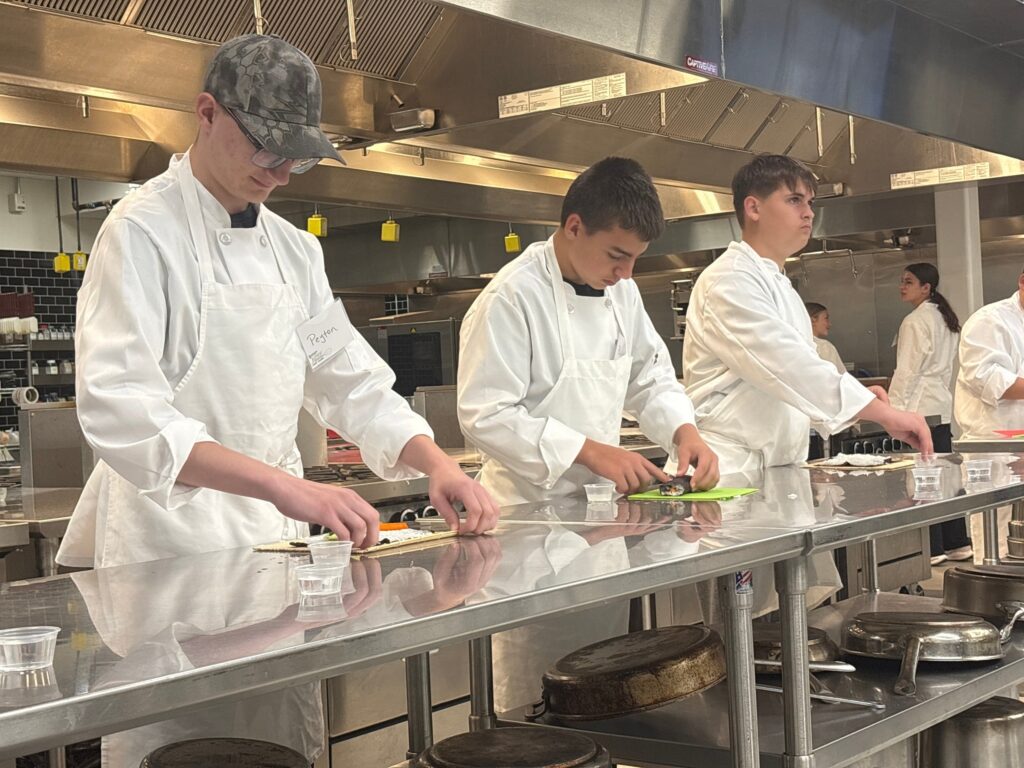
On a bright June day, a group of young teens donned white chef coats and gathered around kitchen stations to embark on a culinary adventure. These budding chefs carefully sliced avocados and cucumbers, rolled them with soy paper using bamboo sheets, and crafted sushi rolls under the guidance of an instructor from Lakeshore College.
This scene wasn’t a typical classroom activity. Instead, it was part of a summer camp at Lakeshore College designed to introduce students to high-demand careers early on. The camp, held on the Cleveland, Wisconsin campus, offered students aged 11 to 18 a taste of various professions, including culinary arts, manufacturing, and information technology.
Exploring New Horizons
Haiden Taylor, a returning camper, found herself immersed in the world of cooking, mastering dishes like hummus, tzatziki, pizza, and doner kebab. As she approaches her senior year, Taylor is now contemplating a future in the culinary field. “I like working with people. I like working with my hands. I really don’t see myself at a desk job,” she remarked.
Meanwhile, Electro and Maintenance Mechanic instructor Kaven Lewis observed a shift in attitudes toward skilled trades. “It was … ‘Go to college, get an education,’” he said. “Now it’s like, ‘Trade school, that’s where all the money is going to be.’ It’s kind of cool to be in the middle of that transition.”
In another part of the campus, younger students were engrossed in assembling mousetrap-powered cars. Despite some trial and error, including a car that exploded at the starting line, they learned valuable lessons about speed, torque, and distance.
Nearby, in the welding and fabrication lab, students were crafting metal spatulas, many with plans to gift them for Father’s Day. Ben Reynolds, a chef and culinary arts instructor, noted, “It’s really fun to see the ones that aren’t sure, and then by day three they’re like, ‘yup!’”
Filling Workforce Gaps
The summer camps, initially grant-funded and now supported by the college, adapt yearly to address changing industry demands. This year’s focus on culinary, manufacturing, and IT careers reflects regional needs. Notably, the restaurant industry is projected to add 740 jobs by 2032, according to state data.
While culinary programs show mixed success in boosting earnings, welding and metalworking jobs are expected to grow by about 10 percent, offering students a potential salary increase of up to $30,000 over high school graduates.
Even without firm career decisions, campers gain essential skills like confidence and communication. Reynolds emphasized the program’s philosophy: “I don’t expect you to know what you want to do your whole life. I just expect you to go experience things and try things and find out what makes you want to get out of bed.”
Miranda Dunlap reports on pathways to success in northeast Wisconsin, working in partnership with Open Campus. Email her at mdunlap@wisconsinwatch.org.