A Community’s Legacy: The Fight Against a Proposed Nuclear Waste Site
This coverage is made possible through a partnership between BPR and Grist, a nonprofit environmental media organization.
In the heart of Sandy Mush, where the community center now hosts bustling kids’ camps, there once brewed a storm of urgent meetings and heated debates over a contentious federal proposal. Terri Wells, a local farmer who has taken on the role of community archivist, recalls a time when the center’s kitchen was filled not with the laughter of children, but with the fervent discussions of residents opposing a nuclear waste dump.
Wells, who was just 14 during the events of 1986, recalls the intensity of the discussions that dominated local talk. Her cousin, Bill Duckett, was a prominent figure in leading the opposition. After his passing, Wells sought out his granddaughter, hoping to uncover any remnants of the campaign.
“I reached out to my cousins and said, ‘Could you please dig around and find those materials?’” Wells said. “And thankfully they did.”
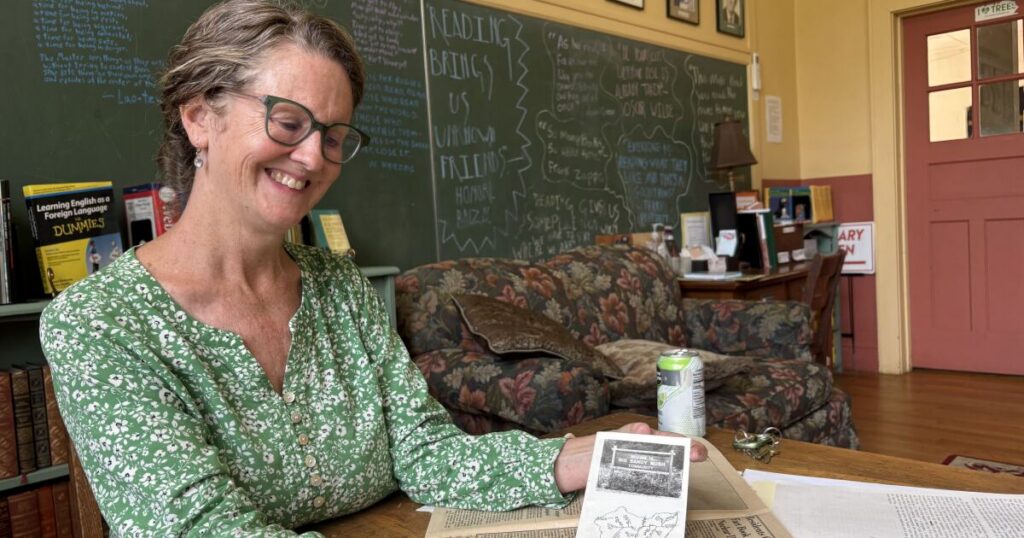
Jessica Duckett, Bill’s granddaughter, discovered a treasure trove of her grandparents’ saved newspaper clippings and anti-dump campaign memorabilia, which she donated to Wells. These artifacts have now found a home in the Buncombe Special Collections, preserving the memory of a community’s stand against a federal plan.
Provided by Buncombe County Special Collections
/
Duckett, William “Bill”
As Wells reviewed the materials with BPR, she highlighted an article from the now-defunct West Neighbors newspaper:
“It is the belief of many local people that the U.S. Department of Energy came to North Carolina ill prepared with facts that were not well documented,” she read. “Betty Duckett of Big Sandy Mush community in Leicester puts it more kindly: ‘They came here with incomplete information.’”
In response, the residents rallied and meticulously gathered their own data, counting water springs and crafting informational pamphlets. They even created satirical artwork, like a map warning of Asheville’s bleak future if the dump were to be established there.
“DON’T LET THIS SATIRE BECOME REAL. GET INVOLVED TO STOP THE DUMP. PROTEST TO YOUR ELECTED REPRESENTATIVES – – SPEAK OUT~,” warned the text beneath the satirical map.
The proposal’s failure came after state geologists determined that local geological conditions did not meet the Department of Energy’s criteria. Leonard Weinstein, a lead geologist on the study, stated, “The basic factual data accumulated during the study reveal that local geologic conditions do not meet the Department of Energy’s stated criteria.”
Jessica Duckett reflects on how these historical items have deepened her understanding of her family’s legacy. “I would hear my grandparents talk about it, but it was always just like, my grandmother had a picture of him with George H.W. Bush hanging up and it was like ‘that’s when your papaw met the president,’” she said. “I didn’t know what a nuclear waste dump was.”
Wells emphasizes the importance of community organization and awareness, urging communities to define their priorities from within. “Instead of somebody coming in and telling your community what’s important. It’s like, okay, what do the people in the community think is important?” Wells said.
Those interested in this chapter of Sandy Mush’s history can access the materials at Buncombe County Special Collections, or explore them online here.