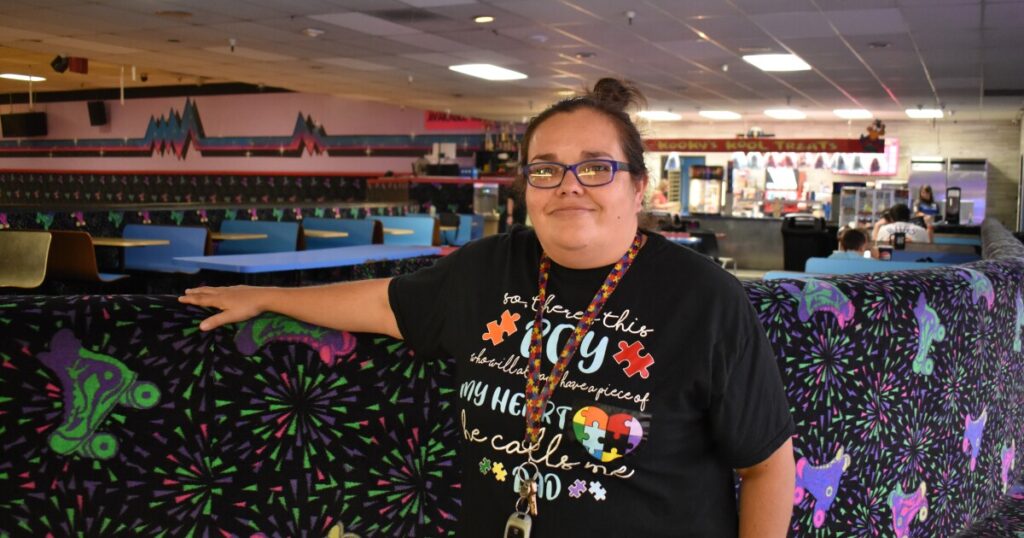
On certain Thursday evenings, Reno’s Roller Kingdom transforms from a vibrant, music-filled rink into a serene space tailored for neurodivergent individuals. This initiative, known as sensory night, provides an inclusive environment where the music is softer, and the atmosphere is calming, allowing guests to enjoy a more comfortable experience.
Bradley Hargrove, the general manager of Roller Kingdom, spearheaded this initiative with her son Kylan in mind. Kylan, an enthusiastic skater with ADHD and sensory processing issues, inspired Hargrove to create an inclusive space for him and other children with similar needs. “Everybody should have the same opportunity to have the same amount of fun,” Hargrove expressed.
Autumn Novotny / KUNR Public Radio
Hargrove often worries about finances, and the introduction of a new law promises some financial relief. This law will allow family caregivers, who meet professional standards, to receive Medicaid compensation for tasks such as bathing, dressing, and mobility support.
“I actually do this job and some other outside things to be able to afford the care for my son and to balance out everything with insurance,” Hargrove noted. “That bill would allow me to focus more on the needs of my son and not have to work so hard. However, it’s not an opportunity right now.”
Implementation of this law might take several years, with Nevada Medicaid projecting a 2027 start. Families could begin receiving payments the following year, contingent on federal approval. The bill sponsor, Democratic Sen. Angie Taylor, expressed her dismay over the delay, stating, “There are people all across our state that need this help. The sooner we can get it, the better.”

Lucia Starbuck / KUNR Public Radio
Nevada Medicaid estimates that around 10% of families with children in the state might qualify for this program, with caregivers potentially earning up to $25 per hour. The number of payable hours will depend on the care plan, though the minimum wage for this type of work is set at $16.
Across the nation, family caregivers are contributing over $600 billion in unpaid labor annually, as highlighted by AARP. Jennifer Ng’andu of the Robert Wood Johnson Foundation emphasized the unique challenges these caregivers face, noting that they are “experts, educators, advocates” for their children. “You shouldn’t have to go broke to take care of your child,” she stated.
States like Delaware are also exploring solutions, allowing family members to be compensated for up to 40 hours a week for caregiving.

Autumn Novotny / KUNR Public Radio
At a recent sensory night, Maria Lopez’s children were deeply engaged in their video games. Lopez, who has two autistic children, finds solace in the community at Roller Kingdom. She established the Special Needs Community of Northern Nevada and believes the new legislation could provide much-needed respite.
“I’m on the clock 24/7. As we do this interview, I’m staring at my children. Things like respite are very much needed in this community, but the sad thing is, it’s not going to have any impact for years, so I’ll still be here struggling because my son can’t go to any of these daycares in town. We’ve been kicked out,” Lopez shared.