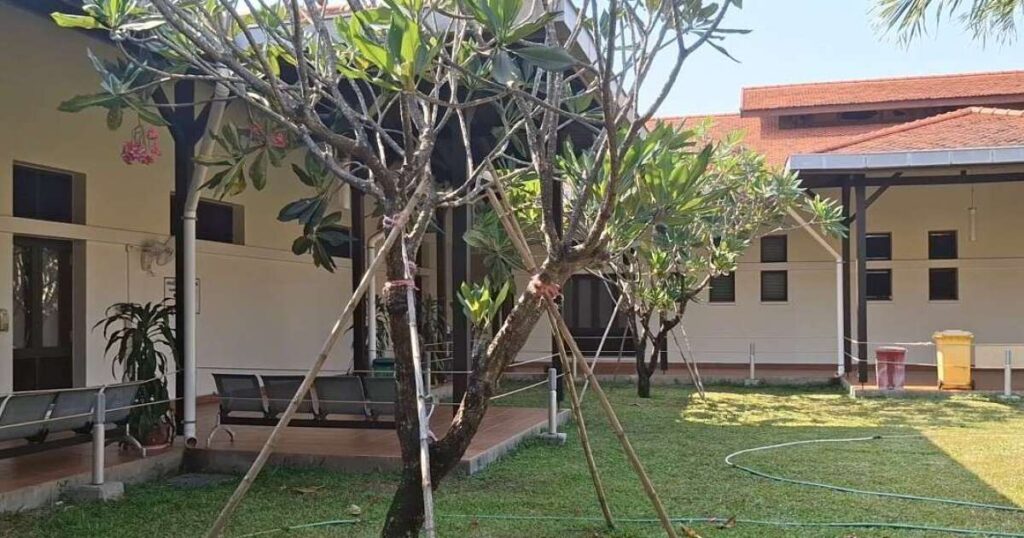
In March, students from the University of Nevada, Reno’s Orvis School of Nursing embarked on a remarkable journey to Kampot, Cambodia. Their destination was the Sonja Kill Memorial Hospital, known for its distinctive architectural design.
Located a few miles from Kampot, Sonja Kill Memorial Hospital stands out for its open-air design, where the space between buildings is just as significant as the interiors themselves. The hospital consists of several enclosed structures housing various wards, including maternity and pediatrics. Instead of enclosed corridors, patients and visitors navigate through open-air, terracotta pathways.
The natural sounds of wildlife accompany the hospital environment, with birds chirping throughout the day and cicadas buzzing incessantly around midday, forming a backdrop to daily healthcare routines.
This open-air design is not only practical for Cambodia’s hot and humid climate but also serves a unique purpose. Kin Sou, the hospital’s chief administrative officer, explained, “The concept and architecture was designed for children, not for adults. They don’t want to frighten the children so they built low buildings. They need space. Patients like children come and enjoy running [around].”
While initially created for pediatric care, the hospital’s design now shapes treatment for all patients. For example, Chi Vorn appreciates the ability to take his father, a wheelchair user after a medical emergency, outside. Vorn shared, “I say that the hospital has a nice and clean environment with trees and grass and also a fresh breeze. Whenever I go out and carry my dad, it feels fresh and really helps reduce stress.”
For the nursing students from Reno, this setting was a departure from their clinical experiences in the United States. Alex Henrikson, a student working at Renown Regional Medical Center in Reno, noted that replicating such an open-air layout in the U.S. would be challenging, especially in urban hospitals that need to accommodate large patient numbers. However, efforts are underway to integrate nature into healthcare environments.
Renown has established Fianna’s Healing Garden, a tranquil space created in memory of Fianna Dickson Combs, who believed in the therapeutic power of nature. Henrikson acknowledged the garden’s impact, saying, “I think it’s very beneficial for their health. You kind of see a change in just their mood, but being able to just go outside and relax away from the beeping monitors and all that.”
Kathleen Leslie / KUNR Public Radio
Henrikson mentioned that while the garden is well-maintained, it is sometimes underutilized due to its distance from patient rooms. However, when used, it offers a meaningful respite.
At Sonja Kill Memorial Hospital, the integration of wards and walkways ensures that stepping outside becomes an effortless part of the healing process. Chhagn Reasmey, head of the in-patient nursing department, emphasized the importance of mobility for recovery, stating, “It’s a good sign if they can go out from the bed, especially outside of the building. It’s a good sign that they can get better soon and can go home.”
Deputy chief nursing officer Cathy Pingoy observed that the serene environment helps patients relax, with some even setting up mats to bask in the sun. She remarked, “We try to control that as much as possible for safety, but when they do that they know that your facility is really nice.”
Pingoy highlighted the significance of a peaceful atmosphere in patient recovery, as healing occurs not just within the confines of hospital rooms but in the surrounding spaces as well.
This coverage was produced in collaboration with the Reynolds School of Journalism’s Hitchcock Project for Visualizing Science and the Orvis School of Nursing.