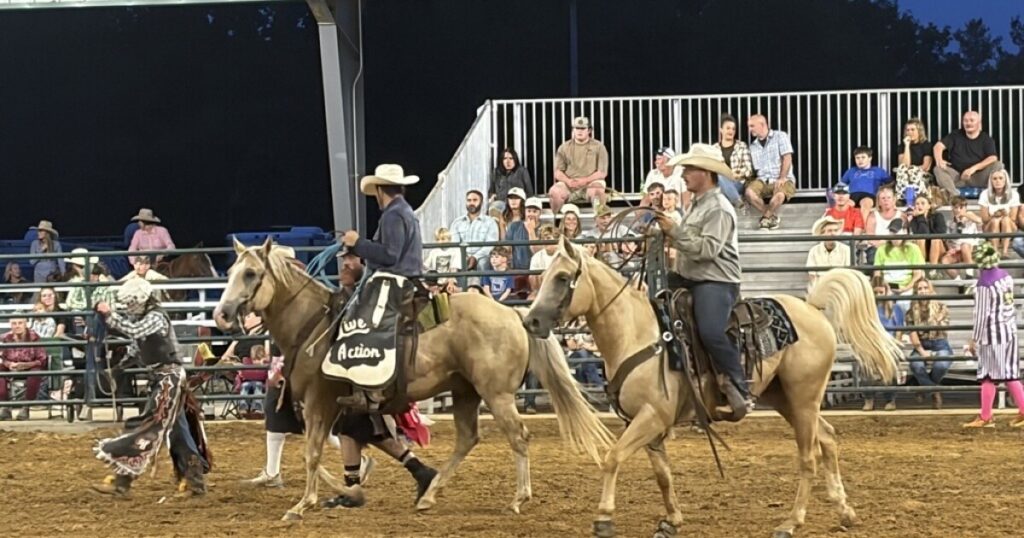
A Longstanding Rodeo Tradition Thrives in Western North Carolina
Hidden amidst the hills of Marshall, a deep-running rodeo tradition continues to captivate audiences in Western North Carolina. For over six decades, the Madison County Fairgrounds has been home to electrifying events such as steer wrestling and barrel racing, attracting a diverse crowd eager to witness these daring spectacles.
Every other Saturday during warmer months, the fairgrounds transform under the glow of bright lights. Spectators clad in jeans, cowboy hats, and large belt buckles flock to one of the state’s oldest rodeos to experience the excitement firsthand.
Participants range from the very young to the seasoned. Children as young as four take part in mutton busting, riding sheep with enthusiasm that often ends in quick tumbles. Meanwhile, young adults face the challenge of broncos and bulls, and accomplished riders compete in barrel racing and roping well into their seventies.
After a hiatus of nearly two years, the rodeo has returned in full swing, bolstered by a $2.4 million upgrade to its facilities. With the addition of a new covered arena, both participants and spectators are now shielded from inclement weather.
A crowd of about one hundred gathered on a balmy July evening to enjoy the show. Some lined up for refreshing hand-squeezed lemonade, while children eagerly pressed against the green fence for a closer view of the arena.
Alan Wyatt, a local whose roots go back six generations in Madison County, expressed his joy at the rodeo’s return, noting its significance in the community’s recovery from Hurricane Helene. “It’s just a wonderful feeling to have this beautiful building and to see the kids and the smiling faces,” Wyatt remarked. “When the kids are peering through the fence all around the arena, that speaks to me. And that’s what this is all about. It’s for that next generation and for generations to come that my kids and my grandkids can have a place to come.”
Since 1965, the rodeo has been a community cornerstone, originating as a Fourth of July event on Blannahassett Island to support the Marshall Fire Department. Kenny Treadway, the rodeo’s current producer, is the grandson of one of its founders, carrying on the legacy of this multigenerational tradition.
“This county has accepted rodeo for 61 years and I hope they do it for another 61 years,” Treadway stated. “I hope my family, when I move on, I hope my son takes this over. It wouldn’t make me no more happier for it to be 200 years from now still having a rodeo here.”
Treadway emphasized the rodeo’s inclusivity, offering something for all ages. “We have everything from a five-year-old who is in sheep riding to, you know, you could be 70, 80 years old getting a team roping or something like that,” he said. “It’s for everyone.”
The rodeo also serves as a training ground for aspiring athletes who learn resilience with each ride. “The superstars of this sport, they’re great and everything like that, but really, I just like the try of people,” Treadway mentioned. “The try and the heart, you know, to keep coming back wanting to do better every time they come. That’s what I like the most about it.”
Seventeen-year-old bull rider Tommy McCloud, recovering from a torn ligament, eagerly anticipates his return to competition. “It’s a part of who I am,” he shared. “Most people think rodeo is just about the bulls or the broncs. It’s a deeper connection. It’s like a family that you have. You support each other and help each other grow.”
Bronco rider Kyle Thompson, at 22, embodies what he calls “the cowboy mindset.” He explained, “It doesn’t matter if you get thrown right out the chute or you’re a roper and you missed your calf or whatever. You’re going to walk out of the arena with some dignity, not throwing a hissy fit or stuff like that. It’s a very composed, very professional thing.”
Thompson is already sharing that mindset with his young daughter. “She’s been on a kick. She likes to ride horses,” he said. “We started her riding horses before she could walk. She’s two and she can ride better than most adults.”