Children’s literature has a unique charm, whisking young minds into realms of imagination and wonder. The essence of a captivating children’s book, however, is a blend of timing, rhythm, and storytelling finesse.
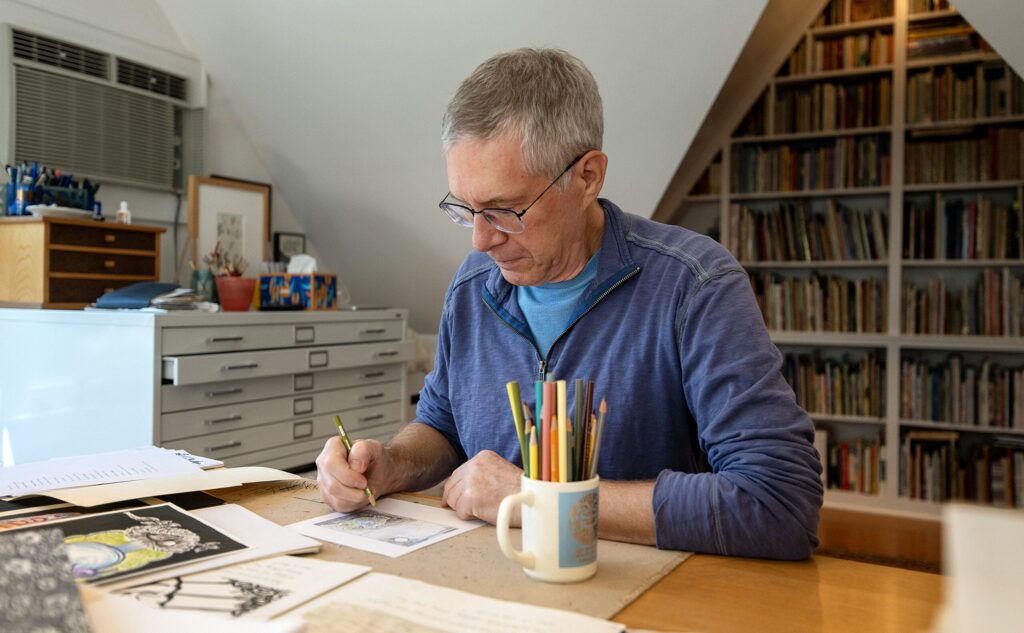
Kevin Henkes, a distinguished children’s book author and illustrator from Wisconsin, emphasizes the importance of timing in crafting engaging stories. “There is a rhythm, there is a flow, there are beats,” Henkes explains, underscoring the musicality inherent in successful children’s books.
Journey from Wisconsin to Literary Acclaim
Born in Racine, Wisconsin, Henkes always had an artistic flair, often found with a paintbrush in hand during his youth. His passion for art and storytelling blossomed at the University of Wisconsin-Madison, where he sold his first book at the youthful age of 19. During a summer break, he ventured to New York City with aspirations of securing a publishing deal, setting his sights on Greenwillow Books.
With determination and portfolios in hand, Henkes approached Susan Hirschman, the founder of Greenwillow Books. Despite her initial curiosity about his age and solo travels, she saw promise in his work. Hirschman offered to publish “All Alone,” which explores a young boy’s adventures in solitude. Henkes recalls her saying, “Let’s call your mother and tell her we’re publishing your book,” a moment he describes as “mind-blowing.”
The Art of Rhythm and Repetition
Henkes’ literary career has since flourished, producing nearly 50 picture books and numerous children’s novels. His 2005 Caldecott Medal-winning book, “Kitten’s First Full Moon,” exemplifies his mastery of rhythmic storytelling. “Particularly with picture books … the goal is that they’re going to be read aloud again and again,” Henkes states, emphasizing the importance of getting the words just right.
His works, such as “Sun Flower Lion” and “A House,” create interactive experiences that invite children into a dialogue with the reader, fostering a deeper connection with the story.
Drawing from the Familiar
Henkes often explores everyday life in his stories, drawing inspiration from common experiences. “I am drawn to small domestic stories,” he shares, reflecting on a philosophy of writing what you know. His books often feature ordinary settings and characters, yet reveal profound insights about life through detailed storytelling.
The beloved mouse books, including “Chrysanthemum,” “Lilly’s Purple Plastic Purse,” and “Wemberly Worried,” tackle relatable themes such as school anxieties and social fitting-in.
Henkes finds inspiration in everyday observations, noting, “I think writers and artists are observers, so we’re always kind of watching.” His shift in the mid-80s from human characters to animals allowed him to infuse humor into his stories, enhancing their appeal. “By drawing mice, I can heighten the humor in a way,” he says, explaining how the use of animals offers a humorous exaggeration that might not translate as well with human characters.
Despite the whimsical animal characters, realism remains a cornerstone of Henkes’ storytelling. He likens his stories to “little sitcoms,” where problems arise, escalate, and ultimately resolve, all while providing laughter and enjoyment for his readers.
Ultimately, Henkes aims for his books to be a source of joy. “More than anything, I hope that they have a good time. I hope that they enjoy the story,” he expresses, aspiring for his stories to become cherished parts of family life.
“Wisconsin Life” is a co-production of Wisconsin Public Radio and PBS Wisconsin, celebrating the state’s unique culture and people.