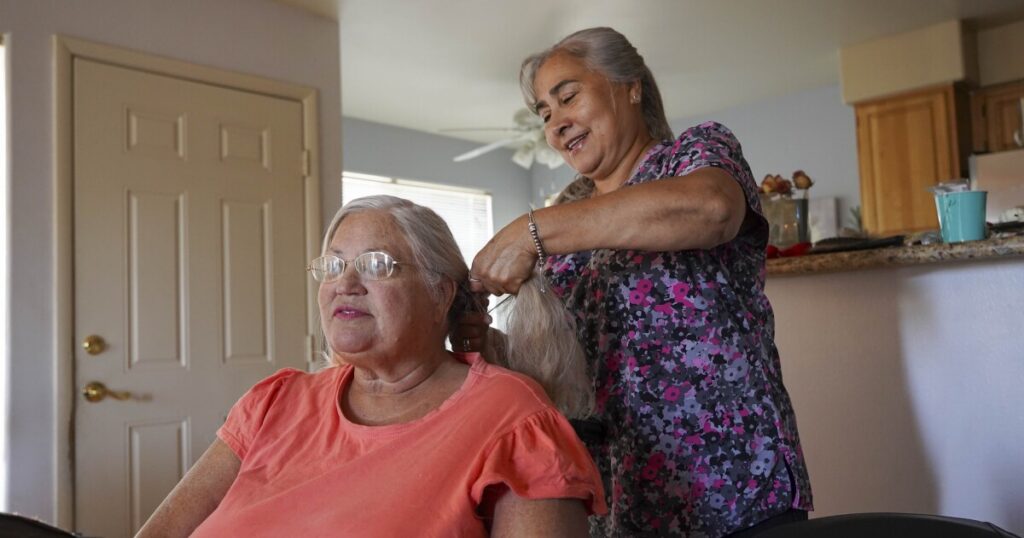
In a cozy Las Vegas home, filled with the scent of blossoming houseplants, the warm companionship between care worker Irma Luz López, known as Malu, and her former client, Diane Wohlman, was palpable. Their shared laughter punctuated stories of dinners out and city adventures, all under the watchful gaze of White Socks, an orange cat with white paws.
“She was always bringing me little treats,” Wohlman recalled, smiling fondly.
Among their cherished memories is the time Wohlman gifted Malu a purple dress for a formal event, a gesture of appreciation for Malu’s care and companionship.
Katherine Fulwider
/
KUNR Public Radio
“She always surprised me, too,” López added, reflecting on her time caring for Wohlman during her recovery from a stroke. For more than two years, López provided overnight assistance, ensuring Wohlman could attend early morning physical therapy sessions.
“If it hadn’t been for Malu, I don’t know, she allowed me to stay in my home,” Wohlman expressed, acknowledging López’s pivotal role in her life.
López’s journey to caregiving in Las Vegas began over three decades ago when she and her children left Los Mochis, Sinaloa, Mexico, seeking a new life. Her past as a pharmacy owner with her ex-husband underscores her deep commitment to helping others. “In Mexican culture, now Mexican-American, in our culture, it’s always pamper whoever is ill in the family, we pamper until they heal, or the elderly,” López explained.

Katherine Fulwider
/
KUNR Public Radio
Home care industry strained by immigration restrictions
Immigrants, including López, comprise a significant portion of the U.S. home care workforce. According to PHI, a national nonprofit, they account for 33% of this sector. Jake McDonald, a senior policy advocate, believes the actual figure is likely higher, as not all undocumented workers are counted.
“Oftentimes, immigrants are also coming from cultures where there’s a greater onus put on caregiving,” McDonald explained. He emphasized their impact on care stability, continuity, and quality, which are crucial for positive health outcomes.
Immigrant caregivers bring additional advantages, such as serving Spanish-speaking communities in Nevada, thanks to their diverse cultural backgrounds.
However, the home care workforce faces challenges due to immigration restrictions. The Trump administration’s policies, including deportations, visa suspensions, and increased processing fees, have removed many workers, particularly those with Temporary Protected Status.
Filling these gaps is difficult, especially in fast-aging states like Nevada. Projections indicate the state will need nearly 10,800 additional personal care aides by 2040, according to the Kenny Guinn Center for Policy Priorities.
Jeanne Batalova from the Migration Policy Institute highlighted the paradox of demographic demands and restrictive immigration policies. “Instead of working illegally in someone’s home, they could have worked through an agency, which meant better conditions for them, as well as better oversight to the client,” she noted.
Elsewhere, countries like Canada are exploring solutions, such as a pilot program offering caregivers a path to permanent residence, though it’s currently paused due to a backlog.
A bilingual cat bonds two strangers together
López, a legal resident, isn’t concerned about her status, but she empathizes with others’ fears. “My daughter said, ‘Mom, I’m worried for you with this administration,’ and I say, ‘Don’t worry.’ What I want people to know about me is just that I’m here to serve,” she stated.

Katherine Fulwider
/
KUNR Public Radio
Wohlman, who initially held strong opinions about immigrants, had her perspective transformed through her relationship with López. “I was just very staunch about it, but now I understand,” Wohlman admitted. “She’s been here many years; she may not be a citizen, but she’s an American to me.”
For Wohlman, an immigrant caregiver meant embracing diverse experiences, from trying new foods like flan to sharing a bilingual connection with her cat, White Socks, gifted by López.
This story was published with the assistance of the Journalism & Women Symposium Health Journalism Fellowship, supported by The Commonwealth Fund.