Luke Holdsworth, a highly regarded British Sign Language (BSL) interpreter for live concerts in the UK, was born deaf. He only began to experience live music in his 20s, but now plays a crucial role in making these events accessible for the deaf community.
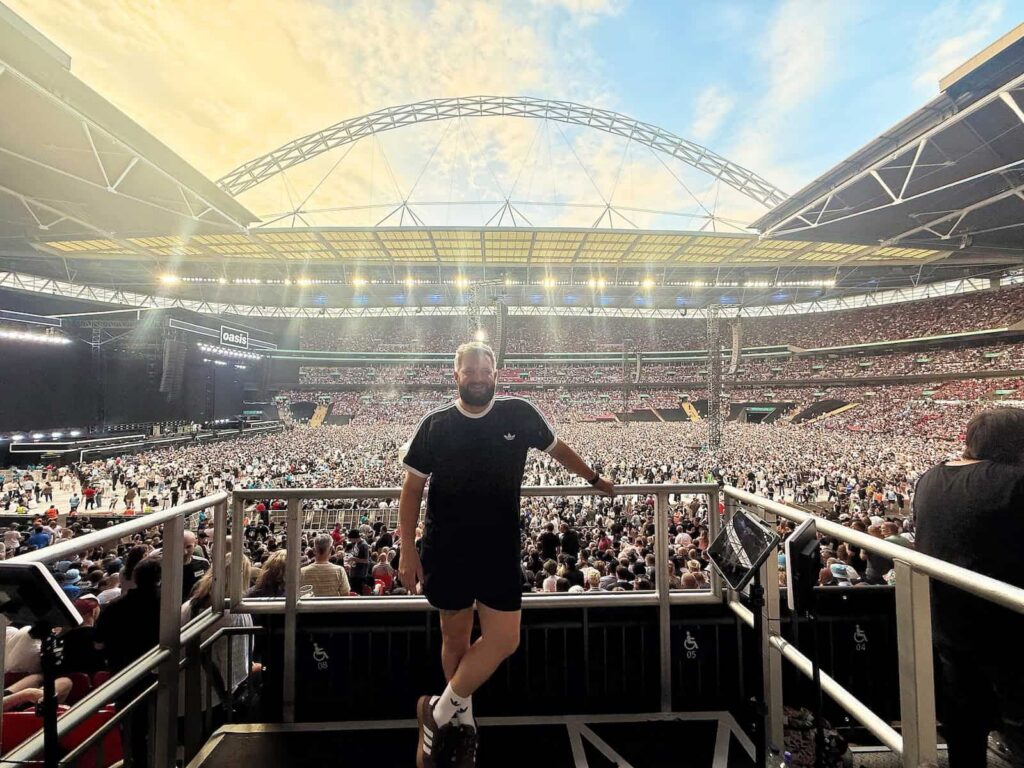
Holdsworth was in the midst of tens of thousands of Oasis fans at Cardiff’s Principality Stadium, not as a spectator but as an interpreter. He used sign language to bring deaf fans into the core of the experience, translating the music, atmosphere, and even the Gallaghers’ distinctive swagger. He described the experience as electric, saying, “It was an incredible privilege to be part of history while at the same time providing access for deaf people, helping them enjoy the shows.”
Holdsworth, 36, was raised by deaf parents and British Sign Language (BSL) was his first language. BSL, which makes use of hand shapes, gestures, facial expressions, and body movements instead of spoken words, was an integral part of his everyday life. In the deaf community, Holdsworth was given his own sign language name – ‘Shy’ – reflecting his reserved personality.
Although sign language interpreters are becoming more commonplace at concerts and festivals, Holdsworth only encountered one for the first time seven years ago. He was mesmerized while watching performance interpreter legend Tracey Tyer signing along to dance legends Underworld at Latitude Festival. This experience inspired him to complete an interpreting course, and in 2023, he found himself signing at London’s Pride celebrations in Trafalgar Square, working alongside Tracey Tyer. Since then, he has signed for artists like Lewis Capaldi, Paloma Faith, and Disclosure. In 2024, he was called to cover 14 dates on Oasis’ reunion tour.
Holdsworth believes interpreting music is about storytelling, not merely signing words. He spends hours engrossed in back catalogues, learning lyrics and delving into the stories behind them. During performances, he conveys aspects like tempo, rhythm, and melody while emulating the artist’s persona to bring songs to life. This interpretation style was particularly effective during the Oasis reunion tour, where he successfully captured the brothers’ iconic Mancunian self-assuredness.
Holdsworth didn’t attend his first concert until his mid-20s, assuming that as a deaf person, it wasn’t meant for him. However, with his work, he aims to provide the accessibility that he lacked in his younger years. “This is embarrassing, but that first concert was One Direction,” he admits, “And there was no interpretation so I didn’t understand a thing. It’s hard to explain what having access means to a deaf person.”
This summer, thanks to his partnership with specialist agency Performance Interpreting, Holdsworth has a busy schedule. He has been signing at Wembley for Harry Styles, with more performances with Lewis Capaldi and dates at Latitude lined up. Despite this, he believes more venues should book interpreters as standard practice. The Equality Act 2010 stipulates that event organisers have a legal obligation to make reasonable adjustments, which could include providing BSL interpretation.
Holdsworth hopes that the presence of performance interpreters at concerts will allow a new generation of deaf music fans to experience the thrill of live music at a younger age. This is about more than accessibility, he emphasizes. It gives deaf people the opportunity to experience one of life’s fundamental pleasures – the power of music to unite and the ability to lose oneself in a shared moment. “Being able to watch a show and being part of the crowd like everyone else – it’s not just about the music, it’s the vibe, the going out with friends, and having fun,” says Holdsworth. “You become one, you’re there as a community.”