The University of Michigan-Ann Arbor has set a new record for total enrollment this fall, with 53,488 students attending the state’s largest public research institution. This marks a slight 1% increase compared to the previous year, driven primarily by a nearly 3% rise in undergraduate enrollment, now totaling 35,358 students.
RELATED STORIES
- UM-Dearborn welcomes second-largest class in history
- UM-Flint fall enrollment climbs for third consecutive year
Adele C. Brumfield, vice provost for enrollment management, highlights the institution’s global reputation: “U-M is recognized around the world for providing a life-changing education. Through innovative partnerships, groundbreaking research, and deep community engagement, we’re expanding educational access and opportunity across Michigan and beyond.”
The incoming undergraduate cohort comprises 9,711 students, with a notable increase in first-year and transfer students totaling 8,178 and 1,533, respectively. This nearly 10% rise from the previous year reflects a geographically diverse group, including representatives from all 50 states, Washington, D.C., five U.S. territories, and 62 countries.
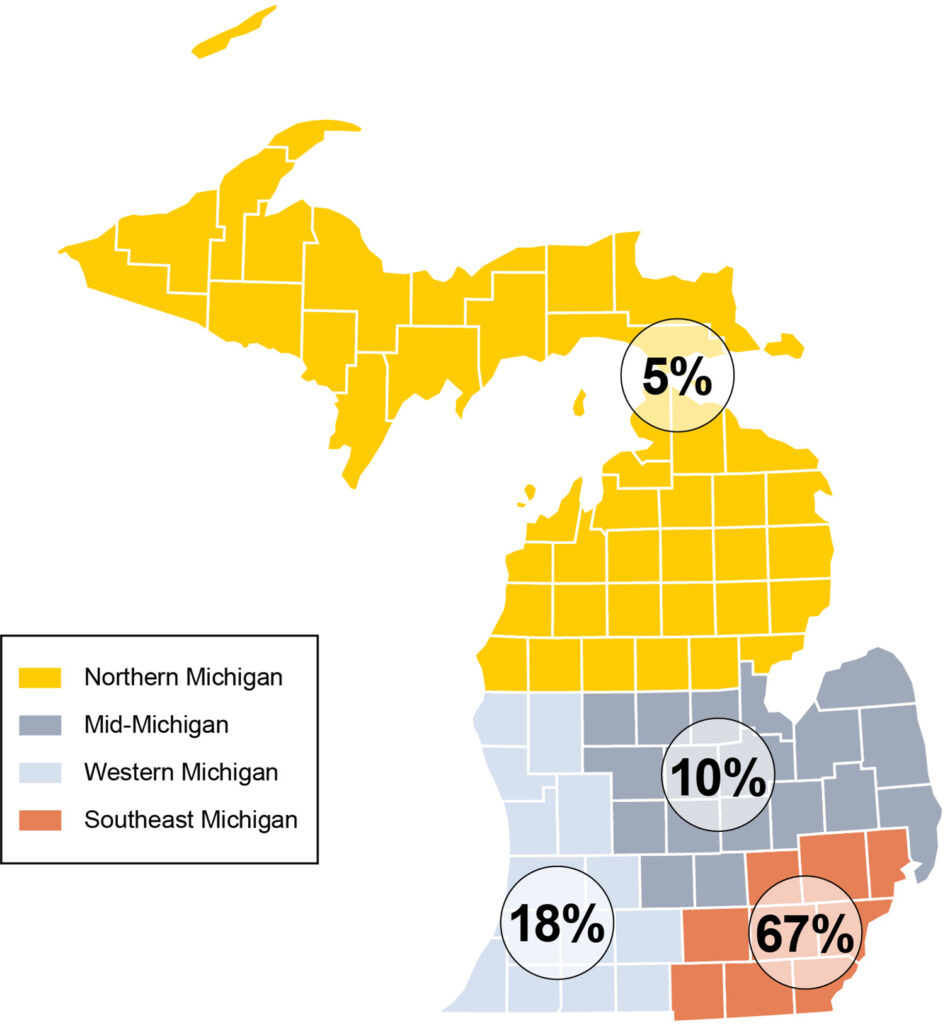
Despite this diversity, most new students are Michigan residents, representing 76 of the state’s 83 counties. Primarily, 67% come from southeast Michigan, while the west side and mid-Michigan contribute to 28% of first-year enrollments, aligning with the state’s population distribution.

The University of Michigan-Ann Arbor remains a top choice for first-year students, evidenced by a record 115,957 applications. First-year applications rose by 11% to 109,112, while transfer applications stayed consistent with 6,845 this year compared to 6,832 last year.
Graduate and professional enrollments experienced a slight decline, with numbers dropping from 18,401 to 18,130 this fall. The makeup of this group includes 9,515 master’s students, 5,814 Ph.D. candidates, and 2,562 pursuing professional doctorates, alongside 239 non-degree seeking individuals. Domestic graduate enrollments saw a 1% increase to 12,652, while international enrollments decreased by 7%, totaling 5,478 students.
Mike Solomon, vice provost for academic affairs – graduate studies and dean of Rackham Graduate School, remarks, “University of Michigan graduate and professional degree programs have seen strong growth over the past five years. The university continues its leadership as a place where students can pursue advanced education and training for careers in a comprehensive range of disciplines and professions.”
A look at the fall 2025 incoming undergraduate class
Erica Sanders, assistant vice provost of enrollment management and executive director of undergraduate admissions, emphasizes the university’s inclusive ethos: “As a public institution, we strive to expand the boundaries of learning for everyone. Throughout the recruitment process, we encourage students from all backgrounds and all regions of Michigan and around the world to consider what a University of Michigan education will mean for their future, and we let them know that we have programs to support all students so they can fully immerse themselves in the U-M experience.”
OFFICE OF BUDGET AND PLANNING REPORTS
Notably, more than 1,500 newcomers are first-generation college students. Additionally, the number of students from households with annual incomes under $50,000 slightly increased to 1,057.
This year’s incoming class mirrors the campus’s recent diversity trends, with 9,711 students including 4,128 students of color, up by 8% from last year. The population of Black or African American students grew by 6%, and Hispanic and Latino students by nearly 2%. Over the past five years, the number of students of color has surged by 36%.
International undergraduate enrollment rose by 3%, from 755 to 781 students, despite challenges faced by international students.
U-M’s continued focus on affordability
Commitment to affordability remains a priority for the university, highlighted by its comprehensive financial aid programs. Annually, over $1.55 billion in aid is distributed, with this fall seeing preliminary figures show $617.9 million awarded to over 32,800 students through federal, state, institutional, and private funding.
The Go Blue Guarantee, which now supports students with household incomes and assets under $125,000, benefits more than 4,900 undergraduates. Tammie L. Durham Luis, assistant vice provost of enrollment management and executive director of financial aid, states, “The university is committed to providing generous financial resources to allow more students to choose U-M and thrive once they’re here. We work to ensure that prospective students and families know they are welcome and can succeed at U-M.”
The University of Michigan’s enrollment statistics are compiled based on data from the September 16 fall census date.