UM-Dearborn Students Break Ground in Cancer Research Under Esteemed Professor’s Guidance
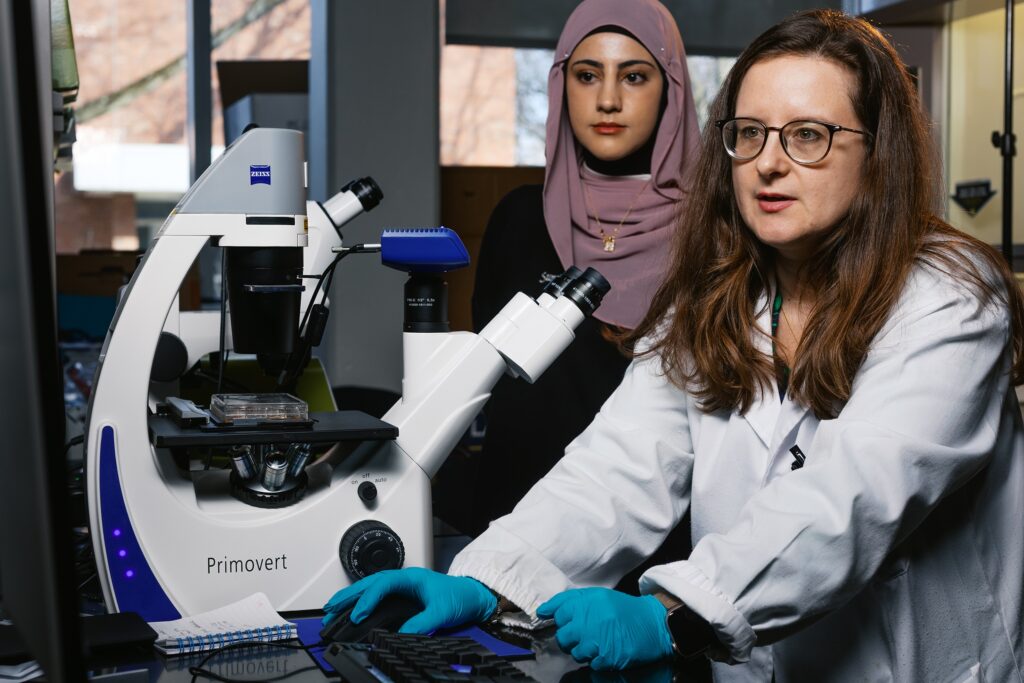
Within the walls of the Cancer Therapeutics Lab at UM-Dearborn, junior biochemistry major Wiam Almahdi is making strides in cancer research. Her work focuses on studying melanoma skin cancer cells to evaluate the potential of Spinosyn A, a natural pesticide, in inhibiting their growth.
Almahdi is driven by her ambition to become an epidemiologist, and she believes her experience in the lab is invaluable. “I have learned how a lab operates, how to use the equipment and run tests. I’m becoming more independent and I’m becoming more confident in trusting my decisions and results. I am doing cancer research as an undergraduate. This is not something many people can say,” she shared.
Much of Almahdi’s progress can be attributed to her mentor, Besa Xhabija, an associate professor of biochemistry at UM-Dearborn. Having taken two courses with Xhabija and worked in her lab for a year, Almahdi appreciates how technical topics are made accessible. “She is always there to help if I need it and she takes technical topics and makes them easy to understand,” Almahdi said. “In her lab, we are performing tests that are done in industry to make discoveries of our own.”

Xhabija’s collaboration extends beyond the university, involving partnerships with Cayman Chemical and Michigan Medicine’s Rogel Cancer Center, among others. “If you want to work in medical research, Professor Xhabija’s lab is where you want to be,” Almahdi affirmed.
The Almahdi siblings share a common path. Wiam’s brother, Yazan Almahdi, a UM-Dearborn alum, also trained in Xhabija’s lab and now works at the Rogel Cancer Center as a research technician, contributing to clinical research in melanoma and sarcoma.
Committed to nurturing future scientists, Xhabija integrates her personal journey into her mentorship approach. Growing up in post-Communist Albania, her passion for science was fueled by her parents’ sacrifices to provide educational resources. “They were colorful, easy-to-understand and had wonderful photos. But they were so expensive. One textbook would cost one-tenth of my parents’ salary,” she recalled.
Xhabija’s academic path led her from Albania to Canada, where she attended York University. Despite initial struggles, mentorship from Panayiotis “Otis” Vacratsis at the University of Windsor guided her through to her Ph.D. “Otis is very good at reading people. He saw I was drowning, but that I was eager to learn. His support rebuilt my confidence and taught me that working through challenges is what makes you more resilient,” she reflected.
In her lab, Xhabija focuses on cancer cell metabolism and nutrient pathways, aiming to suppress tumor growth. She’s published studies highlighting how targeting these processes can potentially slow melanoma and renal cancer cell growth.
As Almahdi continues her research, she aspires to work for the Centers for Disease Control and Prevention within the next decade. Reflecting on her experience, she noted, “Working in Professor Xhabija’s lab will help me stand out. I am learning so much.”
Through Xhabija’s mentorship, UM-Dearborn students are not only equipped with technical skills but also inspired to tackle pressing health challenges. “These are students who ask questions that matter. They notice patterns others might miss. They develop judgment. Over time, you see something shift. They begin to see themselves differently,” Xhabija remarked. “They are not standing at the edge of discovery — they are inside it.”