U-M’s Negro-Caucasian Club: A Pioneering Push for Racial Equity
The University of Michigan in the 1920s was a microcosm of the racial challenges permeating American society. Amidst a backdrop of segregation and discrimination, a group of students took bold steps to confront these issues directly on their campus.
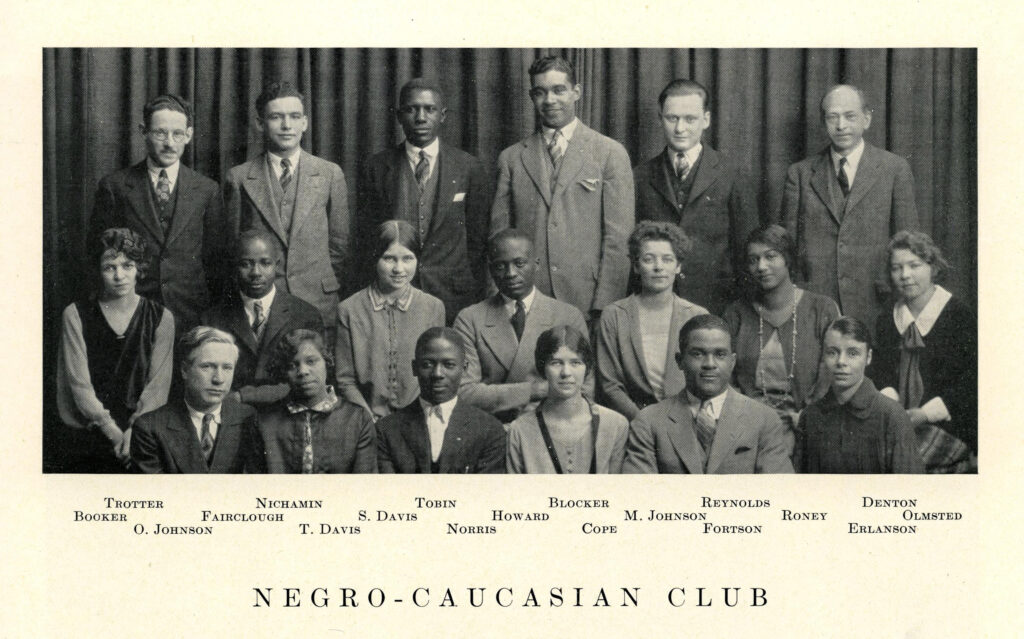
In March 1926, the Negro-Caucasian Club was founded by a determined group of students at the University of Michigan. Their mission was to foster equity for Black students both in the university setting and the wider community of Ann Arbor. The inception of this club originated from an incident in the fall of 1925 involving Lenoir Bertrice Smith, one of the few Black students at U-M, and her white friend, Edith Kaplan.
During a visit to an Ann Arbor restaurant, Smith and Kaplan experienced blatant discrimination when a server ignored them, and a busboy placed dirty dishes on their table. Kaplan later remembered the scene vividly. “I trembled with rage when I saw [Smith’s] face and knew that the dirty dishes had not been accidental,” she said.
This event highlighted a broader issue: despite attending classes with their white peers, Black students faced segregation in various aspects of university life. They lived separately, with Black men in specific fraternity houses or boarding with Black families, and Black women barred from university dormitories. Furthermore, establishments like the Michigan Union and local public swimming pools were off-limits, and Black students were excluded from university dances.
U-M alumnus Joseph Leon Langhorne encapsulated the sentiment, stating: “The colored were not part and parcel of the school.” Seeking change, Smith and Kaplan approached faculty member Oakley Johnson and subsequently Dean John Robert Effinger, requesting the university’s support in advocating for fair treatment. However, Dean Effinger’s response was described as “correct, cold and unsympathetic.”
Determined to make a difference, Smith, Kaplan, Johnson, and nearly two dozen other students established the Negro-Caucasian Club. Initially comprising 26 students, including 21 Black and five white members, the club aimed to encourage understanding between races and eradicate discrimination. However, when seeking official recognition, they faced university-imposed limitations. Dean Joseph Bursley approved discussions on race but was wary of overt anti-discrimination activism. Consequently, the club’s mission was reframed to focus on “friendliness,” “fair-mindedness,” and impartial “study and discussion,” earning a one-year trial period without the university’s name in its title.
Despite these constraints, the club was proactive. They conducted surveys among white students to understand their interactions with Black people, uncovering widespread ignorance and stereotypes. To combat these issues, the club invited influential Black intellectuals and leaders to speak at U-M. Esteemed figures like philosopher Alain LeRoy Locke, NAACP cofounder W.E.B. DuBois, and novelist Jean Toomer graced the campus. Additionally, they facilitated meetings with labor leader A. Philip Randolph, Judge Frank Murphy, and lawyer Clarence Darrow.
For approximately five years, the Negro-Caucasian Club thrived and renewed its membership annually. However, the economic pressures of the Great Depression led to its decline in the early 1930s. Nonetheless, the club’s legacy endured through its alumni, who went on to impact fields such as medicine, social work, academia, and journalism. Notably, Lenoir Smith Stewart became a leader in the serology section at University Hospital, and Kaplan distinguished herself as an expert in ancient languages at the University of Chicago.
In 1969, following the death of Martin Luther King Jr., surviving members including Langhorne reconvened in Washington, D.C., to reflect on the Civil Rights Movement’s progress and reminisce about the club’s influence during their time at U-M. Langhorne observed, “I think the N.C. Club served a distinct purpose then. It was the only forum … for airing of Negro people’s views and students’ problems in Ann Arbor.”
This story was adapted from a story on the Heritage Project by James Tobin, which can be found online at myumi.ch/A1X4g.