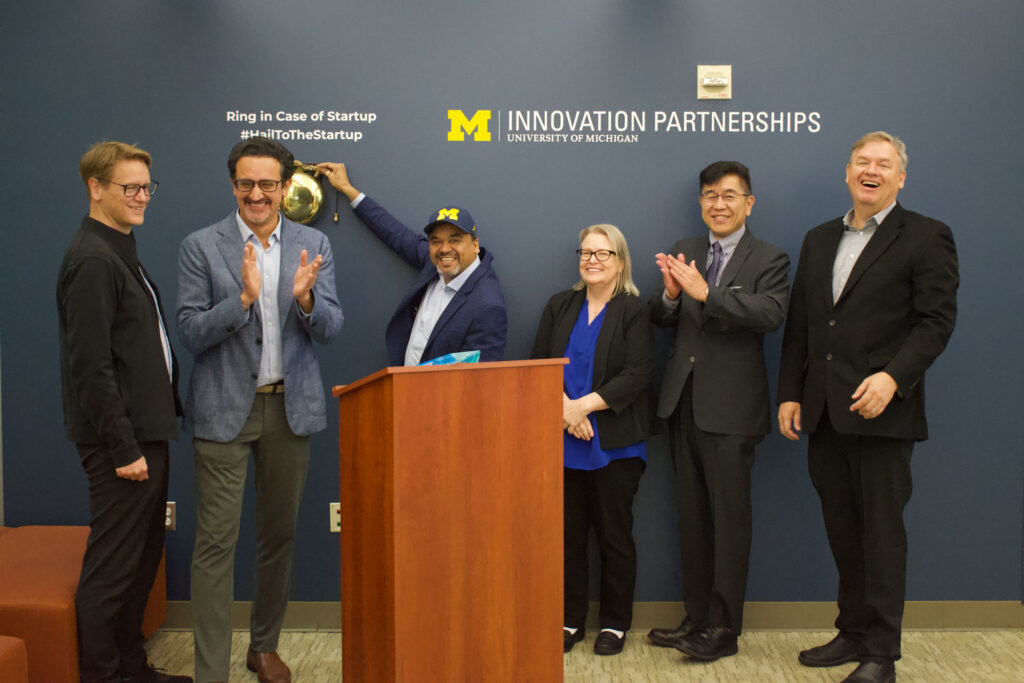
Transforming academic innovations into thriving startup businesses is a formidable challenge, yet it is a crucial endeavor to ensure research findings benefit society. Regulatory hurdles, fierce competition, and, most significantly, funding obstacles often complicate this transition.
Innovation at Michigan
- From the start of an academic journey to the culmination of commercial success, innovation at U-M takes many forms. See more of the story:
Over the past ten years, the University of Michigan (U-M) has excelled nationally in transforming ideas into viable businesses by systematically removing barriers to the commercialization of academic research. This achievement is credited to U-M’s Innovation Partnerships, which provides extensive research support and fosters collaborations that propel lab work into impactful economic and community developments.

In fiscal year 2025, U-M set records in commercialization:
- 31 new startup companies
- 673 new invention reports
- $31.4 million in licensing revenue
Based on recent national surveys, U-M ranks second for both startup launches and invention reports, a remarkable feat considering its Midwest location, far from traditional coastal startup hubs. To capture venture capital interest, U-M cultivated a Midwest innovation ecosystem, providing fertile ground for transforming research into public benefits.
“We believe that public investments in university research are essential to improving our nation’s health and economic prosperity and to addressing the huge challenges facing our society and our shared planet,” said Kelly Sexton, associate vice president for research – innovation partnerships and economic impact.
U-M’s commercialization efforts are not new, but recent initiatives have significantly accelerated the translation of research into market-ready solutions, akin to infusing investment into a budding enterprise.
“We stand on a remarkable legacy of positive impact through commercialization,” Sexton noted. “From the bladeless Intralase Lasik eye procedure that has gifted improved vision to millions, to the OLED displays integrated into our daily lives, Michigan’s innovations have reshaped the world.”

The Blueprint for Success
Through its Innovation Partnerships, U-M has established a robust framework that marries entrepreneurial talent with promising research, enabling ideas to evolve into flourishing startups. This initiative spans corporate and foundation alliances, licensing, and ventures, ensuring comprehensive commercialization support.
The collaborative efforts of U-M’s corporate and foundation alliances team assist faculty in diversifying research funding and managing large-scale research collaborations. Meanwhile, the licensing team oversees one of the nation’s most substantial university intellectual property portfolios, guiding faculty through the complexities of commercialization.
The ventures team focuses on launching startups based on U-M’s intellectual property, offering funding and business mentorship to navigate from idea validation to company formation. Entrepreneurs are matched with seasoned leaders and investors to sustain early-stage momentum.
“Innovation Partnerships represents a cornerstone of our research ecosystem,” stated Arthur Lupia, vice president for research and innovation. “By empowering our researchers to translate groundbreaking discoveries into real-world solutions, this incredible resource accelerates our mission to transform ideas into impact.”
Retaining Local Talent
Attracting and retaining talent in Michigan is a strategic priority. Through collaborations with investors and industry leaders, Innovation Partnerships has crafted a supportive ecosystem where startups choose to launch and grow locally.
The Technology Transfer Talent Network (T3N), established in 2012 with support from the Michigan Economic Development Corp. (MEDC), exemplifies this effort. The network pairs experienced entrepreneurs with research teams statewide, providing mentorship in commercialization.
“This investment makes sure we keep our top talent at the early stage. Once you start building a team, you want it to stick around,” said Ben Marchionna, MEDC chief innovation ecosystem officer. “That’s a really great opportunity for us to stop talent from going somewhere else. If we can keep them in the early stages, that’s better for the state,” he added.

Financing Future Innovations
Achieving startup success necessitates substantial funding. Even highly successful ventures often have long gestation periods. For instance, HistoSonics, a U-M startup that developed an FDA-cleared liver tumor treatment, was acquired in 2025 for $2.25 billion, having been founded in 2009 based on prior research.
Securing funding in Michigan has traditionally been challenging, but U-M’s Accelerate Blue Fund, launched in 2019, addresses this gap by investing in early-stage UM-licensed startups.
“Accelerate Blue operates as an evergreen fund, recycling returns back into the fund for investment in future U-M companies,” Sexton explained. “It is already having a catalytic impact. For every $1 we invest, our companies raise $42 in outside funding. $11 million has helped unlock more than $460 million in capital for our startups. This is how we maximize impact per unit of effort.”
Since its inception, the fund has grown to manage over $29 million, sourced primarily from private donors, U-M funding, and the state’s Michigan Innovation Fund.
Complementary to this is the MEDC-supported Michigan Translational Research and Commercialization program, providing translational funding to projects at major Michigan research institutions with commercial potential.
U-M ranks second nationwide in invention reports, just behind MIT, highlighting the effectiveness of its commercialization initiatives.
“Academia is known for lots of inventions, but less well known for commercialization of those ideas into the market,” Marchionna remarked. “Very few universities in the world do that well. Innovation Partnerships is the tip of the spear. That is what matters to economic development. Making sure there is a durable economic impact.”

Encouraging New Success Stories
Research commercialization at U-M aims to positively impact individuals and communities, as evidenced by startups like GripFusion. Founded in 2023, GripFusion developed a baseball that measures pressure and flight performance.
The company was co-founded by Mason Ferlic, a U-M Ph.D. candidate, aerospace engineer, and former Olympian, alongside Michael Freehill, a professor and former MLB player. “It’s very personal to me, I’ve always been extremely passionate about being a creator and innovator,” Ferlic expressed, crediting U-M’s early support.
In 2026, GripFusion delivers its technology to Major League Baseball and NCAA clients, with U-M not only financially supporting but also providing essential mentorship and resources.
Another beneficiary, General Orbit, leverages magnetometers for advanced positioning solutions in challenging environments. Co-founders Moldwin and Ojeda utilized the Accelerate Blue Foundry to recruit their CEO, Parker Boundy.
“Innovation Partnerships has been great to work with, from helping us set up the company to making sure we are on a good footing for being successful,” Boundy stated.
In October 2025, General Orbit won the Detroit regional PitchMI startup competition, earning $375,000 and advancing to the statewide finals with a chance to win an additional $1 million.
“The biggest challenge in research commercialization is turning the research into a product. Innovation Partnerships starts with coaching and mentoring, and then, provides tools to be able to do it,” Boundy observed.
Boosting Michigan’s Economy
Startups have a profound effect on Michigan’s economy and quality of life. Their growth is vital for long-term job creation, urban development, and infrastructure investments.
“Over the long run, research shows the younger companies are responsible for the net new jobs in an economy,” Marchionna explained. “Big, established companies can add big numbers of jobs in good times; but in bad times they also shed lots of jobs.”
U-M’s startups have generated over 8,000 jobs, with more than 2,500 in Michigan alone.
“The return on investment in university-based innovation programs, particularly Innovation Partnerships, are arguably among the highest returns of any state-based investments,” Marchionna concluded.