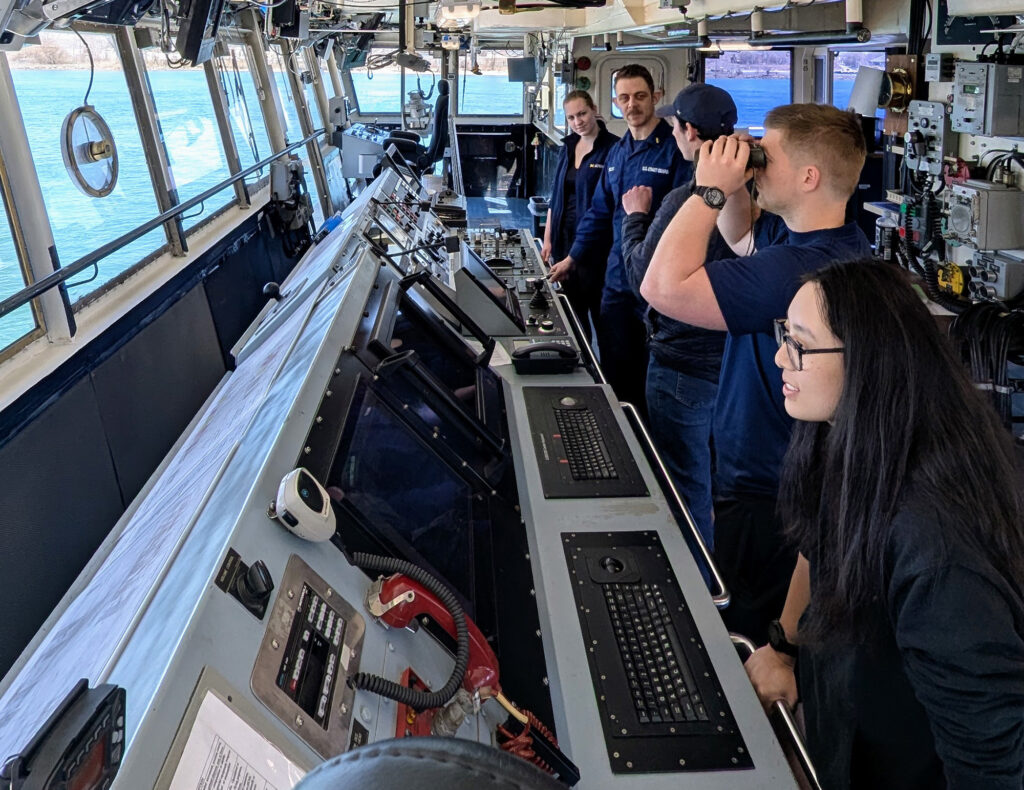
As the Great Lakes’ massive waters lap at the University of Michigan’s doorstep, a unique opportunity awaited recognition. Sam Blum, a mechanical engineering senior, noticed a gap when he sought ways to engage with the U.S. Coast Guard. Despite the presence of Auxiliary University Program chapters nationwide, the U-M lacked its own. The realization that this was “a missed opportunity” spurred him to action.
Blum’s initiative found a kindred spirit in Christian Sandvig, a professor keen on the same idea. Together, they established U-M’s Coast Guard Auxiliary University Program, a rarity among college campuses and the sole chapter near the Great Lakes. The program is gearing up to gain official detachment status by spring. 
Functioning as the U.S. Coast Guard’s volunteer component, the auxiliary partakes in critical operations like search and rescue, environmental education, and disaster response, barring direct military or law enforcement roles. Unlike ROTC, the auxiliary offers freedom from service obligations post-graduation, a point emphasized by Lt. Michael Jenkins from Coast Guard Sector Detroit: “The nice thing about the auxiliary is that because it is volunteer, there’s no commitment.” 
Participants drawn to the program typically have an affinity for maritime activities or environmental stewardship. Sandvig, who joined the auxiliary in 2022, simply states, “I needed an outlet that allows me to spend a certain amount of my time talking and thinking about boats.” For junior John McCalmont in naval architecture and marine engineering, the program harmonizes with his lifelong nautical interests as a fulfilling way to give back.
The program also caters to those aspiring to maritime careers, like freshman Victoria Long, who aims to become a Coast Guard officer piloting helicopters. “Since joining, I’m even more sure, this is absolutely what I want to do,” she shared. 
The rigorous path to qualification includes online courses on Coast Guard operations and weekend sessions on practical skills. As McCalmont humorously notes, “Having to spend a couple hours clicking through what is effectively the government’s filing system” isn’t the highlight, but hands-on activities such as navigation and survival gear training offer engaging experiences.
Recent graduate Patrick Hullman fondly recalls a water survival drill, stating, “I got to hug my buddy Hal while we were both shivering and neck deep in water, just trying to share body heat.” These experiences, along with a burgeoning environmental track, attract students to the program. 
Jenkins highlights the strategic importance of Michigan for Coast Guard operations and student exposure: “It gives the students and the Coast Guard that opportunity to really understand the organization and hopefully accelerate their career path.” The unit’s official chartering in late April will confer “plank owner” status to its early members, a naval tradition celebrating their foundational role. 
Blum, reflecting on his journey as a co-founder, remarks, “There’s definitely a sense of fulfillment in getting to participate in a larger organization that is doing good work — that you are helping people.” For those interested, the program welcomes new faces every Wednesday at North Quad, offering an inclusive community experience, as described by Long, who felt instantly connected and adopted by the group.