An Innovative Hub for Dialogue Debuts at University of Michigan
The University of Michigan recently hosted a Preview Day for its Center for American Dialogue, an initiative poised to tackle pressing societal issues in today’s polarized environment. Opening this September, the center promises to become a vibrant platform for fostering civil discourse and strengthening civic trust among students, faculty, and the public.
Initially announced in 2025 by President Domenico Grasso, the center aims to serve as a beacon for reasoned dialogue and mutual understanding. President Grasso emphasized the importance of respectful exchange as foundational to both the university’s mission and a functioning democracy. Grasso stated, “As a university dedicated to the public good, our common ground must be reasoned discourse and civility. I believe we can — and must — rise to this moment, together, in ways only Michigan can.”
The unveiling event, witnessed by hundreds in the Lydia Mendelssohn Theatre and via livestream, included a presentation by Arthur Lupia, the center’s lead and U-M’s vice president for research and innovation. Lupia outlined the center’s framework, which was developed with input from faculty and staff across all three U-M campuses.
Lupia described the center as “a true start-up” and highlighted its potential to redefine how Michigan contributes to national conversations. “This is our time,” he asserted. “The Center for American Dialogue gives the nation a new reason to Look to Michigan.”
The center’s first year will feature five programs and two innovation accelerators, all designed to encourage civic engagement and meaningful dialogue:
- Certificates and Micro-Credentials — Courses in civic skills and dialogue techniques will be offered. Initially for the U-M community, the course offerings will later be available to the public for free.
- Interactive Role-Playing Simulations — Offered in locations like the Gerald R. Ford School of Public Policy, these simulations aim to provide transformative educational experiences.
- Speaker-based Engagements — The “Convene with Purpose” series will facilitate discussions to solve real-world problems across various platforms.
- Cooperative Extensions — Expanding civic dialogue beyond campus, this initiative will partner with communities and organizations statewide.
- Connection-Building Games — Games and apps will be developed to enhance collaborative skills.
The two accelerators, Innovation Accelerator Competition and America’s Dialogue Lab, will encourage new ideas and assess the impact of the center’s initiatives.
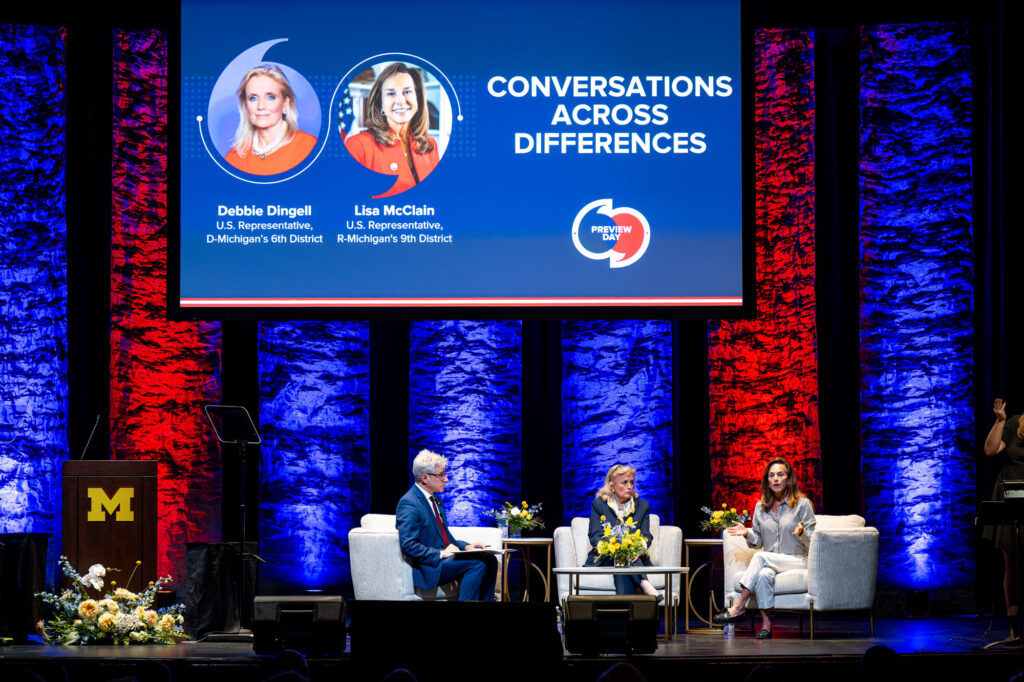
Preview Day also featured a discussion led by Lupia with U.S. Representatives Debbie Dingell and Lisa McClain, who illustrated the power of bipartisan cooperation. “We can have very good conversations about how to solve problems because we listen to each other,” Dingell noted. McClain added that overcoming societal bitterness requires a conscious choice to embrace positivity.
Keynote speaker David Brooks, a renowned author and commentator, contextualized the center’s mission in a broader historical narrative. He suggested that periods of cultural transformation, like those of the 1960s, often follow societal disillusionment. Highlighting the potential of universities like U-M, Brooks said that they can drive a humanistic revival by fostering continuous intellectual engagement.
The event also included remarks from student government presidents Eric Veal Jr. and Angelica Previero, along with performances by the U-M Chamber Choir and students from the School of Music, Theatre & Dance. The center, originally labeled as the Institute for Civil Discourse, is set to span U-M campuses and other strategic locations, offering a unique platform for dialogue and collaboration.