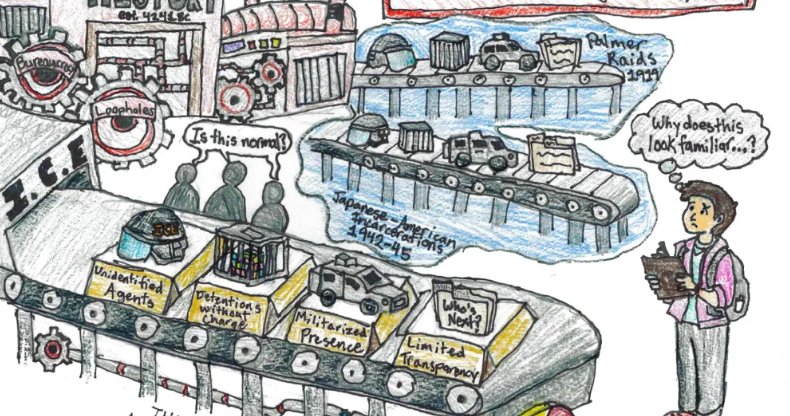
A high school editorial cartoon has spurred a debate on student press freedom after its removal from a school publication. The cartoon, titled “ICE’s militaristic operations are history repeating,” was initially published in The Wingspan, the student newspaper. However, school administrators took it down just two days later, igniting discussions on censorship and students’ rights to free expression.
“I guess I wasn’t surprised,” said student journalist McClaren, reflecting on the decision. “I mean, I knew it was controversial. I knew that people would disagree. But isn’t that the point?” Initially accepting the situation, McClaren later consulted the Student Press Law Center through its legal hotline for guidance. The SPLC suggested McClaren request a written explanation for the cartoon’s removal from administrators.
Afterwards, McClaren attempted to publish an opinion piece addressing the censorship issue, but the school blocked this attempt as well. In response, school officials proposed alternatives: publish a pro-ICE cartoon or provide a detailed explanation of the original cartoon’s meaning. McClaren argued that these options undermined the intent of an editorial cartoon.
In a bid to restore the removed content and advocate for student press rights, students formally appealed to the Gretna Public Schools Board of Education. They called for a school press freedom policy, the reinstatement of the cartoon, permission for student journalists to report on its removal, and an end to prior review by school administration. Another student journalist, Nick Mitchell, launched a petition echoing similar demands, which has garnered over 400 signatures.
Gretna Public Schools have yet to reach a decision on the appeal. They issued a statement to Nebraska Public Media News, emphasizing their support for student journalism while highlighting the need for “balanced” coverage in the current “divided political climate.” The statement also noted the district’s duty to prevent substantial disruptions in the school environment.
Public Schools and Free Speech Rights
Jonathan Gaston-Falk, a staff attorney at the Student Press Law Center, is assisting the Gretna East students. He explained that, while lawful reasons exist for censoring student work, public school settings present unique challenges. “Whenever a student journalist is censored for their work in school, there are lawful reasons to censor that work,” Gaston-Falk stated, noting that certain speech in public schools is not protected under the First Amendment.
Most student journalists are affected by the 1988 Supreme Court decision Hazelwood v. Kuhlmeier, which allows schools to limit speech conflicting with educational goals. Despite this, Gaston-Falk noted that students are entitled to a valid reason for censorship, a right not always upheld, potentially violating federal protections.
Nebraska lacks additional speech protections for student journalists, unlike eighteen states with “New Voices” laws. These laws protect student journalists and teachers from censorship and include employment protections for media advisors, who can otherwise face indirect pressure from school administrators.