Challenges in Education: The Story of a Special Education Teacher’s Journey
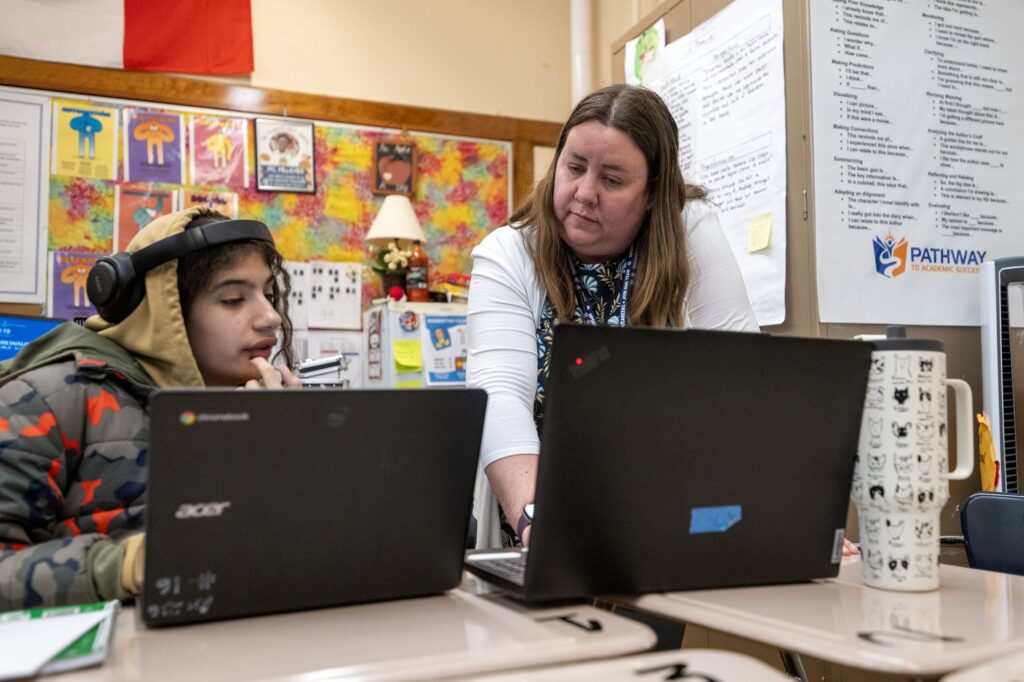
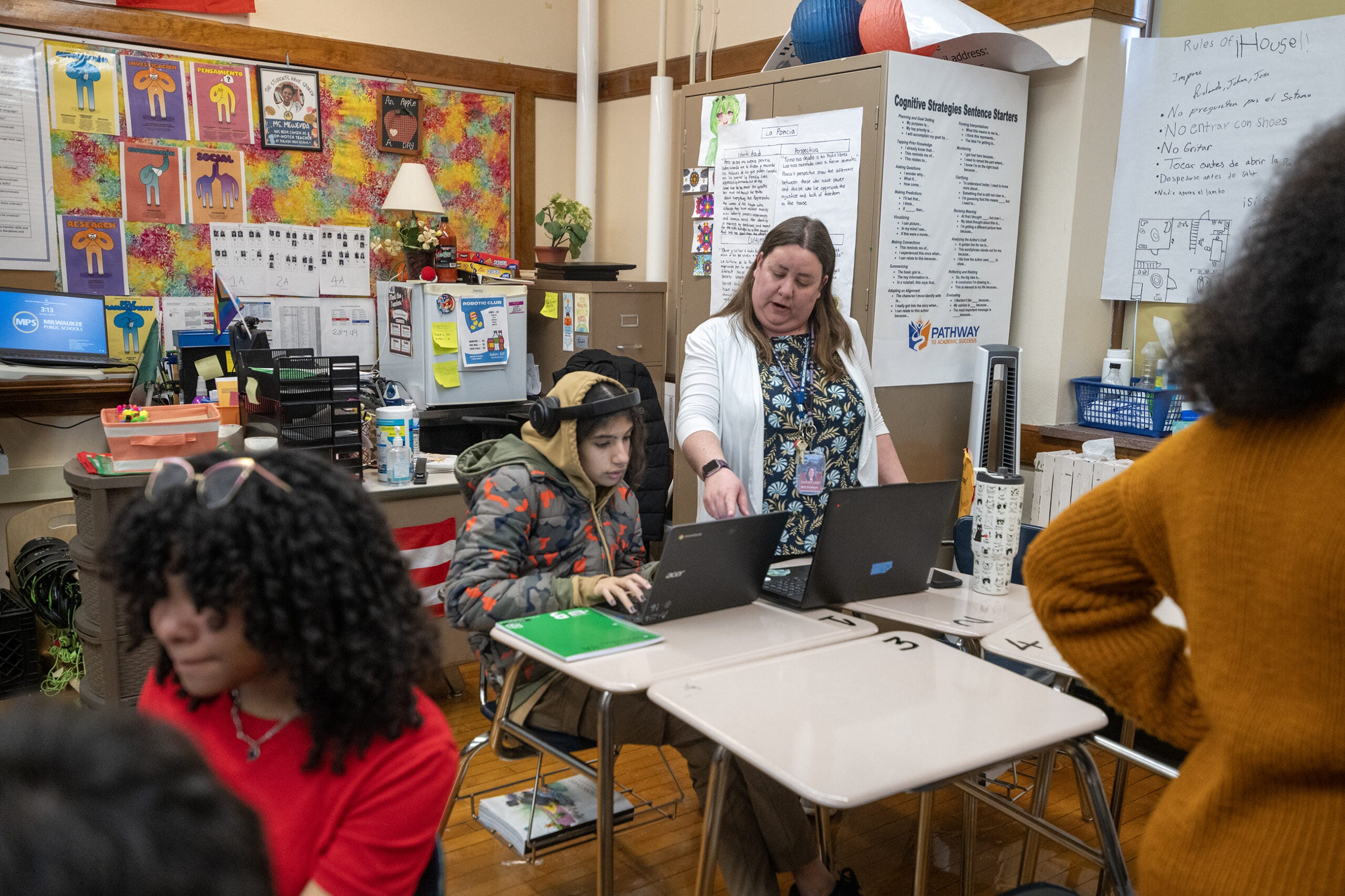
As the school day draws to a close at Casimir Pulaski High School, one classroom remains vibrant with activity. While most students prepare to leave, Sarah Lind, a dedicated special education teacher, is focused on guiding a student through English homework challenges.
“So what’s different about these two paragraphs?” Lind asks, engaging a freshman in a learning moment that extends until the final bell rings.
Pulaski High operates as a full-inclusion school, integrating general and special education students within the same educational environment. Lind’s role involves transitioning between classrooms to offer assistance wherever it’s needed.
Lind’s path to becoming a teacher was almost derailed. A former journalist, she entered the field through the University of Wisconsin-Madison’s teacher residency program. However, the program faced a severe funding cut in its final stages due to federal budget decisions.
The UW-Madison program, initiated in 2023, was designed to train future special education teachers in collaboration with Milwaukee Public Schools. Supported by a $3.28 million grant from the U.S. Department of Education, the initiative aimed to address the shortage of special education teachers.
Michael Harris, chief of staff for Milwaukee Public Schools, praised the program, saying, “We’ve always struggled to fill our special education vacancies. So what a great opportunity to recruit individuals who would go through a high-quality program?”
Funding Challenges Due to DEI Concerns
The grant was unexpectedly canceled in February 2025 due to its association with teaching “divisive ideologies” such as Diversity, Equity, and Inclusion (DEI). This resulted in financial uncertainty for the program.
Despite this, Milwaukee Public Schools and UW-Madison continued to support the program financially, emphasizing its importance in addressing the district’s educational needs.
Kimber Wilkerson, the project director, expressed frustration at the termination, noting that the program’s objectives did not align with DEI as defined by critics. UW-Madison’s appeal to the Department of Education was ultimately unsuccessful.
New Educational Policies in Trump’s Second Term
Since Donald Trump began his second term as president, education in the U.S. has undergone significant changes. His administration’s actions have included dismantling the U.S. Department of Education and eliminating DEI initiatives.
In Wisconsin, these changes led to the termination of many federally funded projects at state universities, including 145 at UW-Madison, though ongoing litigation has reinstated some.
Conservative perspectives, like that of Will Flanders from the Wisconsin Institute for Law & Liberty, support these reforms. Flanders stated, “You just can’t use racial terms to do it. Create a program for low-income families, and oftentimes you’ll benefit African American families and Hispanic families as well.”
Unfamiliar Territory for Educators
For Wilkerson and her team, the termination of the Teacher Residency Program was a first in her extensive career. Despite the challenges, the program managed to train numerous educators, emphasizing the need for well-prepared special education teachers in Milwaukee.
“It’s critically important to schools and to kids with disabilities and their families to have access to well-educated special educators,” Wilkerson said, emphasizing the ongoing need for such programs.