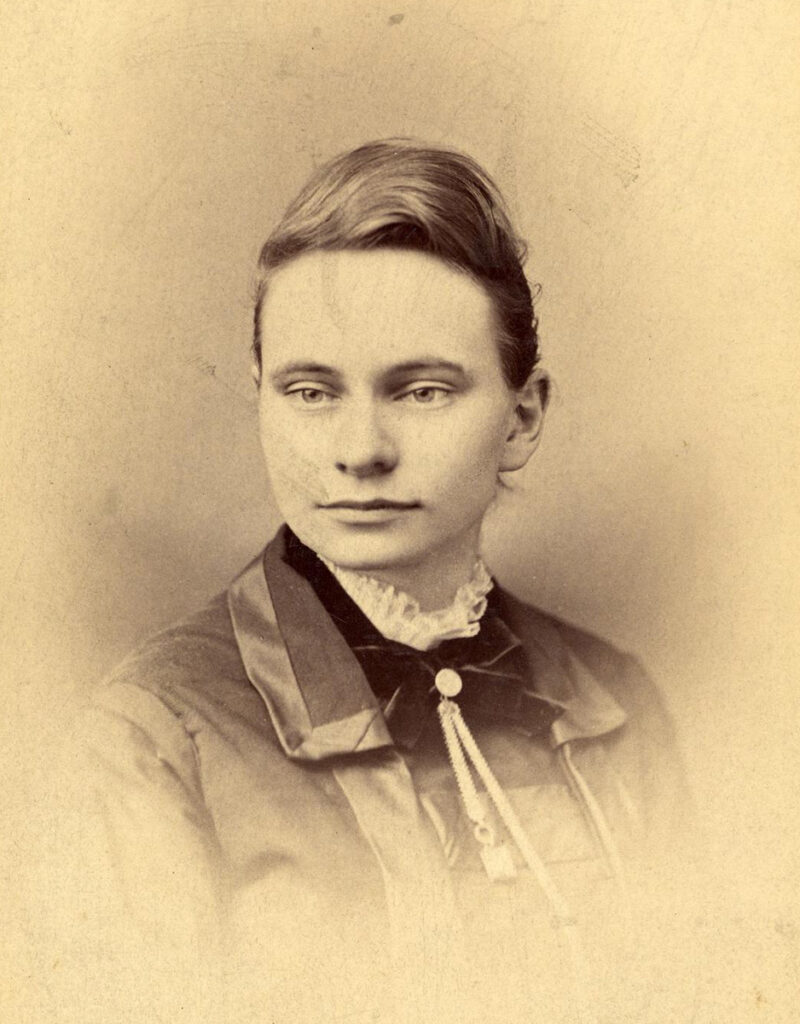
The academic journey of Rose June Colby stands as a remarkable testament to the pioneering spirit of women in higher education. Her achievement as the first woman to earn a Doctor of Philosophy degree from the University of Michigan in 1886 was a significant milestone, marking her place in the annals of academic history.
Early Life and Education
Born on June 4, 1856, in Cherry Valley, Ohio, Colby relocated with her family to Ann Arbor during her teenage years. Her parents, proponents of education, seized the opportunity provided by the University of Michigan’s 1870 decision to admit women, facilitating their daughters’ college pursuits.

Colby began her education in Ann Arbor High School, graduating in 1874. Following her sister’s footsteps, she enrolled at the University of Michigan, where she described her educational experience as profoundly impactful. Reflecting on her time there, Colby once wrote, “From the time [the university] opened to women when I was 14 and knew I was to go to Michigan, it gave a settled purpose and wider outlook.”
Academic Achievements and Challenges
After obtaining her bachelor’s degree, Colby embarked on a teaching career at high schools and briefly attended the Harvard Annex, now known as Radcliffe College. She returned to the University of Michigan to pursue advanced studies, ultimately earning a master’s degree and then a Ph.D. Her dissertation, “Some Ethical Aspects of Later Elizabethan Tragedy, Preceded by an Examination of Aristotle’s Theory of Tragedy,” not only represented a personal academic triumph but also placed her among America’s early female Ph.D. holders.
Despite her academic prowess, Colby faced difficulties securing a university teaching position, leading her to return to high school teaching. Her perseverance paid off in 1892 when she joined Illinois State Normal University, now Illinois State University, where she would make her mark for the next four decades.
Legacy and Influence
At Illinois State, Colby was more than a faculty member; she became a champion for women’s education and rights. As an English literature professor and dean of women, she also sponsored the university’s Sapphonian Society, advocating for young women’s empowerment. Her commitment to the women’s suffrage movement further underscored her dedication to societal progress.
Colby’s formal teaching career concluded with her retirement in 1931, yet her passion for knowledge continued as she wrote and lectured until her death in the spring of 1941, at 84.
— Genevieve Monsma, The University Record