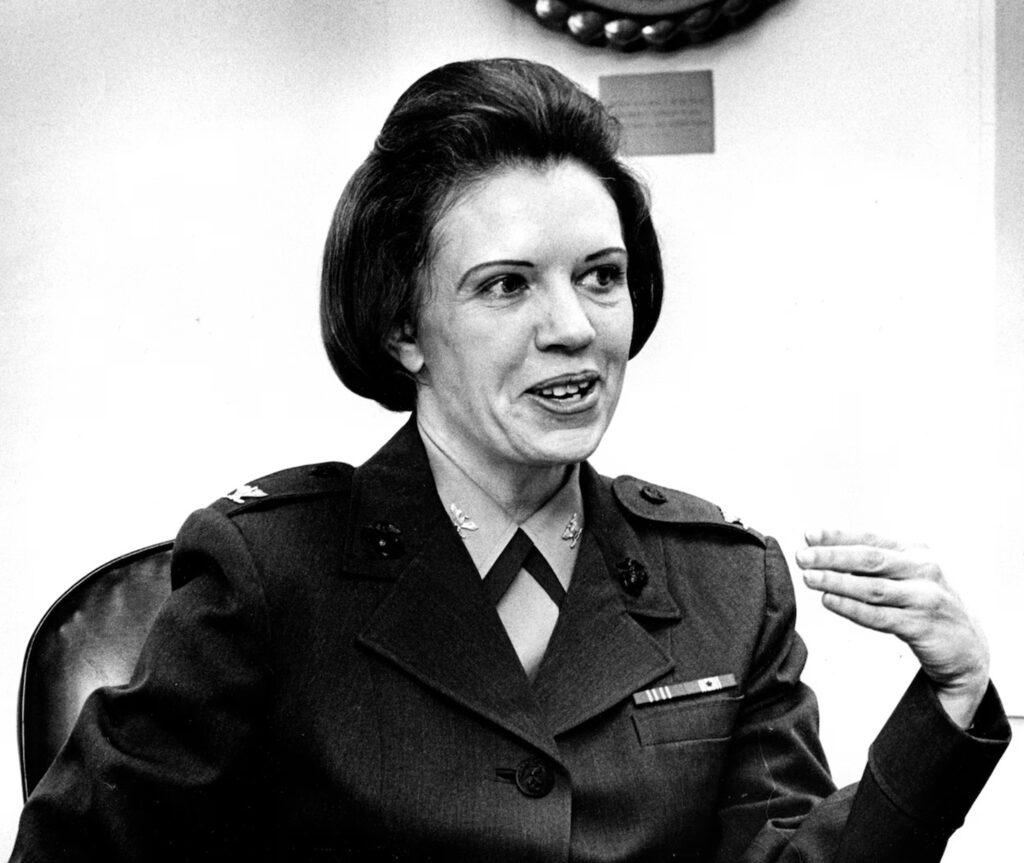
In 1949, a headline in the Michigan Daily stopped University of Michigan sophomore Margaret Brewer in her tracks: Gal Marines To Try for Commissions. This headline would set the stage for a groundbreaking career that led Brewer to become the first female general in the United States Marine Corps.
During her high school years, Brewer’s interest in the Marines was piqued by meeting the veterans who famously raised the American flag at Iwo Jima in 1945. When the opportunity arose for women to receive a commission in the Marines upon completing an officer training program, Brewer, drawn by her admiration, took the plunge.
She embarked on training at Quantico, Virginia, between her sophomore and junior years and again before her senior year. Brewer planned to serve as a reservist for three years after earning her bachelor’s degree in geography and then pursue a master’s in conservation. But the trajectory of her career took her on a different path, one that would see her become a headline herself.

Over her remarkable 28-year career, Brewer reached a significant milestone in 1978 when she was appointed as the first woman general in the Marine Corps, earning the rank of brigadier general. Reflecting on her nomination by President Jimmy Carter, she shared, “Thursday, the sixth of April about 10:00 in the morning,” as a moment she would never forget.

In the aftermath of World War II, women began serving as Marine reservists, but it wasn’t until 1948 that they gained regular military status. Brewer was part of this evolution, serving during a time when female Marines were designated as Women Marines. Her duties included commanding all-women units and roles such as commander of the Woman Officer School and director of Women Marines.
In 1973, Brewer played a crucial role in advocating for policy changes that would allow women to take on roles traditionally reserved for men, such as military police and aircraft maintenance. Her recommendations also extended to assigning women to the Fleet Marine Force, albeit not in direct combat roles. She recounted a conversation with General Robert E. Cushman Jr., saying, “I said, ‘Well, general, this is just a pilot program and if it doesn’t work we can always discontinue it and not assign any more women to these units.’” Cushman’s response was prophetic: “Margaret, you know as well as I do that once we establish this pilot program there will be no turning back.”
Cushman endorsed the proposals with a note of encouragement, “O.K.— let’s move out!” paving the way for women to fill various roles including MPs, welders, mechanics, combat engineers, and truck drivers. This increased integration saw Brewer become the last director of Women Marines, as the designation faded, and all women in the Corps simply became “Marines.”
Upon her retirement in 1980, Brewer reflected on her career, acknowledging, “I never felt discriminated against as a woman,” but also recognized the potential for greater opportunities that should have been available to women. Brewer passed away on January 2, 2013, in Springfield, Virginia, leaving behind a legacy that continues to inspire.