Economic and Environmental Priorities Intersect in Business Strategy
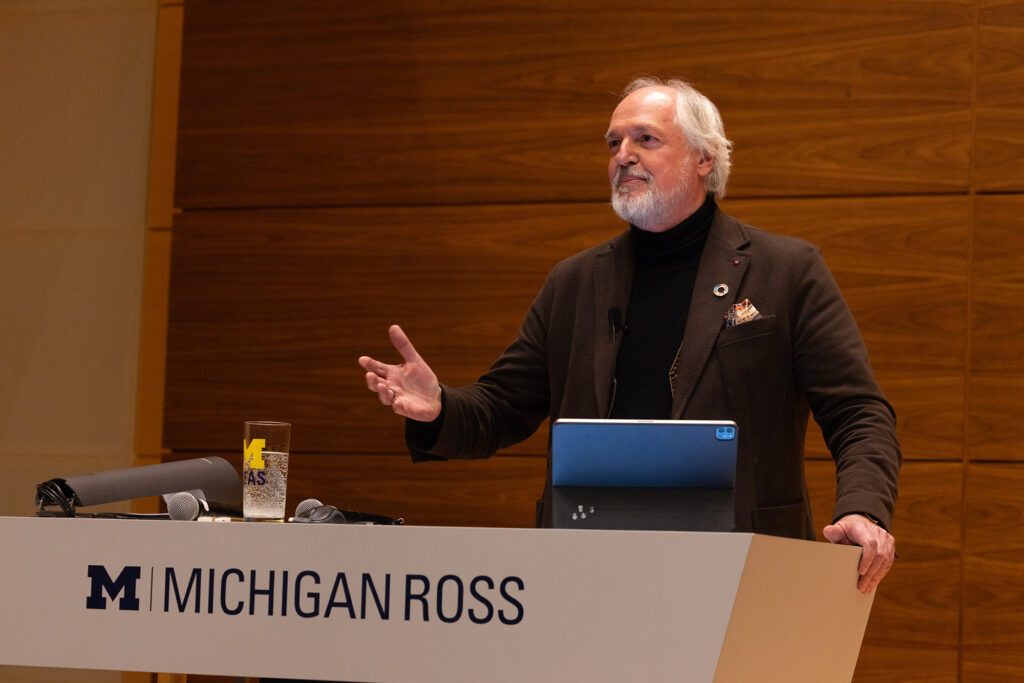
Business strategy is increasingly intertwining with sustainability goals, a trend underscored by businessman and author Paul Polman during his presentation at the Peter M. Wege Lecture on Sustainability on March 26. Polman emphasized that long-term financial success hinges on integrating environmental responsibility into corporate practices.
Polman, a former CEO of Unilever, highlighted several pressing challenges like climate change, biodiversity loss, and inequality, which are reshaping the business landscape. He posed a choice to CEOs: embrace sustainable business practices now or risk future financial setbacks.
“The financial market is already rewarding companies that are positioning themselves to this greener, more inclusive, more sustainable future that we all aspire to,” Polman stated.

Polman, who led Unilever from 2009 to 2019, has since advanced sustainable finance and impact investing. He also contributed to the development of the United Nations Sustainable Development Goals (SDGs), advocating for companies to build a “flywheel of sustainability” that fosters growth through efficiency, innovation, and resilience.
The 24th Wege Lecture saw over 250 attendees at the Stephen M. Ross School of Business, co-sponsored by U-M’s School for Environment and Sustainability and the Center for Sustainable Systems, with additional support from the Erb Institute.
In his bestselling book, “Becoming Net Positive: How Courageous Companies Thrive by Giving More Than They Take,” Polman examines leadership strategies that align business success with societal benefit. He emphasized the importance of leading with humanity and courage to address global challenges.
“At the end of the day, it’s an issue of leadership and putting humanity back at the center and doing what we know is instinctively right,” Polman commented. “But that’s hard to do, and it takes courage.”

After his lecture, Polman engaged in a dialogue with Andrew Hoffman, a professor at the Ross School, discussing the pressing need for service-oriented leadership to address global inequalities.
Polman concluded by highlighting the disparities faced by the majority of the world’s population, stressing the responsibility of those in privileged positions to aid others. “This is still a world where 95% of the people are not in the positions where we are,” Polman said. “They might not have access to food… If you belong to that 5% that has won the lottery ticket of life, then I think it’s your duty or obligation to put yourself to the service of the other 95%.”