Reviving a Legacy: PARI’s Role in NASA’s Artemis II Mission
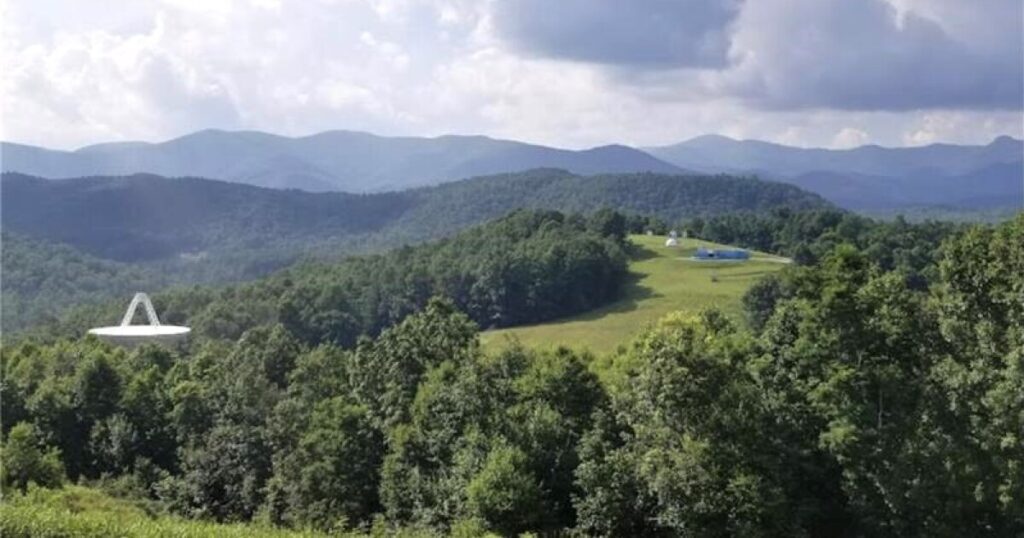
In the heart of Pisgah National Forest near Rosman, Transylvania County, lies a hidden gem of astronomical significance. The Pisgah Astronomical Research Institute (PARI) is preparing to play a pivotal role in NASA’s Artemis II mission, using its massive radio telescopes to track the Orion spacecraft as it embarks on its journey around the moon.
The Pisgah Astronomical Research Institute is among 34 global organizations chosen by NASA to support the Artemis II mission. This mission marks the first crewed launch of the Space Launch System rocket, scheduled to blast off from Kennedy Space Center at 6:24 p.m. EDT on Wednesday.
The involvement in such a milestone is deeply meaningful for PARI’s team. “This site being involved with this kind of work again after so many years is really exciting,” remarked Timothy DeLisle, PARI’s Director of Software Engineering and Head of Education. “It kind of brings us back to our roots.”
PARI’s history is rich and intertwined with space exploration. Originally constructed by NASA in 1962 as the Rosman Satellite Tracking Station, it played a crucial role in supporting satellite communications and the Apollo missions. After transitioning to a top-secret NSA intelligence facility in 1981, it was closed by the government in 1995, nearly facing demolition.
Rescued by a couple from Greensboro, the site was transformed into a nonprofit dedicated to science education and research. Now, more than six decades after its inception, PARI is back in the game with NASA.
During the mission, one of PARI’s 26-meter radio telescopes will track the Orion spacecraft, converting radio waves into data to assist NASA in monitoring its trajectory. “One of the really important things when you’re sending a spacecraft somewhere is to make sure it’s moving the way you want it to move,” DeLisle explained in an interview with BPR. “Tracking Doppler shift from the ground is an important part of doing that.”
Staff will maintain a constant watch over the telescopes, making real-time adjustments as needed. “These instruments are 60 years old. They’ve been well maintained, but they can still get a little cranky,” DeLisle noted.
Beyond its involvement with Artemis II, PARI aims to showcase its potential as ground-based support for the increasing number of spacecraft. “There’s more stuff out there that needs to be communicated with than there are currently ground stations to do the work,” DeLisle said. “What we’re hoping is this is going to lead to us being utilized more for this kind of work in the future.”
PARI also serves as an educational hub in Western North Carolina, offering summer camps, public stargazing events, school field trips, and private events. Its exhibits feature NASA Space Shuttle artifacts, meteorite samples, and a vast collection of astronomical glass plate negatives.
“Our primary goal is to make the tools and experiences of space science accessible to a wide range of people,” DeLisle shared. “People can come here, dig into what makes space science so interesting and get to do some of it themselves.”
Interested in learning more? The Astronomy Club of Asheville is hosting a free public talk by DeLisle on PARI’s contribution to Artemis II.
What: Tracking Artemis II’s Orion Spacecraft
When: Thursday, April 2, 7-8:30 p.m.
Where: UNC Asheville Reuter Center, also available via Zoom Info: astroasheville.org