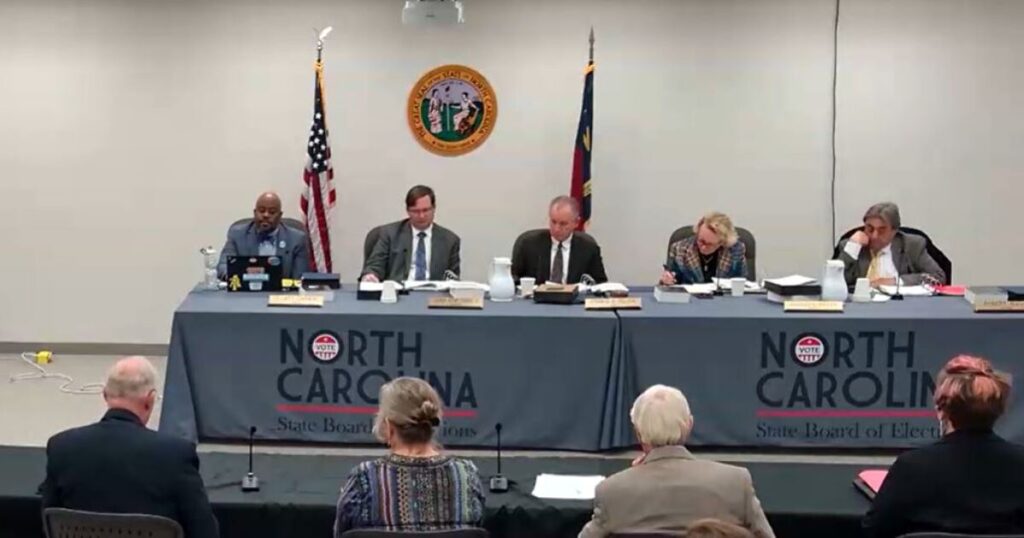
In a move that has sparked significant debate, the North Carolina State Board of Elections decided to close early voting sites on several college campuses, including Western Carolina University (WCU), for the 2026 primaries. This decision, passed by a narrow 3-2 vote, aligns with party lines, effectively relocating the early voting site to the Jackson County Recreation Center in Cullowhee.
The Republican-led State Board reviewed early voting plans from 12 counties after local boards failed to reach consensus. WCU was among five colleges impacted by the board’s decisions. Chris Cooper, a political science professor at WCU, commented on the predictability of the outcome, stating, “All 100 counties have majority Republican control.”
Jackson County’s disagreement over early voting sites began in December when the local board voted 3-2 to remove the WCU site. State law mandates that any non-unanimous county plan be examined by the State Board of Elections. The WCU site, established in 2016, has been a significant polling location, serving over 76,000 voters over nine election cycles. Despite this, the board decided to consolidate locations to the Recreation Center.
At the state board meeting, three proposals were presented. Republican Board Chair Bill Thompson advocated for the consolidation, citing concerns over accessibility and costs estimated at $20,000. He argued against accusations of voter suppression, asserting, “I’m confident that college students are capable of getting themselves six-tenths of a mile from the edge of campus to the Cullowhee Rec. Center to vote.”
Democratic members Betsy Swift and Roy Osborn had different approaches. Swift challenged the cost-saving claims, estimating savings at only $6,000, and highlighted the potential impact on young, rural voters. The Democrats’ proposals included maintaining the five existing sites or relocating the site to a building on WCU’s edge.
Jackson County’s Election Director Amanda Allen raised concerns about the Recreation Center’s capacity, noting it would be the smallest site serving the largest precinct. After much discussion, the board’s Republican members voted in favor of Thompson’s plan, with Democrats opposing.
MADISON COUNTY
In contrast, the State Board unanimously decided to retain two early voting sites in Madison County, overruling the local board’s decision to close two of three precincts. The county’s plan, led by Chair Dyatt Smathers, aimed to reduce costs by centralizing voting at Asheville-Buncombe Technical College. Smathers justified the plan by highlighting the per-voter cost savings.
Opposing this, County Board Secretary Brian Ball proposed maintaining all three sites, emphasizing the geographic and logistical challenges for voters in this rural, mountainous region. Concerns about accessibility led the state board to amend the county’s proposal, adding the Beech Glen Community Center as a second site.
WCU’s Cooper noted the unexpected nature of the Madison County decision, stating it was a rare deviation from the norm of siding with the majority plan. He anticipates further debates as preparations for the general election proceed.