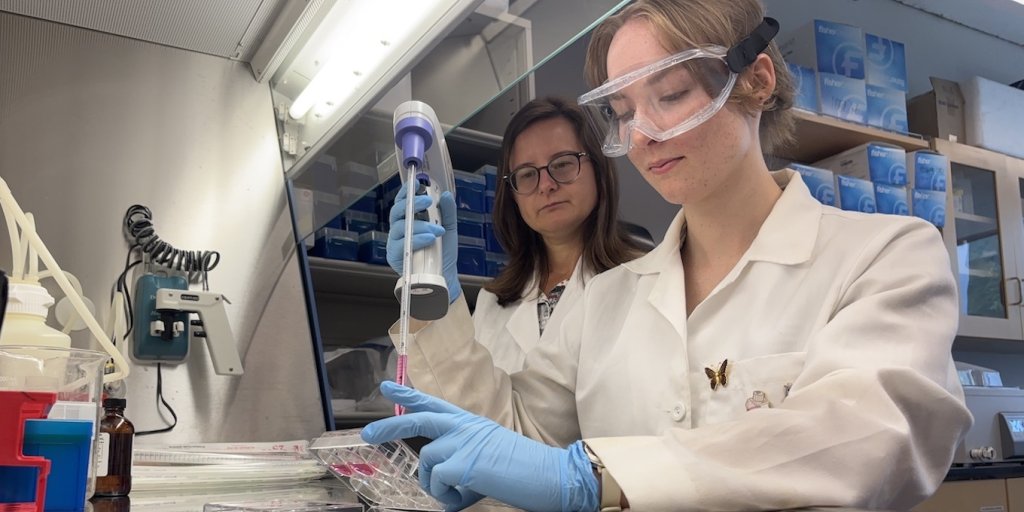
Renowned for its increasing prevalence, kidney cancer has secured its place among the top ten most diagnosed malignancies in the United States. Researchers are actively seeking solutions to counter this trend, with innovative efforts spearheaded by biochemistry senior Eva Schwark and Associate Professor Besa Xhabija at the University of Michigan-Dearborn. Their collaborative research explores natural methods to inhibit the growth of renal tumors.
Their initiative is part of the Summer Undergraduate Research Experience within Xhabija’s Cancer Therapeutics Lab. Entitled “Investigating the Role of Natural Products in the Treatment of Renal Cancer,” the project examines the potential of natural compounds, such as Spinosyn A—a soil-derived pesticide—to impede renal cancer cell proliferation. Schwark notes, “When I tell people about the work I do, many share personal stories about how cancer has touched their families or friends. They often tell me how much they appreciate the work I’m doing.” Her findings were highlighted at the SURE Showcase, and her ongoing research continues to uncover new insights.
Schwark’s engagement with Xhabija’s lab extends beyond this project, having contributed to multiple research efforts over the past two years. Notably, she has explored melanoma cells, building on findings that identified a deficiency of the enzyme Argininosuccinate Synthetase 1 (ASS1) in melanoma, a deficiency also present in kidney cancer as noted by the wider medical community. Her SURE project delves into the role of Spinosyn A in activating ASS1 within renal cancer, a novel exploration in this context.
“ASS1 is emerging as a tumor suppressor and researchers have learned that it is deficient in a lot of cancer types, including melanoma, breast and renal,” Schwark explains. “Spinosyn A, the natural drug we are using in the lab, binds to ASS1, which activates it and increases its efficacy in the cell, helping to restore normal metabolic flow and inhibit cancer cell growth and division.” Schwark and Xhabija are in the process of preparing their research for publication, reflecting promising early results.
Beyond research, Schwark is intent on a career in medical research, exploring graduate school opportunities. Her work in Xhabija’s lab has provided her with practical experience and technical skills, including the use of advanced tools like digital holographic microscopy and bioinformatics. Xhabija emphasizes, “Alongside technical expertise, Eva has gained the ability to think critically about her findings and connect them to broader scientific questions, a skill we worked on together throughout the summer.”
Xhabija’s mentorship has been instrumental in shaping Schwark’s academic journey, starting from an introductory lab class that sparked her interest in biochemistry. “I didn’t realize it at the time, but that changed everything,” Schwark recalls, attributing her career trajectory to those formative experiences.
This summer, Schwark also participated in the Michigan Institute for Data Science and AI in Society’s program, acquiring advanced AI and data science skills. She was the only undergraduate in the cohort, an experience Xhabija praises: “It reflects what I value most in mentorship: helping students build technical skill, scientific reasoning and confidence while introducing them to opportunities they may not have imagined for themselves.”
Schwark’s story, according to Xhabija, exemplifies the transformative impact of accessible, high-impact learning experiences like the SURE program. “Watching Eva grow this summer into someone who is ready to take that next step has been one of the most rewarding moments of my career,” she says, highlighting the broader benefits of undergraduate research in fostering future scientific leaders.
Explore more about SURE projects from various colleges at UM-Dearborn.