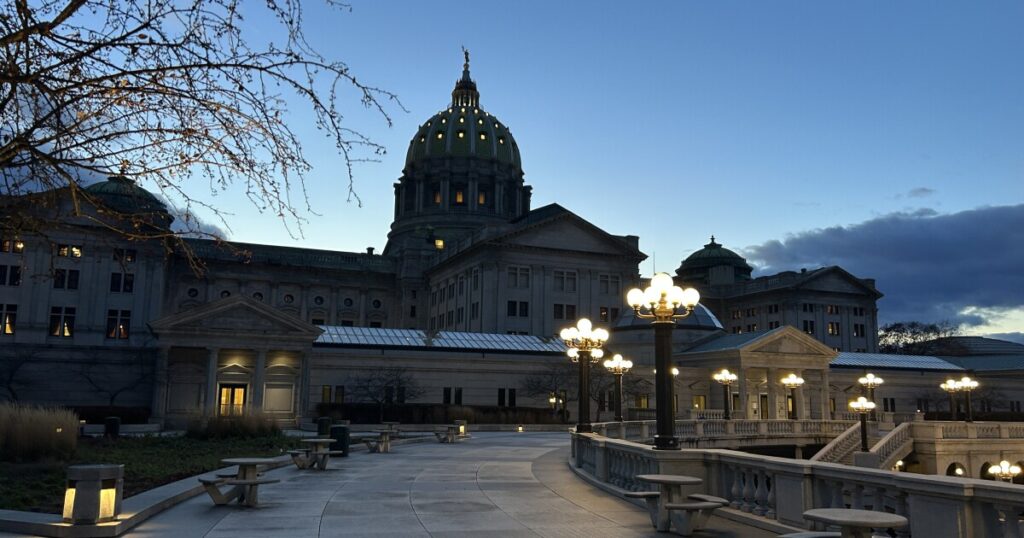
As Pennsylvania legislators gear up for a crucial Wednesday meeting, keen eyes are watching the state budget proceedings in Harrisburg. A consensus seems to have been reached on a fiscal plan, but environmentalists are raising alarms over the potential exclusion of a key greenhouse gas initiative.
According to state lawmakers, a closed-door discussion has culminated in a nearly $50.1 billion budget for the fiscal year ending June 30, 2026. Although details remain scarce, reaching an agreement on the overall spending figure is a fundamental milestone.
On Tuesday evening, State Senators reconvened to deliberate on a general fund budget bill and accompanying code bills in committee. Meanwhile, State House members were engaged in private discussions. Both legislative bodies are set to reconvene on Wednesday morning, with the budget-related legislation needing approval from each chamber and Governor Josh Shapiro’s signature.
The proposed budget signifies a nearly 5% increase in spending compared to the previous year. Despite being $1.5 billion below Governor Shapiro’s earlier proposal, it surpasses what Republican leaders have indicated they are willing to allocate. Republicans argue that the Democratic budget plans risk exceeding projected state revenues, warning of tougher budget negotiations if spending continues to outpace revenue.
Governor Shapiro and Democratic leaders advocate for utilizing state savings to support underfunded schools and healthcare services for disadvantaged Pennsylvanians. They also proposed generating revenue by legalizing recreational cannabis and regulating skill games, but these measures face opposition and are unlikely to be included in the final budget.
Environmental initiative in question
An important environmental measure could be sidelined in the budget talks. Patrick McDonnell, CEO of PennFuture, indicated that legislative insiders alerted him about potential plans to forgo joining the Regional Greenhouse Gas Initiative. This multi-state compact, initially proposed by former Governor Tom Wolf, would require energy companies to pay for emissions.
“Every day [last] week it felt like we were even closer to DEFCON-1,” McDonnell remarked.
Pennsylvania’s entry into the initiative has been stalled due to legal challenges, with an appeal pending before the state Supreme Court. Governor Shapiro has expressed a preference for crafting a state-specific emissions reduction plan rather than joining the regional group.
In Philadelphia, renewable energy advocates gathered to defend the emissions initiative. However, the numbers seem stacked against them, with all Senate Republicans and six Senate Democrats opposing the regional effort. First-term state Senator Nick Pisciottano criticized the initiative as unconstitutional, arguing it imposes a tax without legislative approval.
Pisciottano commented, “ That will at least allow us to move forward and talk about environmental and energy policy in a coherent way in Pennsylvania, because we’re not doing that right now.”
Opposition also comes from Pittsburgh Works Together, a coalition of labor and business groups. Ken Zapinski, the group’s director of research and public policy, warned that taxing energy production might lead to reduced generation, potentially causing blackouts if supply fails to meet demand.
“We don’t have enough power at a time when the governor himself says we need to work on lowering costs and we need more reliable electricity,” Zapinski stated.
Despite Pennsylvania’s substantial energy output, McDonnell of PennFuture argues that charging emissions fees could generate nearly $1 billion annually for renewable energy projects, reducing fossil fuel reliance. Currently, renewable sources account for only about 5% of the state’s energy production, lagging behind other states and Texas, the nation’s top energy producer.
Learn more from our partners at WESA.