From the rhythm of rock ‘n’ roll to the cadence of poetry, Sherman Funmaker’s journey is a testament to the unpredictable paths of life. Once a high school dropout with dreams of musical stardom, Funmaker has now embraced a new role as a published author, sharing his reflections and stories.
Born in Black River Falls, Funmaker grew up near Wisconsin Dells, leaving school at 16 to chase the dream of becoming a drummer like his heroes, The Beatles. Alongside a friend, he hitchhiked to Los Angeles to break into the bustling music scene. Despite spending two decades immersed in music, Funmaker eventually returned to Wisconsin, enrolling at the University of Wisconsin-Baraboo at the age of 50. It was here that he discovered a passion for writing, earning a degree in English and finding a new identity as a storyteller.
Funmaker’s debut book, “Bear Tracks: Memories of a Ho-Chunk Elder,” published by the Wisconsin Historical Society Press, is a poignant collection of poems and musings that reflect on his childhood, his travels, and his return to Wisconsin. In an interview with WPR’s “Wisconsin Today,” Funmaker expressed his desire for the book to preserve his family’s storytelling legacy, a tradition passed down from his grandmother, the celebrated Ho-Chunk autobiographer, Mountain Wolf Woman.
“It’s almost like a diary or a journal,” Funmaker said. “Once I got into the whole writing groove, what I wanted to talk about was: ‘Yes, this is who I am.’ I’m proud to be a Ho-Chunk tribal elder.”
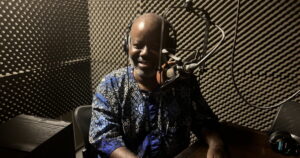
Having transitioned from music to writing, Funmaker’s story is one of defying expectations and embracing change. His conversation with “Wisconsin Today” delves into his unexpected path and his reflections on Native identity.

The following interview has been edited for clarity and brevity.
Rob Ferrett: At one point in “Bear Tracks,” you say you don’t necessarily remember a ton about your childhood, but there’s enough to get a taste of your experience growing up in the 1950s and ’60s. How did the process of putting together this book help you dig into those memories?
Sherman Funmaker:
I didn’t start writing until I was 52. I went to university and while I was there, I took a creative writing class. Before that, I had never really written anything — maybe a couple letters to my folks while I was away, but I wasn’t ever thinking about writing.
When I started writing, I didn’t know how to write a story. I thought, “How am I going to do this?” But when I started doing it, it just started coming out. Once I got into my head, like, “OK, I can remember the story about me and my cousin Joe,” or “I can remember stories about me and my mom and dad driving to powwows,” it helped me go back once I started writing, because I had to put something on paper.
RF: That’s one of the things I love about the book — you got that late start in writing, you weren’t into school. If I went back and told 16-year-old Sherman, “Hey, you’re gonna be a writer,” would that have been a big shock?
SF:
That would have been like, “You’re crazy, man. I can barely write.” I dropped out of school. And even in grade school, I skipped so much school, it wasn’t even funny. At that time and even 20 years ago when I started writing … I’d never dreamed like, “This will be a book.” I never thought about that at all.
RF: What was it like the first time you held “Bear Tracks” in your hands?
SF:
It’s beyond my wildest imagination. When I got the first one in the mail, I literally cried. I really did. I’m just like, “Oh my gosh, I’m holding this thing and I don’t have to self-publish,” you know? I can hand this out. I can read from this. But yeah, I was overwhelmed because, as a high school dropout, I never wrote anything — didn’t know I was even an OK writer.
RF: I want to go back and meet the 16-year-old Sherman. You dropped out of high school, like you said — you were going to live the dream. You came first to Madison, then California, to play rock ‘n’ roll. What led you there?
SF:
Well, I started playing music when I saw The Beatles on “Ed Sullivan,” so I was 11 or 12 years old at the time. And I was always a music guy. I could remember lyrics and I could sing. So when I saw them, I was like, “Yeah, that’s what I want to do.”
So I started playing. Soon after, we got a little crappy band together — back then there were garage bands and they all sucked. We sucked. It was like, “I’m not gonna make money doing this. I’m not the best drummer and I won’t ever be the best drummer or singer or anything,” but I just had to do it. It was just like: This is what makes me feel good. This is what gives me joy.
Back then, everything was going on in California. So when I was 19, my buddy Steve and I hitchhiked from Mauston, Wisconsin to LA. So yeah, cool journey.

RF: In “Bear Tracks,” you’re looking back on this with the benefit of years of experience. But in your poems, I still hear the 16-year-old kid in there. You’re the same guy in a lot of ways. How do you juggle being an elder and a young rock ‘n’ roller, all in the same person?
SF:
I think that when I was writing these, it was easy for me to go back, because it was such a good time for me. I was with my family. I’m one of 11 kids, so my mom and dad, they worked hard. They did what they could to keep us on the straight and narrow as much as possible.
It’s always easy for me to go back and write about my cousins, my mom and dad, my grandmother — Mountain Wolf Woman — my grandfather. Even now, I’m 73 and I don’t feel 73. I really don’t. I feel like 25, except for my body.

RF: You write about stereotypes and expectations. You’ve got this poem, “An Indian Poem,” where you write: “They want me to Injun it up / To speak of the Earth and Moon.” Have you gotten that a lot in your life, like, “Hey, man, do Indian stuff?”
SF:
That’s funny. Being Native, you run into people who … like the Native life and the Native idea of living. When I was in school 25 years ago, I thought, “I’m not going to write about the moon and the sky and the stars.” First of all, that’s not me — I’m not that type. I’m not a medicine man. You know what I mean? I’m just a regular guy that happened to write a bunch of stuff down on paper, and now it’s in a book.