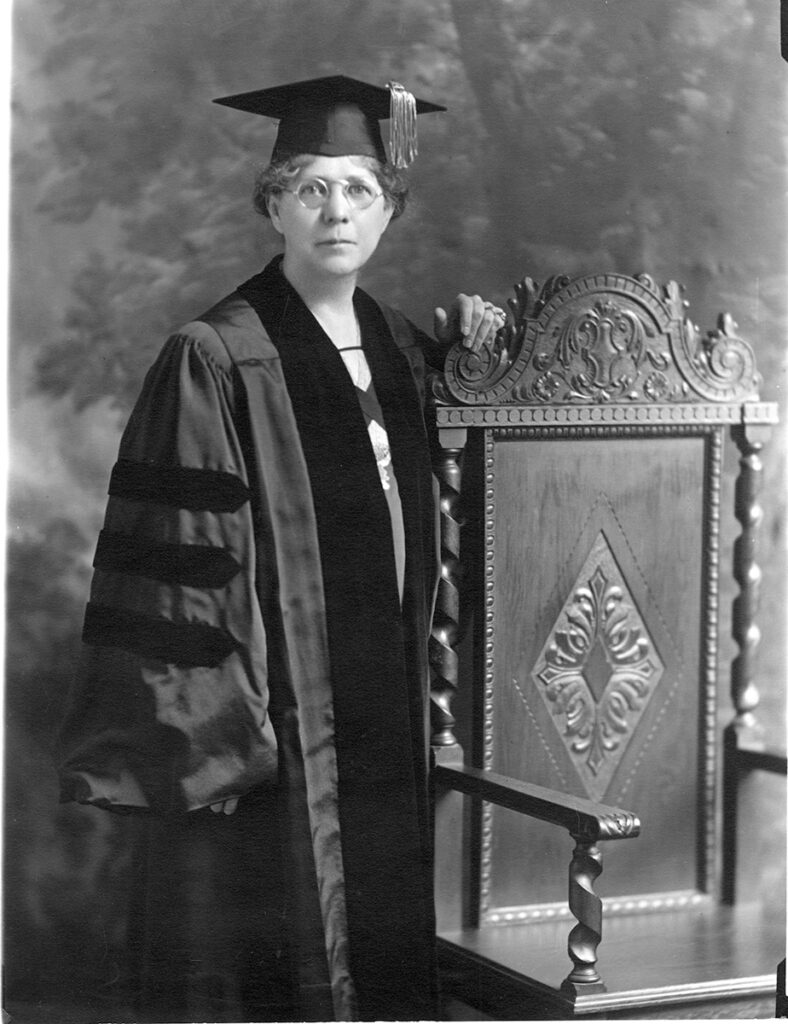
The University of Michigan, established in the heart of Detroit in 1817, has a storied tradition of governance. However, it wasn’t until the late 1920s that a woman broke through the institution’s male-dominated leadership ranks.
Esther Marsh Cram became the first woman to join the University of Michigan’s Board of Regents in 1929. Her appointment came when Governor Fred W. Green, a fellow alumnus, selected her to fill a vacancy left by Benjamin S. Hanchett’s resignation.

Governor Green emphasized the importance of female representation, stating, “The women of Michigan rightly feel that they are entitled to representation on the Board of Regents of our university. Over 2,500 women are attending the university, and surely there are problems connected with their attendance that will be settled best with the advice of a woman alumnae on the Board of Regents.” He expressed confidence in Cram’s abilities, citing their long-standing friendship as evidence of her potential as a capable regent.
Esther Hewitt Marsh, as she was known during her student years, was part of a family legacy at U-M, with her father, Augustus, having graduated in the mid-19th century. After earning her degree, Cram dedicated herself to teaching history at several Michigan high schools until she left the profession in 1909 to focus on her family.
Cram regarded her role as regent as a significant accolade. “I consider this appointment as a great honor to the womanhood of Michigan,” she remarked, highlighting her commitment to studying and applying herself diligently to the position.
Her tenure began amidst administrative upheaval, following the resignation of President Clarence Cook Little. Cram played a crucial role in electing Alexander G. Ruthven as the university’s new president. Her initial contributions on the board were notably influenced by her gender, as she joined the Michigan League Board of Governors and collaborated with Ruthven to propose a new dean of women.
In reflecting on her responsibilities, Cram stated, “I believe that it is the duty of any woman coming up on the Board of Regents to cooperate to the best of her ability, to weigh pros and cons concerning any measure that may come up for consideration, and to cast a vote as conscientiously as any other regent.”
Cram’s service on the board spanned until 1935, after which she was elected for another term. However, due to health concerns, she stepped down in 1943. Her peers commended her dedication and impact, noting that “the interests of the institution, and particularly those of its women students, were close to her heart,” reflecting her unwavering loyalty and commitment to the university’s community.
— Kim Clarke, Office of the President