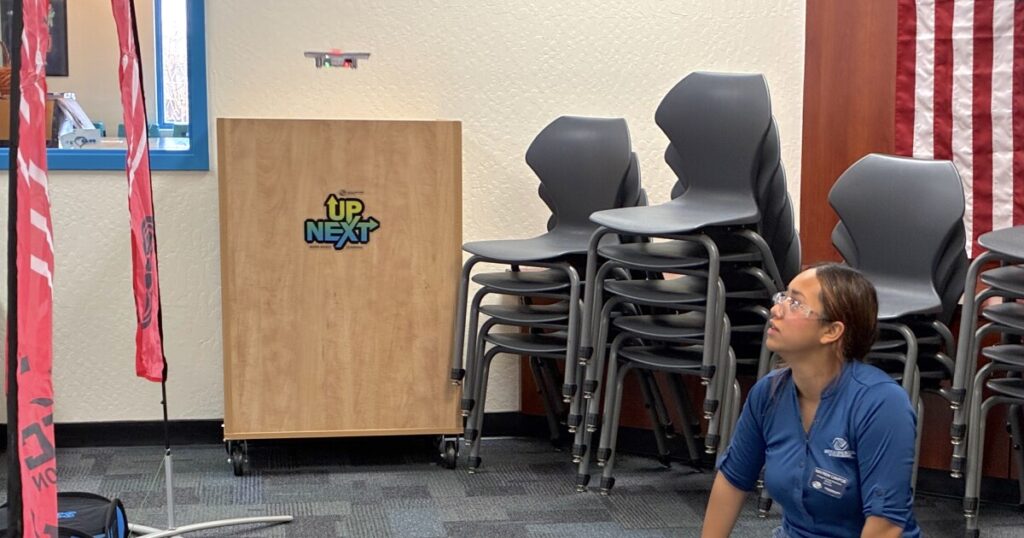
A new initiative at the Boys and Girls Club of Truckee Meadows in Reno, Nevada, is setting the stage for future careers in drone technology. Here, staff members are engaging in a multi-day drone certification training, learning skills they plan to pass on to their students. The club, in collaboration with the Desert Research Institute, is equipping its team with aviation, coding, and flight safety knowledge to inspire the next generation.
“They’re not aware that this is a life and workforce skill set that is needed in a lot of fields,” explained Mayrem Campos, the club’s college and career director. “They don’t know that they can get their pilot’s license in drones at 16.”
Campos, who previously had no experience flying drones, is now learning not only how to operate them but also how to code them. The training is supported by the George. W. Gillemot Foundation. Although it doesn’t provide a commercial license, it lays the groundwork for those interested in the burgeoning drone industry.
Drones Gaining Prominence in the Mountain West
Once merely hobby gadgets, drones have become vital tools across various sectors in the Mountain West. In agriculture, they are used to monitor crops, and in the energy sector, they inspect pipelines and facilities. Public safety agencies utilize drones in disaster scenarios, where human intervention is too risky.
Dirk Giles
/
U.S. Forest Service
At the U.S. Forest Service, drones play a key role in wildfire management. According to Dirk Giles, head of the agency’s unmanned aircraft systems program, their drone fleet surpasses 400, conducting over 10,000 flights each year. “Drones are not going to replace piloted aviation,” Giles stated. “It’s really just another tool in our toolbox.” Drones can cover distances and offer visibility that traditional aircraft cannot, particularly at night.
Innovations in Firefighting
Private companies are also pioneering drone technology for firefighting. California-based startup Seneca is working on autonomous drones capable of quickly deploying fire-suppressing foam to tackle wildfires in their nascent stages. “Fire grows exponentially,” noted Stuart Landesberg, Seneca’s founder and CEO. “And so in the very early phases, even these huge fires were quite manageable if you caught them early enough.”

Seneca’s technology is set to be deployed this summer in California and Colorado, thanks to a five-year agreement with the Aspen Fire Protection District. The firm, which has nearly 50 employees, is rapidly expanding. “We’re hiring like crazy,” Landesberg said, anticipating a 50% increase in staff over the next six months.
Fostering Future Innovators
Back in Reno, Michelle Gallivan-Wallace of Nevada Robotics at DRI is guiding the club staff through flight training and obstacle navigation. “They are sponges,” she observed. “They love learning, and they love imparting knowledge for getting kids ready for the STEM workforce.”
Campos sees the training as more than just technical skill-building. “This teaches them how to work in teams,” she said. “It teaches communication skills. It teaches them to be okay with failing and improving, which are all skills that employers are looking for.”
The initiative is designed to not only certify staff but also prepare them to educate students who might one day shape the future of industries reliant on drone technology within the Mountain West and beyond.
This story was produced by the Mountain West News Bureau, a collaboration between KUNR, Wyoming Public Media, Nevada Public Radio, Boise State Public Radio in Idaho, KUNC in Northern Colorado, KANW in New Mexico, Colorado Public Radio, KJZZ in Arizona and NPR, with additional support from affiliate newsrooms across the region. Funding for the Mountain West News Bureau is provided in part by the Corporation for Public Broadcasting and Eric and Wendy Schmidt.