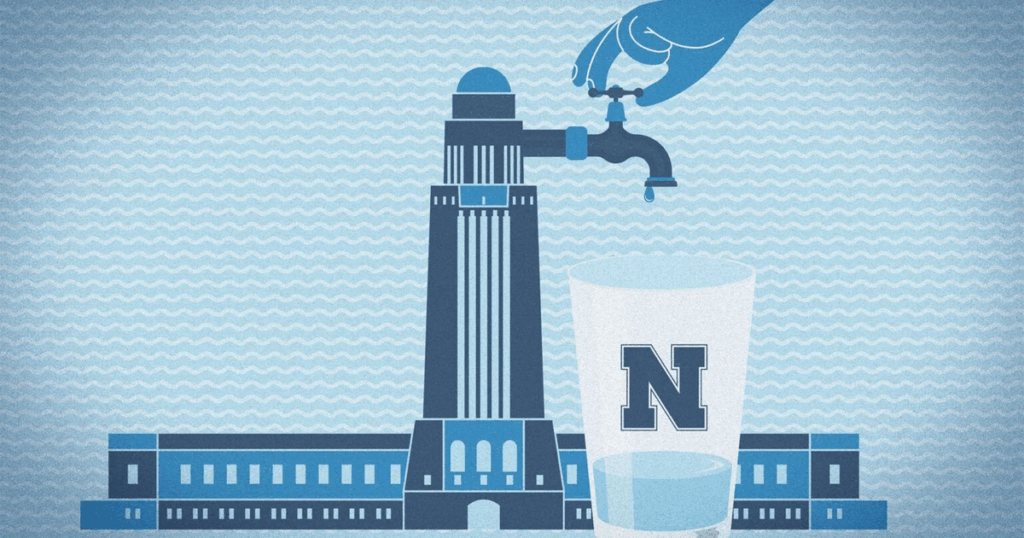
The financial landscape for the University of Nebraska has been shifting over the years, with state funding failing to keep pace with inflation and rising costs. This has sparked a discourse on campus and among state officials about the future of funding for higher education in the state.
“The last couple of years, the discourse at the Legislature has been, ‘Sorry, you have enough money already,’” remarked John Shrader, president of the faculty senate at the University of Nebraska-Lincoln (UNL). He further noted, “We’re the bad guys, because we have a $27 million deficit, but frankly, the investment in this campus has not been as high as it needs to be for us to be what they want us to be.”
State Funding and University Budget
State funding is a critical component of the university’s state-aided budget, which combines tuition with taxpayer dollars to support academic and public service missions. This funding is unrestricted, giving the university discretion over its allocation.
According to Harvey Perlman, who served as UNL chancellor for 16 years, “That’s what the Legislature is essentially funding, the ability to teach students and the instructional part of the university. Instructional costs have gone up, and the Legislature has not kept up with those increases.”
Trends Over the Years
In 1990, the university received $388 million, accounting for 34% of its total budget and 74% of its state-aided budget. Fast forward to this year, and state funding has risen to $699 million, but it now represents just 19% of the total budget and 63% of the state-aided portion.
Despite the nominal increase in funding, Anne Barnes, NU’s senior vice president and chief financial officer, pointed out that it hasn’t kept up with inflation. If it had, the university would have an additional $216 million this year to cover costs like rising salaries and healthcare premiums.
Doug Kristensen, retired chancellor of the University of Nebraska at Kearney, noted, “One year of inflationary cuts isn’t a huge impact to the institution. But if you do it over 20 years, that becomes a huge gap.” He emphasized that this long-term trend has led to significant budget reductions.
Shift in State Budget Priorities
Over the decades, the university’s share of the state’s budget has decreased. In 1990, it comprised a quarter of the state budget. Now, it stands at 13.25%, with the Department of Health and Human Services receiving the largest share at 42%.
Other areas, such as K-12 education, the prison system, and Medicaid, have seen their budgets grow, impacting the funds available for the university. Tom Bergquist, retired director of the Legislative Fiscal Office, explained, “That kept forcing us to scrape back at the university. When things got tight finance-wise, they were the largest discretionary item.”
As the state’s financial priorities have shifted, the discussions about university funding have evolved, highlighting the complex balancing act faced by the Legislature.