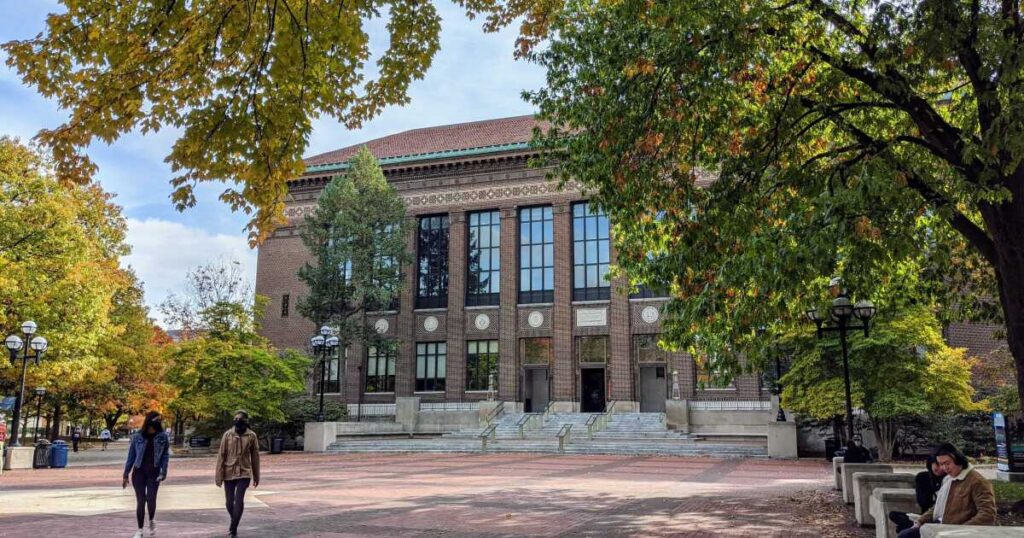
The University of Michigan is currently facing a federal investigation after two Chinese scientists associated with the institution were charged with smuggling biological materials into the United States. This action has prompted the U.S. Department of Education to scrutinize the university’s foreign funding, particularly in light of these “highly disturbing criminal charges,” which have raised concerns about potential national security threats from China.
Paul Moore, the chief investigative counsel for the department, expressed concerns over the university’s perceived history of underestimating threats from foreign influences. He stated, “Despite the University of Michigan’s history of downplaying its vulnerabilities to malign foreign influence, recent reports reveal that UM’s research laboratories remain vulnerable to sabotage.”
The investigation aligns with former President Donald Trump’s initiative to enhance transparency concerning foreign gifts and contracts to U.S. academic institutions, with a specific focus on those linked to China. Similar probes have been conducted at prestigious universities such as Harvard, the University of Pennsylvania, and the University of California, Berkeley.
Additionally, Republican lawmakers have urged academic institutions to sever research connections with China, alleging that such collaborations facilitate the theft of technology. In response to these pressures, the University of Michigan ceased a partnership with a Shanghai-based university earlier this year due to security concerns raised by House Republicans.
The federal inquiry requires the University of Michigan to provide financial records and information regarding its research collaborations with international institutions. The Department of Education has accused the university of providing “incomplete, inaccurate and untimely” public disclosures concerning foreign funding sources.
In response, university spokesperson Colleen Mastony assured that the institution would comply with federal investigators and emphasized their commitment to legal compliance. She stated, “We strongly condemn any actions that seek to cause harm, threaten national security or undermine the university’s critical public mission.”
The charges brought in June involve a Chinese scientist and his girlfriend, both linked to a University of Michigan lab, who were reportedly intercepted by the FBI while attempting to smuggle a toxic fungus into the U.S. Shortly after, another Chinese scientist was arrested upon arrival in the country, accused of shipping biological materials to the university.
The University of Michigan has since initiated a review of its research security protocols. However, the Education Department criticized some university officials for downplaying the risks associated with research collaborations with Chinese entities. Ann Chih Lin, director of the university’s Center for Chinese Studies, was specifically mentioned for her public comments suggesting that fears of technology theft from China are exaggerated.
The Education Department highlighted Lin’s remarks as troubling given the university’s reliance on American taxpayer funding for its research. This comes amid federal requirements for universities to report all foreign gifts and contracts exceeding $250,000, a law that saw renewed enforcement during Trump’s presidency but was partially relaxed under President Biden.
U.S. universities generally agree on the necessity of bolstering research security but caution against fostering distrust towards Chinese scholars, noting that only a minority have been implicated in espionage activities. A report from House Republicans last year revealed that significant federal funding has inadvertently supported Chinese advancements in artificial intelligence, semiconductor technology, and nuclear weapons.
China remains a significant source of international students in the U.S., ranking second after India, with over 270,000 Chinese students enrolled in the 2023-24 academic year, constituting about a quarter of the foreign student population.