Montana’s economic future seems aligned with 2025 trends, with a lower risk of recession in 2026, as per the Bureau of Business and Economic Research (BBER) at a recent seminar. BBER Director Jeffrey Michael highlighted Montana’s wage improvements, elevating from 49th to 41st nationally in over a decade—a priority for Gov. Greg Gianforte’s administration. The state’s gross domestic product and unemployment rate outshine national averages, showcasing economic resilience.
Since 2021, Montana’s wage growth surged from 46th to 41st, surpassing the U.S. average with a 5.4% increase versus the national 3.4%. Yet, inflation and a high housing market temper these gains, with job growth mainly in healthcare, while other sectors decline. Michael described it as a “no-hire, no-fire economy,” predicting a 2.6% growth rate, making recession fears less likely.
Inflation may remain near 3% in 2026, slightly elevated due to tariffs. Optimism pivots on artificial intelligence and data centers, though concerns about AI’s sustainability, environmental impacts, and power demands persist. “AI is driving productivity growth,” Michael noted, questioning if technology enhances efficiency.
Tariffs contribute to a 2.7% inflation rate, higher than desired. While tariffs impact costs, particularly in automotive, manufacturers absorb them, but this may change. The “One Big Beautiful Bill” tax cuts could boost Montana’s economy, allowing consumers to sustain spending.
Troubles ahead
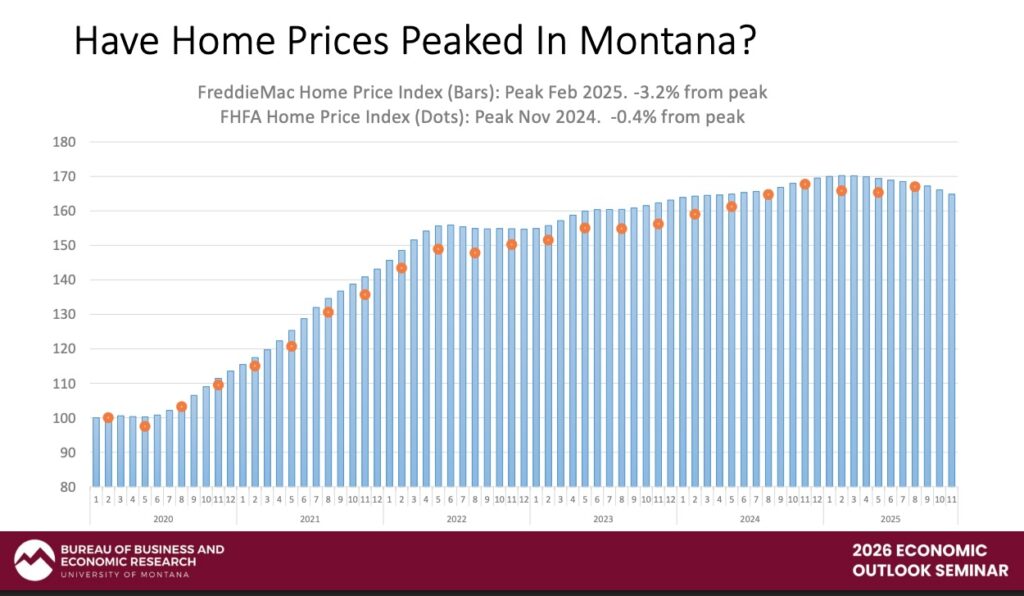
Despite stable inflation and job market, 2026 faces economic challenges like tariff uncertainty and high housing prices. Immigration impacts could lead to higher grocery costs. Hiring thrives in healthcare and tech, while affordable housing remains a concern. Housing prices are cooling slightly, with minor declines in Montana’s real estate market.
The state’s GDP outpaces national figures, yet sectors like manufacturing and mining suffer, with manufacturing dropping 2.8% and mining nearly 13% due to mine closures. “There has not been a lot of hiring in Montana,” Michael observed. In 2025, only four urban counties saw job growth, while the rest experienced a 1.5% job loss, according to the Bureau of Labor Statistics.