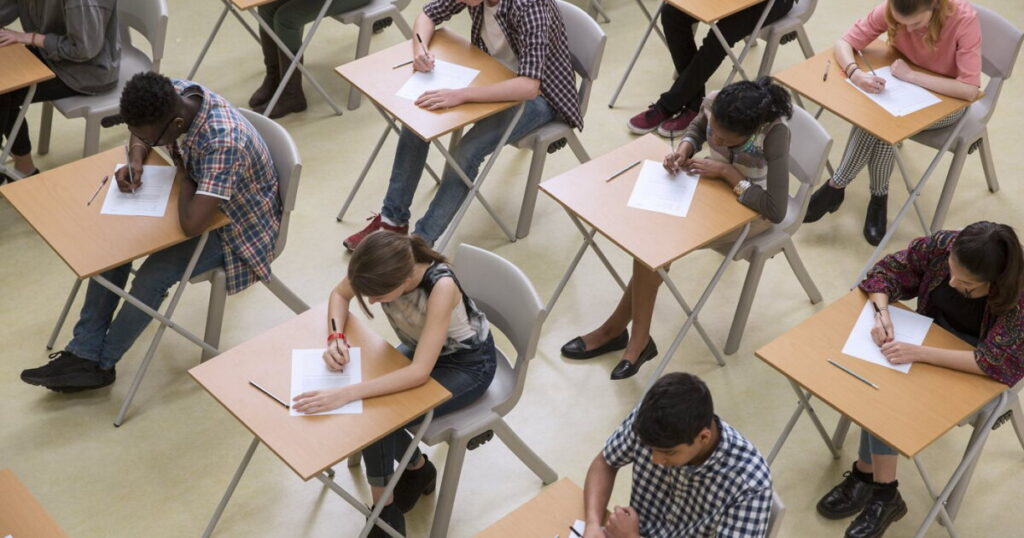
As Michigan grapples with educational challenges, the state’s college readiness, indicated by SAT performance, shows a concerning downward trend. Recent data reveals that only 25% of Michigan’s 11th graders are considered college ready, a decrease from 26.6% the previous year and significantly lower than a decade ago when 35% were deemed ready.
Charlotte Pierce, a senior policy analyst at EdTrust-Midwest, commented on the results, stating, “It’s true that SAT scores are only one predictor of college readiness.” This aligns with other opportunity gaps in Michigan schools, especially those affecting students with the greatest needs. Her organization has released a report highlighting the need for more rigorous coursework.
The decline in readiness is compounded by other academic struggles in the state, such as low reading scores and an absenteeism rate exceeding 27%.
Michigan’s educational strategy is crucial for maintaining competitiveness, with a goal of 60% of its population holding a post-secondary credential by 2030. However, as of 2024, less than 52% have achieved this.
Understanding College Readiness
The College Board defines a college-ready student as one who meets specific benchmarks in math and reading/writing sections of the SAT, providing a 75% chance of earning at least a C in certain college courses. Statewide, 26.5% of students met the math benchmark, while 52.1% reached the reading and writing standards in the 2025-2026 academic year.
Despite the troubling figures, some educators warn against relying solely on SAT scores. Sarah Allen, principal at Grayling High School, remarked, “A student might not score college ready, but if they’re hard workers and we’ve made them leaders and good individuals that work hard, they’re going to be ready to go off to college.”
The College Board also emphasizes that readiness is a spectrum, noting that students scoring below benchmarks can still succeed with adequate preparation.
The Broader Educational Landscape
Michigan is one of the few states mandating the SAT for juniors, with state data showing a drop in college readiness from 34.9% to 25.3% over the past decade. Factors like the shift to online testing, the pandemic, and optional test submissions for college applications might contribute to this trend.
Economic disparity plays a role, with only 11.5% of economically disadvantaged students meeting college readiness criteria, compared to 36% of their more affluent peers. US News & World Report ranks Michigan 32nd for college readiness.
Educational Initiatives and Alternatives
Despite the focus on SAT scores, Michigan schools are exploring various measures of student success. High schools offer test prep courses and practice exams like the PSAT/NMSQT to track progress and aid in scholarship qualification.
Emily McEvoy, director of data and assessment at Anchor Bay School District, argues that college credit attainment is a more reliable indicator of readiness than SAT scores. Michigan’s graduation rate is at a record high of 84%, with 54.6% enrolling in college within six months.
The Michigan Department of Education also highlights other achievements, such as increases in Advanced Placement participation and dual enrollment, contributing to the state’s Sixty by 30 goal. Bob Wheaton, MDE spokesperson, suggests these statistics offer a more comprehensive view of student success.
Brandy Johnson of the Michigan Community College Association points out the importance of support for students entering college unprepared, as it affects the state’s educational objectives.
Steven Snead from Oakland Schools believes SAT data should guide curriculum improvements and teacher coaching while considering local needs and feedback. “We all have work to do,” he asserts.
Meanwhile, Bob Kefgen of the Michigan Association of Secondary School Principals emphasizes the need to evaluate how close students are to proficiency and their readiness in individual subjects, suggesting that the overall picture may be more favorable than it appears.