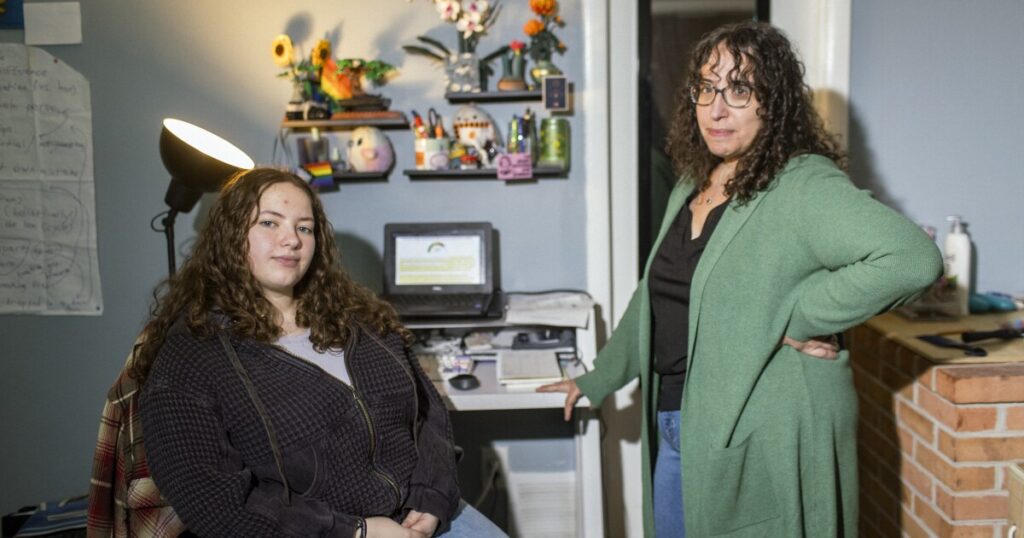
A Maryland high school student, Ailsa Ostovitz, has found herself embroiled in a controversy involving AI detection tools used by her teachers. Accused of employing AI to complete assignments, Ostovitz insists her work is original and questions the reliability of these detection tools.
“It’s mentally exhausting because it’s like I know this is my work,” says Ostovitz, a junior at Eleanor Roosevelt High School. “I know that this is my brain putting words and concepts onto paper for other people to comprehend.”
Ostovitz was surprised when one of her teachers flagged her assignment for potential AI use, supported by an AI detection tool showing a 30.76% probability. The writing in question was a personal description of her favorite music. “I write about music. I love music. Why would I use AI to write something that I like talking about?” Ostovitz argues.
After reaching out to her teacher via the school’s online platform, Ostovitz received no response, and her grade suffered. Her mother, Stephanie Rizk, expressed concern over the quick assumptions made about her daughter’s work. “Get to know their level of skill, and then maybe your AI detector is useful,” Rizk suggests.
The Prince George’s County Public Schools district clarified that the teacher used the AI detection tool independently and that the district doesn’t invest in such software. “During staff training, we advise educators not to rely on such tools, as multiple sources have documented their potential inaccuracies and inconsistencies,” a district statement noted.
The situation with Ostovitz is not an isolated one. A survey from the Center for Democracy and Technology revealed that over 40% of teachers from grades 6 through 12 used AI detection tools last year, despite research highlighting their unreliability.
As Mike Perkins, an academic integrity researcher, points out, “It’s now fairly well established in the academic integrity field that these tools are not fit for purpose.” Perkins’ research indicates that popular detectors like Turnitin and GPTZero often mislabel texts, especially when AI-generated text is altered to seem more human.
Despite these concerns, school districts across the U.S. continue to invest in AI detection tools. Broward County Public Schools near Miami, for example, has committed over $550,000 to Turnitin’s services, which include an AI detection feature. “The Turnitin tool is something that helps us facilitate conversation and feedback, not grading,” says Sherri Wilson, the district’s director of innovative learning.
Why one teacher uses AI detection tools
John Grady, a language and literature teacher, views AI detection tools as a starting point for discussions with students about potential AI use. He teaches at Shaker Heights High School, where the district has invested $5,600 in GPTZero licenses for teachers. Grady uses the tool to gauge the likelihood of AI involvement in student work and follows up when necessary.

“It’s certainly not foolproof,” Grady acknowledges. “But it gives you something to hang your hat on.” If the tool indicates a high probability of AI use, Grady investigates further, including examining revision histories and speaking directly with students.
The AI detection skeptics
Some students and educators remain skeptical about AI detection tools. Shaker Heights junior Zi Shi, a non-native English speaker, worries his writing style might be unfairly flagged due to limited vocabulary. Shi experienced an incident where his assignment was flagged after using Grammarly to polish his work. “It was definitely disappointing to see the comment of it being flagged as AI,” he says.
English teacher Carrie Cofer from Cleveland shares this skepticism. She experimented with GPTZero by submitting part of her own dissertation, which was incorrectly flagged as AI. Cofer argues against investing in AI detection software, suggesting funds could be better used for teacher development.

While Ostovitz adapts by using multiple AI detection tools on her assignments to avoid any future issues, the debate over the efficacy and ethical use of AI detection tools continues. The tools may not be foolproof, but they are becoming a part of the educational landscape, sparking discussions on the balance between technology and traditional teaching methods.
This reporting was supported by a grant from the Tarbell Center for AI Journalism.
Edited by: Nicole Cohen
Visual design and development by: LA Johnson
Audio story produced by: Lauren Migaki
Copyright 2025 NPR