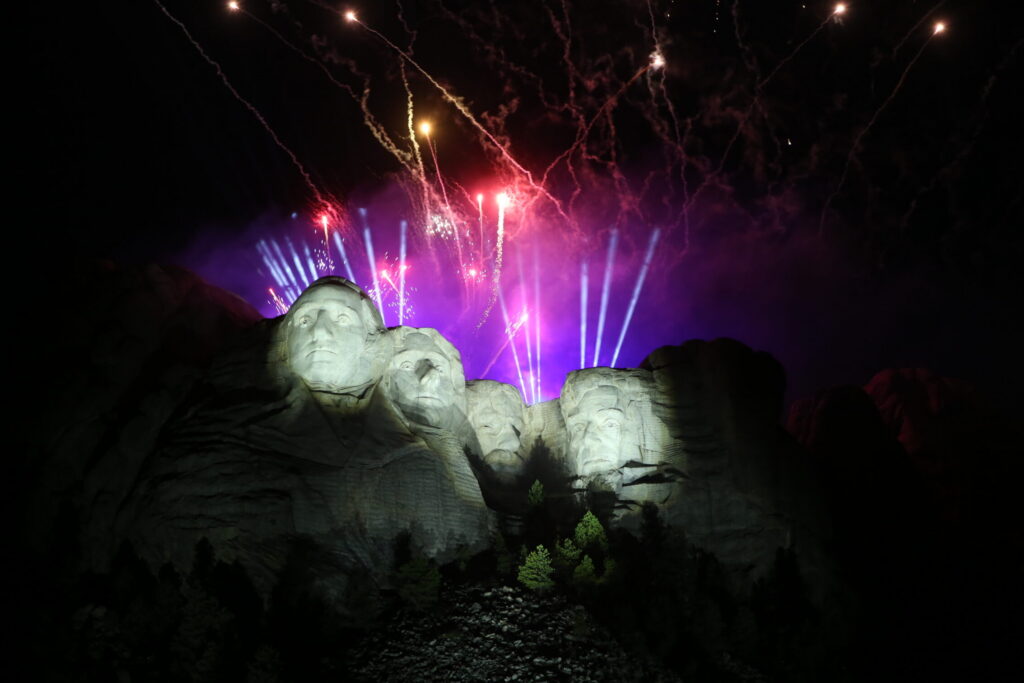

Fireworks explode above Mount Rushmore National Memorial in South Dakota on July 3, 2026, after a speech by President Donald Trump to mark the 250th anniversary of the founding of the United States. (Photo by Meghan O’Brien/South Dakota Searchlight)
The recent fireworks display at Mount Rushmore on July 3 cost South Dakota $450,000 more than it generated in economic impact. The state Department of Tourism reported spending $2.8 million on the event, which brought in $2.35 million, as detailed in a press release. The economic analysis was conducted by Tourism Economics.
Coverage of the event, including broadcast and digital media, resulted in nearly $51 million in “publicity value” from 53.7 billion “audience impressions.” However, this publicity was not factored into the economic impact. The event’s video livestream attracted 107,000 views, highlighting global interest in the Mount Rushmore fireworks celebration.
Tourism Secretary James Hagen praised the event’s success, emphasizing its benefit to the tourism economy and reinforcing South Dakota as a prominent destination. The event costs included $700,000 for pyrotechnics, as per a contract with California-based Pyro Spectaculars. Additional expenses covered media production, shuttle services, and payments to the National Park Service, which oversees Mount Rushmore.
Questions have been raised about whether costs reported included expenses from other public entities like the city of Keystone and Pennington County. The department plans to address these inquiries soon.
The $2.35 million economic impact encompassed visitor spending, hotel rentals, and sales tax revenue. With 4,800 tickets sold, attendees traveled from 40 states to witness the event. The Freedom 250 Mount Rushmore Fireworks Celebration featured a speech by President Donald Trump, who warned of a “mortal threat” from communism.
The fireworks display, though spectacular, has been criticized for its potential wildfire threat to the surrounding Black Hills national forest. Concerns also persist over litter and chemicals from fireworks. While there was no organized protest this year, a group advocating for the return of the Black Hills to Lakota tribes protested similar events in 2020.
This story was originally produced by South Dakota Searchlight, part of States Newsroom, a nonprofit news network supported by grants and donors as a 501c(3) public charity.